Stan Tscherenkow
Before You Commit · VC or bootstrap

Before You Choose VC Or Bootstrap

The pitch deck is open. A friend sent you their term sheet. Your spouse asked what dilution actually means. The capital decision will shape the next decade more than the product decision will.

This page is for the founder who has not yet committed to either path and is reading both honestly.

Short answer

Raise venture capital when the market window is short, the product needs capital to win, and you are ready to be accountable to a board on a quarterly horizon.

Stay bootstrapped when the window is long, capital-efficiency is achievable, and you want to optimize for control over speed.

The path that fits is not the path that excites you. It is the path that fits the company you are actually building.

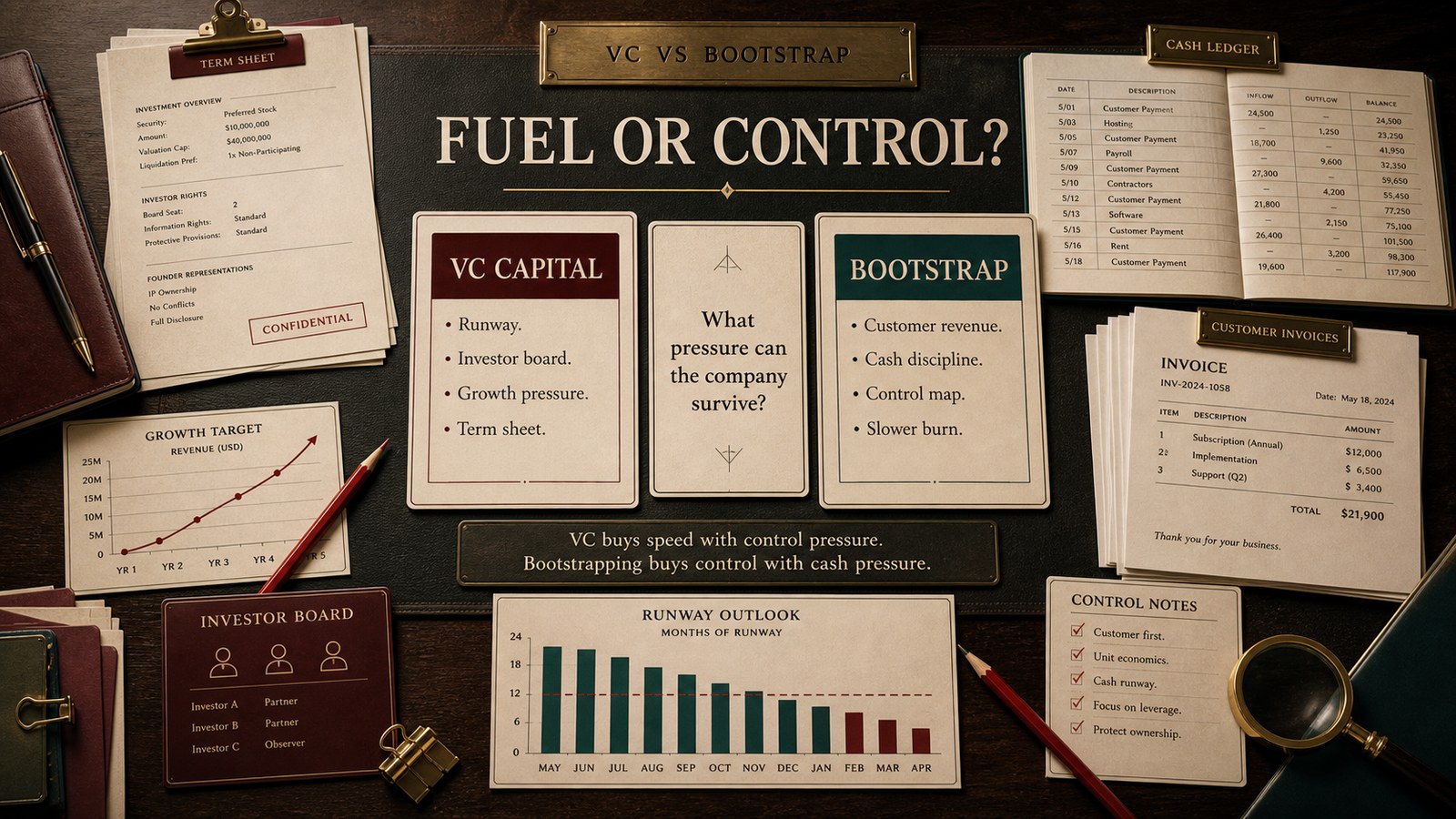
Fast extraction

Questions founders ask before the path locks.

The search phrase is the confession. The diagnosis comes after the confession is visible.

01

Should I raise venture capital or stay bootstrapped?

Raise VC when the market window is short, the product needs capital to win, and you are ready to be accountable to a board on a quarterly horizon. Stay bootstrapped when the window is long, capital-efficiency is achievable, and you want to optimize for control over speed.

02

What is the real cost of raising VC?

The cap-table dilution is the visible cost. The hidden cost is the operating cadence VC imposes: quarterly accountability, growth-at-all-costs framing, board governance, and the requirement to exit on someone else's timeline.

03

What is the real cost of staying bootstrapped?

Slower growth than the VC counterfactual. Higher founder cash risk. Smaller team in the early years. No external pressure to make hard calls. The compounding cost is the market windows you watch other companies close.

04

Can I bootstrap now and raise later?

Often yes. Bootstrap-then-raise founders generally raise at higher valuations with more leverage. The risk is staying bootstrapped past the moment when capital would have compounded a window.

Money already moving

banker conversations, legal fees on draft term sheets, internal time spent reading the market, deferred hiring decisions, the founder's personal cash on the line

Money usually lost

the founder who chose the wrong path loses two to five years of compounding because the operating cadence did not fit the company being built

Blind spot

the founder is comparing the path that excites them to the path that fits, and pretending these are the same comparison

The capital decision is the operating-cadence decision. Founders who optimize for the headline number usually pay for it in the cadence.
Inspection list

What Stan would inspect before the path locks.

Before the capital decision closes

  • Whether the market window is genuinely short or just looks short from inside the company.
  • Whether the product needs capital to win or just needs more discipline.
  • Whether you can operate on a quarterly-board cadence without losing the company you wanted to build.
  • Whether your spouse and the people closest to you have actually signed off on the cash risk path.
  • Whether the bootstrap path requires you to skip a window competitors will capture.
  • Whether the VC path requires you to exit on a timeline that does not match your life plan.
  • What the founder you most respect, who has done both, says when asked privately.

The capital decision is the company you will live inside for ten years.

If you want Stan to read the live decision, use the application route and describe the choice in plain language.

When this is one live commitment and the cost is already real, Tier 01 is the commercial route.