Governance and Boards vs Consulting
Boards govern the company. Consulting solves a defined problem. Boards exist permanently. Consultants leave when the project closes.
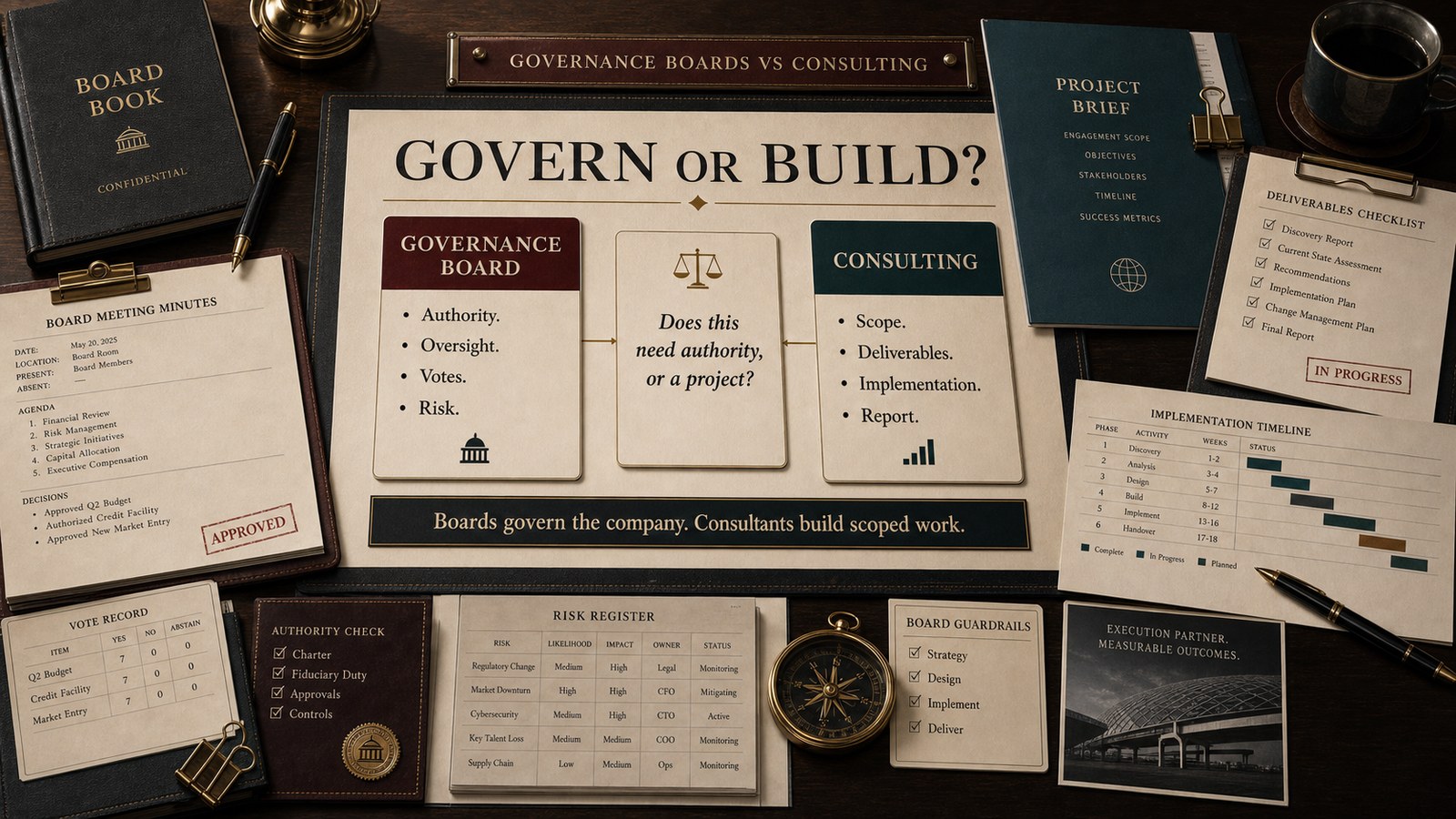
The two get confused when a board asks consulting questions or when consultants are expected to carry approval rights.
The board commissions a strategic review. A consultancy ships a 92-slide deck. The board nods. Nothing changes. Approval without execution. Analysis without authority. Two layers doing work neither one can finish alone.
When Governance is right
A decision binds the company.Only authority can do this.
Capital, control, or governance is shifting.Formal approval required.
External oversight is structurally required.Investors. Lenders. Regulators.
The CEO is held accountable.Not by a deck.
When Consulting is right
A defined problem needs analysis.Scope. Brief. Output.
Internal capacity is missing.Bench depth. Methodology. Specialized knowledge.
The deliverable is a finished thing.Plan. Model. Migration roadmap.
Internal owner will receive the work.Otherwise the deliverable becomes shelf inventory.
Structural differences
| Governance | Consulting | |
|---|---|---|
| Subject of the work | The company's authority | A specific analytical problem |
| What gets built | Approval, minutes, fiduciary record | Document, deck, model, plan |
| Engagement shape | Standing seat, formal meetings | Project engagement, finite scope |
| When it ends | When the director rotates | When the deliverable is signed off |
| What fails when wrong | Approvals on the wrong question | A deck nobody implements |
Real situations
Governance is the answer
Board. Consulting cannot bind anything.
Consulting is the answer
Consultant in. Internal owner receives.
Neither is the answer yet
Both layers are misused. The board needs to vote. The consultant should not be in the business.
Who to choose when
Boards approve. Consultants analyze. A board commissioning consulting to avoid deciding is a common pattern. Governance · Consulting.
When coaching fits
If the question is one layer above the comparison on this page, business coaching sits with the owner before money goes out the door.
See ways to work