Governance and Boards vs Training
Boards govern the company. Training builds capability in the team. The board is upstream of the people the training develops.
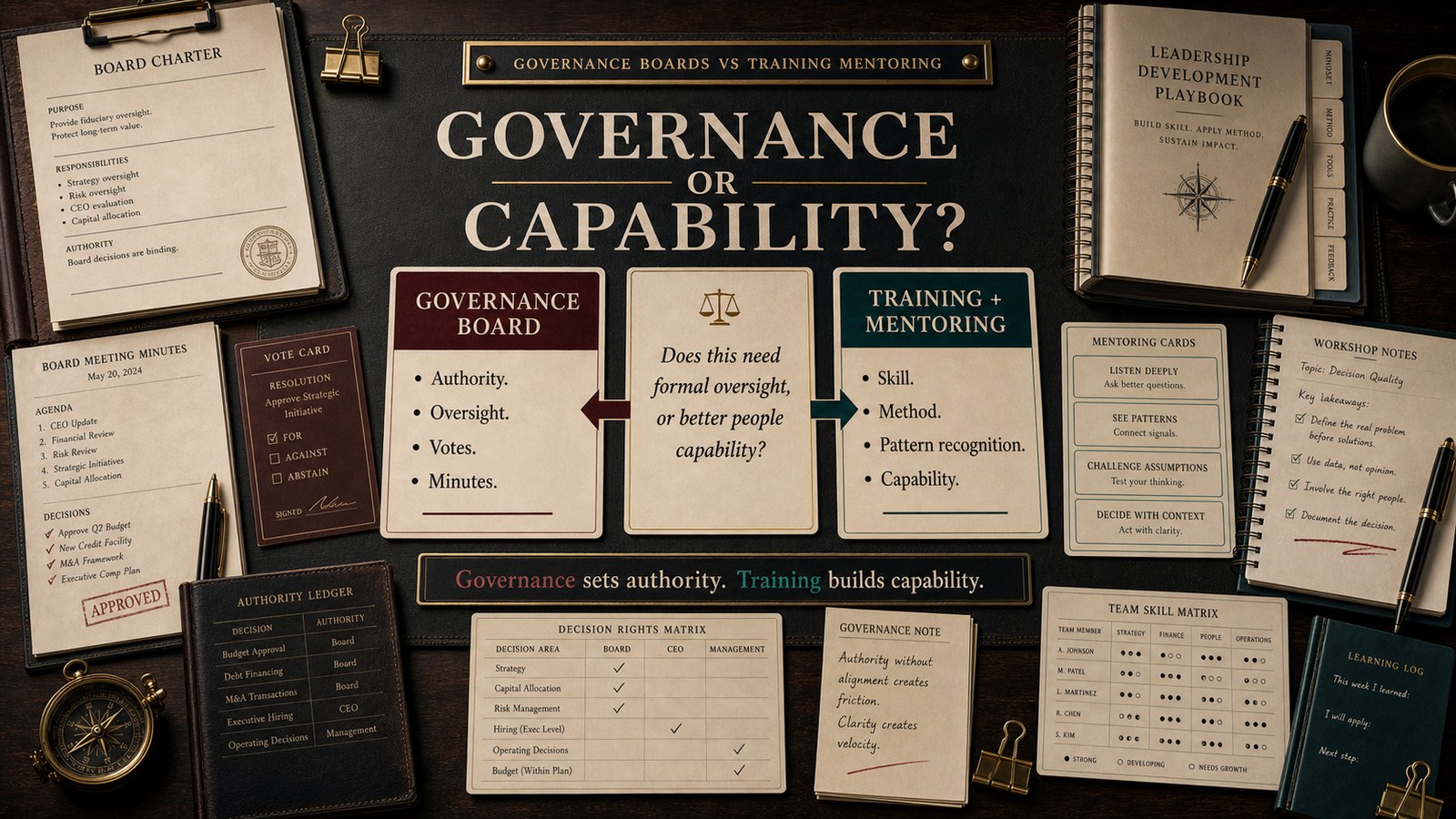
These two layers almost never get confused inside the business. They get confused at procurement, when the company hires training to fix a problem that is structural.
The board says the team needs to be "more strategic." HR commissions a leadership training program. Six weeks. 18 attendees. The team is now better at strategy as a vocabulary. The company is the same company.
When Governance is right
The decision binds the company.Authority.
Capital or control changes.Formal vote.
Senior accountability is needed.A body, not a curriculum.
Exit, M&A, succession is in play.Director-level work.
When Training is right
A defined skill is missing.Technical or process knowledge.
Knowledge transfer before a departure.Mentor captures it.
Junior team upskilling.Repeatable, teachable, predictable.
Repeatable operating motion.Playbook training across teams.
Structural differences
| Governance | Training | |
|---|---|---|
| Subject of the work | The company | The team |
| What gets built | Authority | Capability |
| Engagement shape | Standing body | Curriculum or pattern transfer |
| When it ends | When the director rotates | When the skill is demonstrated |
| What fails when wrong | Approvals nobody respects | Skill in service of the wrong strategy |
Real situations
Governance is the answer
Board. Training cannot help.
Training is the answer
Train them.
Neither is the answer yet
Business coaching sits in between when the problem is the decision, not the skill. Training treats a frame issue as a skill issue.
Who to choose when
Authority is not a skill. A skill is not authority. Governance · Training and mentoring.
When coaching fits
If the question is one layer above the comparison on this page, business coaching sits with the operator before money goes out the door.
See ways to work