Fractional Leadership vs Coaching
Fractional leadership runs a function. Coaching develops the person becoming a leader. One does the job. One develops who does it.
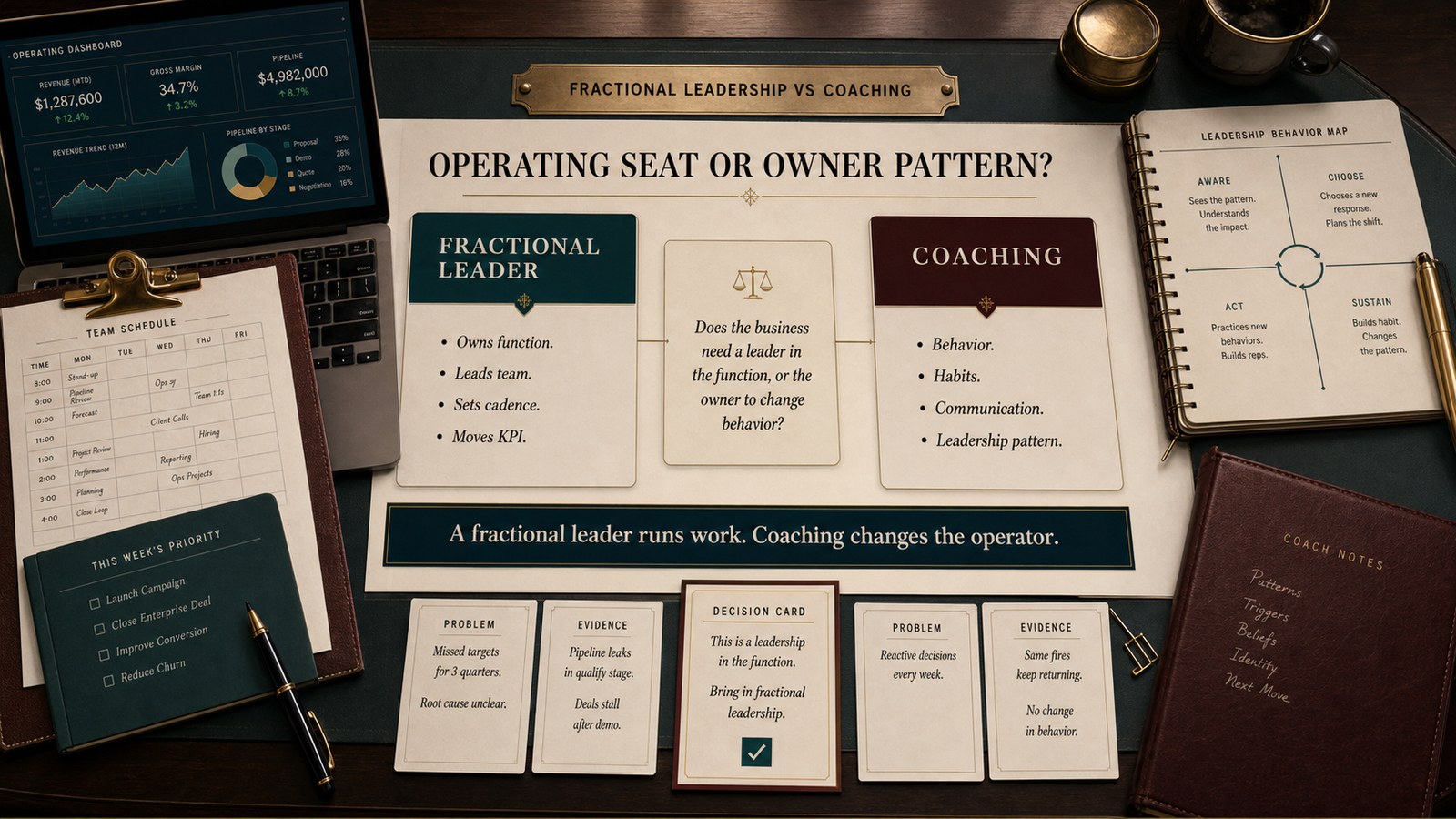
Both are real. Both ship results. They almost never solve the same business drag. The company that hires the wrong one pays for thirteen months and gets a beautiful post-mortem.
9:47 PM. Tuesday. Cold pasta on a plate. The coach said "lead with more confidence" in the 60-minute call this morning. The head-of-operations seat has been empty for four months. Your finance lead is fielding two operations calls a day and quietly stopped sleeping. Confidence is not the problem damaging the company.
When coaching is right
The function works. The leader's head is in the way. The leader knows the job. The team knows the job. The numbers say the work is moving. What is not moving is the leader's own constraint. They circle. They overthink. They explain too much. The job is not the problem. The way the leader carries the job is.
A new senior hire is struggling with the step up.They got promoted from director to VP. Their old skills made them great. Their new role asks for skills they have not built yet. This is a development problem, not a seat problem. The seat is filled. The person in it has to grow into it.
The team is functional. The communication is breaking momentum.People agree in the meeting. People leave the meeting and do something different. The leader has not yet learned how to make a decision land. Coaching catches that. A new operator in the seat does not.
The board has flagged operator effectiveness, not operations.The board did not say "we need a new COO." The board said "the CEO has to stop being the choke point on every approval." That is a coaching problem. A fractional hire under the CEO does not fix the CEO.
When fractional is right
The function is named. The seat is empty. The work is failing.Operations, finance, marketing, sales, product. Someone is supposed to own it. No one does. Coaching cannot help here. There is nobody to coach. The seat is the problem.
The full-time hire is six months too late.You will hire eventually. The damage between now and the start date is real. A fractional leader can start in 14 days and run the function while you search for the permanent one. Coaching does not run the function.
A founder is running three functions and dropping all three. The founder does not need development. The founder needs one of the functions taken off their plate by someone who can actually own it. Fractional leadership fits better than generic motivation about delegating better.
The work is operational, not personal.An ERP rollout is failing because no one is steering it. A pipeline is leaking because no one is the marketing lead. Sales is unmanaged because the head of sales left in March. These are seat problems. Filling the seat is the answer.
Structural differences
| Coaching | Fractional leadership | |
|---|---|---|
| Subject of the work | The person | The function |
| What gets built | Capacity inside the leader | Output inside the company |
| Time the company spends | 60 to 90 minutes per session | 2 to 3 days per week |
| When the engagement ends | When the operator has internalized the change | When the seat has a permanent owner |
| What the team feels | Their leader is different | Their seat is finally filled |
| What fails when wrong | Operator stays the same. Bills paid for 12 months. | Seat stays empty. Bills paid for 12 months. |
Real situations
Coaching is the answer
The functions are staffed. The org chart is fine. The team has gone passive because every choice gets reversed by the CEO. The seat is not the problem. The CEO is the problem. A fractional COO would just be one more person whose decisions get reversed.
Fractional is the answer
The CEO is now running operations on top of the CEO job. Margins are slipping because no one is watching margins. The team is firefighting. A coach for the CEO would make the CEO feel better. It would not fix operations. A fractional COO starts in two weeks and the function has an owner again.
Neither is the answer yet
A fractional COO inherits a frame that may not survive. A coach develops the CEO toward a future that has not been chosen. Both engagements are premature. The decision sits one or two layers up. Name that first.
Who to choose when
If both answers feel partially true, the layer underneath both is unsettled. The frame is not yet decided. business owner coaching sits above both of these, and the right hire becomes obvious once that layer is named.
When coaching fits
If the hire feels urgent and the right hire is still unclear, the work is the layer above the hire. Business coaching sits with the owner on the question itself, before money goes out the door for the wrong role.
See ways to workOr review the Atlas first.
