Manual 09 · Self-organized peer loop
YPO, EO, Vistage, and the rest deliver a real product. Paid groups may also provide facilitation, selection, events and a wider network. A small peer group can organize its own meetings and shared questions. Its costs and support depend on the arrangement; it does not reproduce every part of a paid membership. This manual is the build, the charter template, the cadence, and the moment a paid group becomes the right answer.
Open the build When a paid group is the right call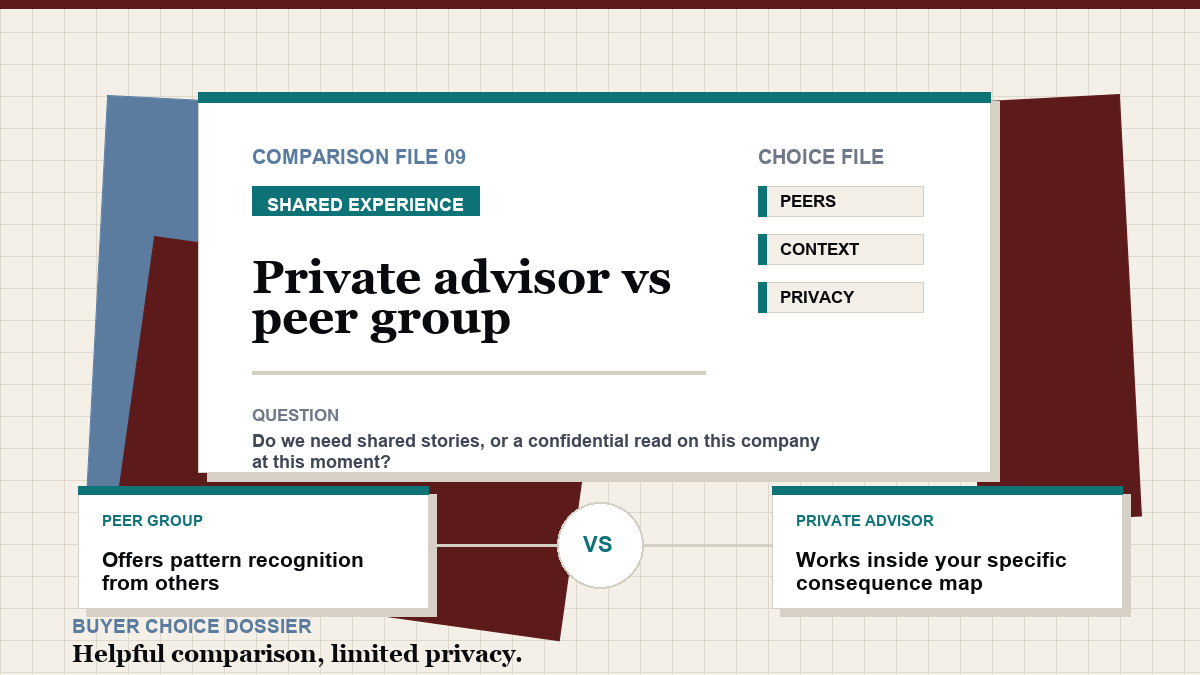
What this work actually is
A self-organized peer loop is a small, deliberately constructed operator group with a written charter, a fixed cadence, and a rotation that makes each member responsible for the team once a quarter.
A working peer loop distills the parts of masterminds, chat groups, and dinners that produce signal.
The reason most informal groups die is the absence of a charter. Two people skip a session because nothing was written down. The third person stops sending notes because nobody reviewed the last set. By month four, the group is a text thread.
A charter and rotation can help, but fit, trust, confidentiality and useful participation still need attention. Treat them as working agreements and review whether they help.
What you need before you start
01 · Three to five operators
Different industries may reduce overlap; they do not establish confidentiality. Similar stage matches the problems. Check for customer, investment and personal conflicts even when the businesses do not compete directly.
02 · A signed NDA
Agree appropriate confidentiality terms with qualified help where needed. Confidentiality terms do not prevent disclosure by themselves. Share only what you are entitled to share, agree how records are handled and leave out identifying or sensitive details when they are unnecessary.
03 · A written charter
What the group is for, what is out of scope, the cadence, the rotation, the attendance rule, the exit rule. Two pages. Re-review at the start of each meeting for the first six months.
04 · A standing block
On every calendar. Not "we will pick a date each month." A standing block survives the operating life. Floating dates do not.
Illustrative starting text, not a legal agreement: “We meet monthly for three trial meetings to examine real business questions. Each member may decline to share confidential material. The host sends the question and permitted context one day ahead. We ask questions before offering suggestions. No member sells to another during the session. We disclose conflicts and agree how notes are stored. We can leave without giving a private reason. After three meetings we decide what to keep or change.”
Agree confidentiality and legal terms separately where necessary. Adjust attendance, timing and group size to the participants rather than treating the example as a universal rule.
The full process
Twelve names. Operators you respect, operators who would respect each other, no commercial conflicts, no customers, no investors, no spouses of either. The twelve becomes the four to six who actually accept and show up.
Two pages. Purpose. What is in scope, what is out. Cadence (monthly, half-day). Rotation (one host per session). Attendance rule (two missed sessions in a year is a conversation; three is an exit). Exit rule (graceful, mutual, no fault). Send it with the invitation. People who say yes have agreed in writing.
Three hours. Each member presents their business in twenty minutes: model, current state, the one decision they are sitting on. No advice. Only questions. The session sets what good participation looks like and surfaces whether the group can be a group.
One host per session. Host brings one decision in writing, two pages, sent twenty-four hours ahead. The group spends ninety minutes on it: questions only for the first thirty, options for the next forty-five, host commits to one move in the last fifteen. The rotation makes everyone responsible for the team.
Check whether the meetings are useful, safe to participate in and realistic to attend. Change the charter when a specific problem calls for it; do not keep a poor arrangement running just to complete a year.
Half-day off-site once a year. Review the charter. Vote yes or no on each clause. Address attendance issues. Decide whether the group continues, whether anyone exits, whether anyone joins. The annual review is what stops the group from drifting into a friendship that no longer produces work.
How to know the loop is going wrong
Hosts are sending the two pages on the day of the session.
The discipline is decaying. Restore the twenty-four-hour rule at the next session, or the work product follows.
The group spends more time on industry chat than on the host's decision.
The structure has slipped. Re-enforce the questions-only first thirty minutes, with a clock if needed.
Two members have missed back-to-back sessions.
The attendance rule is now in play. Have the conversation per the charter; do not let it slide into precedent.
A commercial conflict has appeared and not been declared.
Someone in the group has started selling to or competing with another. Address immediately; the charter's exit rule exists for this.
The host's commitment in the last fifteen minutes has stopped happening.
The session is now venting. The commitment is the entire point. Re-instate it next session.
The group is great socially and you cannot remember the last decision it changed.
It has become a dinner club. Either re-charter or graduate it to friendship and start the loop again.
Tools and tactics
The shared file is what compounds across years; the personal file is what compounds for you.
Shared folder, NDA-protected. Charter pinned at the top. One folder per session: host's two pages, decision committed, retro the next month. Personal sidecar file: every session note, the question someone asked you that you could not answer, the move you committed to publicly.
Documented in full inside the engagement · teaser here
Page one: situation, options, the decision. Page two: the question you actually want the team to address. Sent twenty-four hours before the session. The pre-brief is the artifact that separates a peer loop from a chat.
First thirty minutes of the host's slot: questions only, no advice, no opinions. Forces the group to review the situation before solving it. Cuts the most common failure mode of peer groups, which is premature solution.
First five minutes of every session: last month's host reports back on the move they committed to. Did it happen, what changed, what they would do differently. The retro is what makes the commitment real.
What this work is not
The loop holds you accountable across decisions. Specific decisions where the team has politics, the file has continuity, and the call costs months still belong to a different instrument. The comparison page sets the structural difference.
Review advisor vs. peer group →When the loop has done what it can
Stan reviews each request for fit. All corporate work starts with an inquiry and is quoted separately. Stan confirms the people, stakes, scope, and fee in writing before work starts.
Apply for business coachingWork with me · $1,500/month 1:1 business work · Request scope
