Manual 02 · Self-coaching
A real executive coach charges for the room, the questions, and the witness. Most weeks the room is not what is missing. The questions are. This is the seven-step protocol Stan runs on himself, and the line where a coach earns the seat that this manual cannot fill.
Open the protocol When a coach is the right call
What this work actually is
Self-coaching is not journaling. It is running the same questions a serious coach would run, on yourself, with the discipline to write the answer down, sleep on it, and read it again the next morning.
Three pieces are non-negotiable: a fixed cadence the calendar respects, a stable set of questions you are not allowed to skip, and a written record. Skip any of the three and you are venting, not coaching.
The reason this works is not mystical. The reason is friction. When the question is on a page in front of you and the cursor is blinking, the cheap answer feels like a lie within ten seconds. The same question asked aloud to no one tends to escape with the cheap answer intact.
What self-coaching does not do is replicate the live read of a skilled coach who is watching your face change while you answer. That is a different instrument and shows up in the limits section below.
What you need before you start
01 · A standing slot
Not "when I have time." A recurring block, same day, same hour. The calendar is the contract with yourself. If it moves more than once a quarter, the protocol is not real and the rest of it stops working.
02 · One notebook
Continuity is the asset. A coach has the file from session four when they read you in session twelve. You need the same file. One place, one format, one search. The tool does not matter; the singularity does.
03 · A fixed question set
Listed in the protocol below. The questions are deliberately uncomfortable. You will want to skip the third one. Not skipping it is the work.
04 · A no-edit rule for the first pass
The first pass is messy on purpose. Editing while writing kills the signal. Write all six answers, close the notebook, walk away. Re-open the next morning and edit then.
The full protocol
Five minutes. Not a re-judge. A re-read. Look for the question you punted on, the answer that aged badly, the prediction that turned out wrong. The continuity is the value. Skipping this turns the work into a series of disconnected pages.
What is going on. What changed this week. What is loud in your head right now. Three sentences, no more. The constraint forces the actual signal to the surface; everything else is preamble.
No editing. Write fast. Move on if a question stalls; the stall itself is data. The six questions are stable across weeks and across operators. Replace them only after running them for sixty days.
Star it. Underline it. Whatever marker you use. The answer that was hardest to put on the page is the answer that has the most signal. That is the seed for next week's re-read in step one. The pattern over six weeks is the diagnosis.
Twenty-four hours minimum. The freshly written answer feels true in the moment because writing produces certainty as a side effect. Sleep on it. The morning re-read is when the bad answers become visible.
Re-read in the morning. Edit only the lines you no longer believe. Do not improve the prose. Do not soften the hard ones. The point of the re-read is to catch the version of you that wrote it twenty-four hours ago overstating, dramatizing, or hiding.
One concrete action that comes out of the entry. Not a list. One. A conversation to have, a meeting to cancel, a number to look at, a decision to make by Friday. One move per week, run for forty-eight weeks, is a different operator at the end of a year.
How to know your self-coaching is going wrong
Every entry sounds like the same person solved the same problem.
Self-coaching that works produces visible drift in the questions. If six entries in a row arrive at the same neat resolution, you are pattern-matching, not reading. Replace one of the six questions for a cycle.
The hardest question is missing from the page.
You wrote five answers. The third one is blank or three words. That is the one that mattered. The body knows. Re-open and answer it the next morning, badly if needed.
The weekly move never gets executed.
The move is too big, too vague, or pointed at the wrong question. A weekly move you cannot finish in a week is a goal in disguise. Cut it down until it fits.
The notebook is full of insights and the business is not changing.
Writing produces clarity as a feeling. Without the weekly move and the Friday check, that feeling is the entire output. The protocol is built around step seven for a reason.
The same theme has been hardest for nine weeks.
Self-coaching has hit its floor. The pattern is structural, not situational, and a witness in the room is now the missing piece. This is the moment a real coach earns the seat.
You started editing while writing.
Editing while writing kills the first-pass signal. The reason the protocol separates pass one from the morning re-read is exactly this. Re-instate the no-edit rule for the next cycle.
Tools and tactics
The protocol is the work. The second brain is what makes the protocol compound across years.
One file per quarter. The six questions are pinned at the top. Every weekly entry is dated. Every weekly move is tagged with the Friday verdict. Quarterly review reads the patterns, names what changed, and decides whether the question set needs a rotation.
Documented in full inside the engagement · teaser here
Five minutes on Friday. Did the weekly move happen, yes or no, and what got in the way. Captured next to the weekly entry. Without the Friday check, step seven decays inside three weeks.
One peer who reads your last entry once a quarter. Not for advice. For the read. They name the pattern you are too inside to see. Pairs with a real peer loop, covered in /craft/build-your-own-peer-loop.
A standing question on the last entry of every month: "Has anything come up that I should not be working on alone?" If yes twice in a row, you have already left the protocol's coverage. The roster of coaches and advisors lives in the second brain, ready.
Coming soon
Built when the protocol has run on enough operators to be worth packaging. Listed here so the road is visible.
Printed and digital. Pre-formatted for the seven steps and six questions. Twelve weeks per volume. Released when the question set has been stable for two full quarters.
The structured re-read of twelve weeks of entries: pattern detection, question rotation, escalation triggers. Released as a downloadable workbook and a guided session format.
How to assemble a small bench of coaches and advisors before you need them, so the escalation flag has somewhere to land. Companion piece to the engagement-boundary policy.
What this work is not
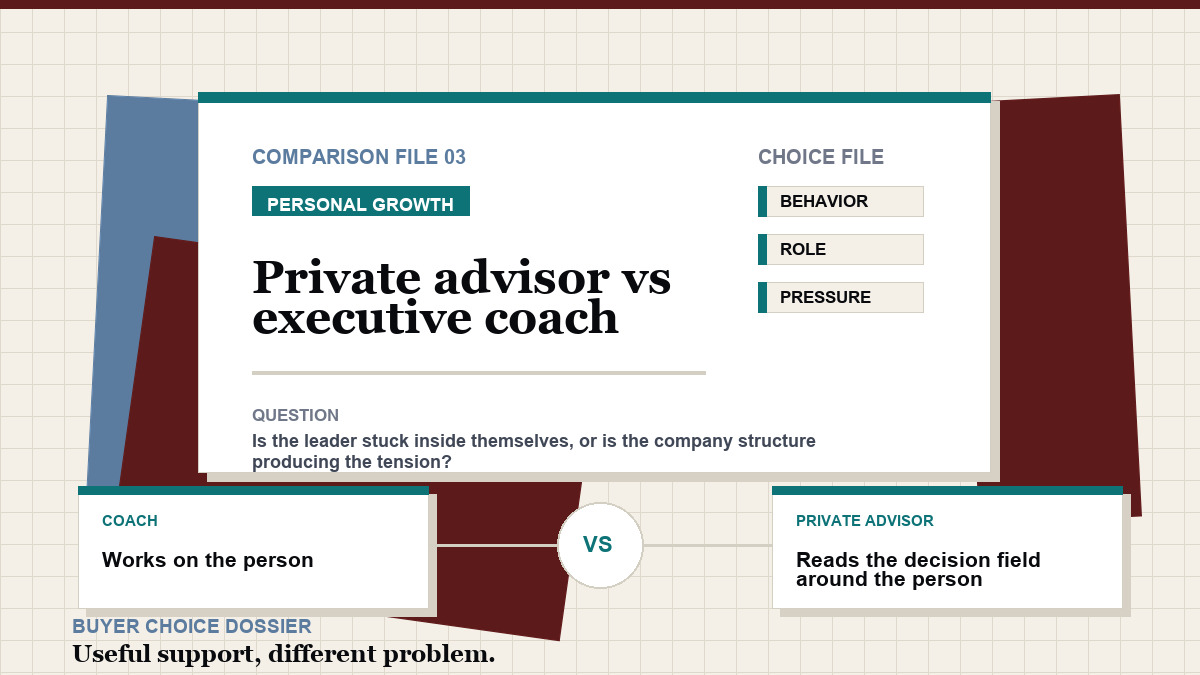
The page can hold the question. It cannot watch your face change while you answer it. A serious coach does that, and the live read is the part of the work that does not survive transmission to paper. The comparison page sets the line in detail.
Read advisor vs. coach →When the protocol is not the missing piece
Application-gated. Personal reply within 48 hours. The first conversation names what the page has not been able to name.
Apply for advisoryTier 01 from $2,500 · Tier 02 from $4,500 / month · All three tiers