Manual 07 · Owner-side exit pre-work
An exit planner engineers the transaction. The pre-work belongs to the owner: what you actually want on the other side, what the business has to look like by then, and what you stop running so the buyer is buying a company, not a job. This manual covers the work the planner cannot do for you.
Open the pre-work When the planner is the right call
What this work actually is
Owner-side exit pre-work is the personal, structural, and operational preparation that has to be done by the owner themselves. The planner sequences the deal. The pre-work decides what deal you should be sequencing toward.
Skipping this work is the most common reason a clean transaction lands the owner in the wrong place six months later. The number was right. The decision underneath the number was not.
The decision to exit is not a financial decision. It is a life decision with financial consequences. The owners who do this well treat it that way. They name what they want on the other side, in writing, before they ask anyone what the business is worth.
The owners who do not do the pre-work end up at closing dinner saying the right things and waking up at four in the morning for nine months afterward. The transaction was clean. The decision was uninspected.
What you need before you start
01 · Time horizon
Closer than 18 months and the pre-work compresses; the manual still helps but the planner conversation is overlapping. Further than 36 months and the work goes stale; revisit when the horizon shortens.
02 · A spouse or partner aligned
If a spouse or partner exists, they get a copy of the day-after document and have a conversation about it. The most common late-stage exit unwind is alignment that nobody checked.
03 · Clean financials
If your books are not clean, the pre-work pauses and the financial reading manual runs first. /craft/read-your-own-books covers that.
04 · A no-leak rule
Pre-work leaks affect tenure, vendor terms, customer renewals, and key-person retention. Write the list of who knows. Hold it. Most owners under-restrict at this stage and pay for it at LOI.
The full process
Two pages. Where you live. What you do on a Tuesday morning. Who you see. What is on your calendar. What is no longer on your calendar. What you are reading. What you are afraid will happen. The level of specificity is what makes this useful; "travel more" does not survive any scrutiny.
The number under which the answer is no, regardless of any other condition. Not the wish number. Not the broker's number. The number that, after tax and after the things you owe yourself, lets the day-after document be true. Calculated by you, with a tax adviser, with the spouse or partner present.
Three to five non-negotiables. Earn-out length, role you will not stay in, employees you will not let go, geography, customer relationships you will protect, ethical lines. Written before any LOI exists. The reason: at LOI, every one of these will be pressured.
List every relationship, system, decision, and account that lives in your head or runs through you. Pick the top ten. Move five of them out within twelve months. The ones you cannot move out are the ones the buyer will value down or earn-out you for.
The accountant has been minimizing taxable income for years. Buyers are valuing reported earnings. Every personal expense run through the business, every aggressive depreciation, every related-party arrangement reduces the price the buyer will pay. Begin the cleanup eighteen months before the conversation.
One folder. Audited financials, clean cap table, customer contracts, key vendor contracts, employee agreements, IP assignments, insurance policies, lease documents, board consents. Walk through the standard diligence list and put each document on the shelf as you go. The folder being ready cuts months off the eventual deal.
Not a formal valuation. A read from someone who has sold companies in your category. Twenty pages of comparables, recent multiples, who has been buying, what they paid for, what they paid down for. Used as a calibration on the floor number, not as a target. The read makes you literate for the planner conversation.
How to know the pre-work is going wrong
Your day-after document is two paragraphs of "spend time with family."
It is a wish, not a plan. Re-write it specific. The point of the exercise is to find the things that you cannot picture, not to confirm the things you can.
Your floor number keeps moving up.
The number is being negotiated against the conversations you are having. The number is supposed to be fixed. Re-anchor it to the day-after document.
You wrote five non-negotiables and have already revised three of them.
Either the originals were wrong or the pressure is already arriving. Decide which, and either fix the list or hold it harder.
You started prepping before talking to your spouse or partner.
The most expensive mistake in the field. Pause everything else and have the conversation now. The cost of misalignment compounds.
You are working harder, not less.
De-keying the business is going in reverse. The buyer reads this immediately. Find the work you took back and give it away again.
Three people now know who did not know last quarter.
The information is leaking. The list of people who know was the contract; the contract was broken. Reset it before the next planner conversation.
Tools and tactics
Pre-work that is not held in one place becomes seven loose conversations across two years. The brain is what keeps it coherent.
One folder. Day-after document, floor number, non-negotiables, de-keying log, financial cleanup tracker, diligence shelf, valuation read. Quarterly review against the original day-after document; if it has drifted, name the drift before continuing.
Documented in full inside the engagement · teaser here
Quarterly half-hour conversation with the spouse or partner where the day-after document is read aloud. Two questions: still true, anything changed. Most exit reversals catch here if the cadence is held.
Twelve months out, a structured read from someone who has sold companies in your category. Twenty pages, no engagement letter, no commitment. Used to calibrate, not to commit.
One page. Names of people who know about the pre-work, what they know, what they were told to do with it. Updated whenever the list changes. The list is your information control.
Coming soon
Released when the templates have run on enough owner-side exits to be worth packaging.
Templates for the day-after document at three months, one year, three years, plus the spouse check protocol. Released after two completed pre-work cycles unchanged.
The structured eighteen-month plan for moving owner-dependencies out of the business, with the order most owners get wrong.
A small structured engagement: Stan reviews the seven artifacts and returns the questions to ask the planner before signing the engagement letter.
What this work is not
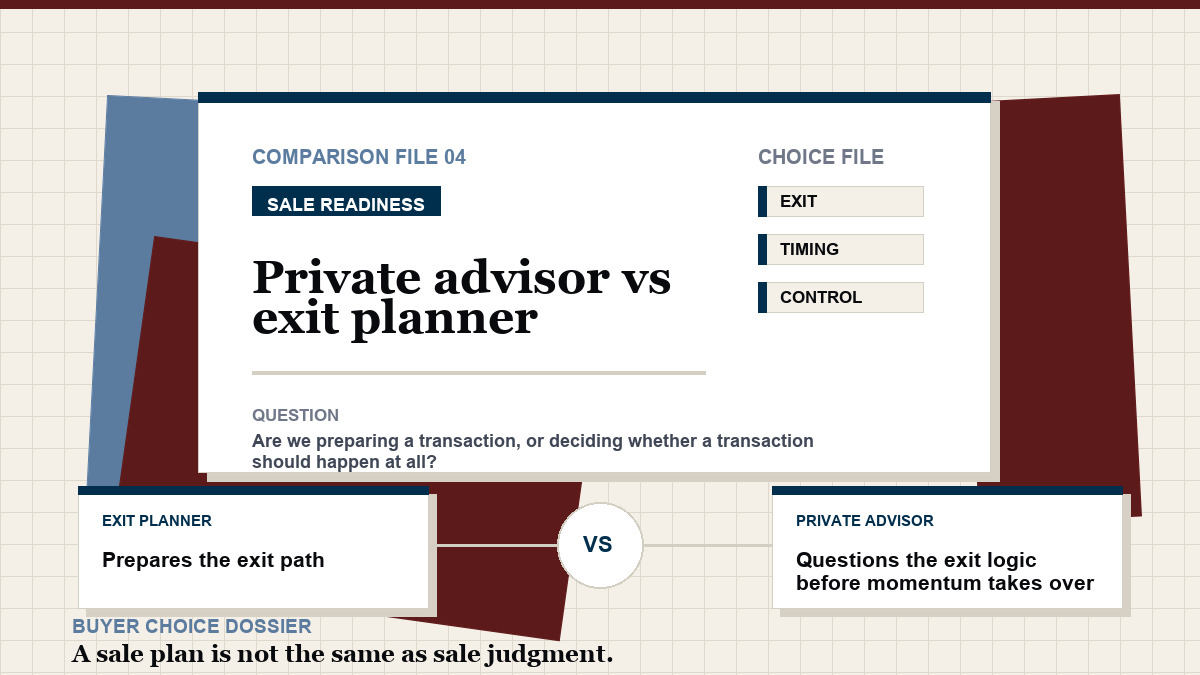
The actual transaction sequencing belongs to a competent exit planner. The comparison page sets the structural difference between sequencing the deal and examining whether the deal is the right decision.
Read advisor vs. exit planner →When the day-after document keeps coming out wrong
Application-gated. Personal reply within 48 hours.
Apply for advisoryTier 01 from $2,500 · Tier 02 from $4,500 / month · All three tiers