The craft · manual 06Run a real internal project on firm-grade disciplinePairs with /comparison/advisor-vs-consulting

Manual 06 · Internal project discipline

Scope your own project the way a firm would, without the firm.

Most internal projects fail at scoping, not at execution. This manual gives you the four artifacts a serious consulting team builds before the first workstream starts, the test of done that prevents scope creep, and the moment a firm earns the engagement.

AudienceFounder, exec sponsor, project lead
Time to scope~one week
Pre-work for any firmSharpens any later RFP
Open the process When a firm is the right call
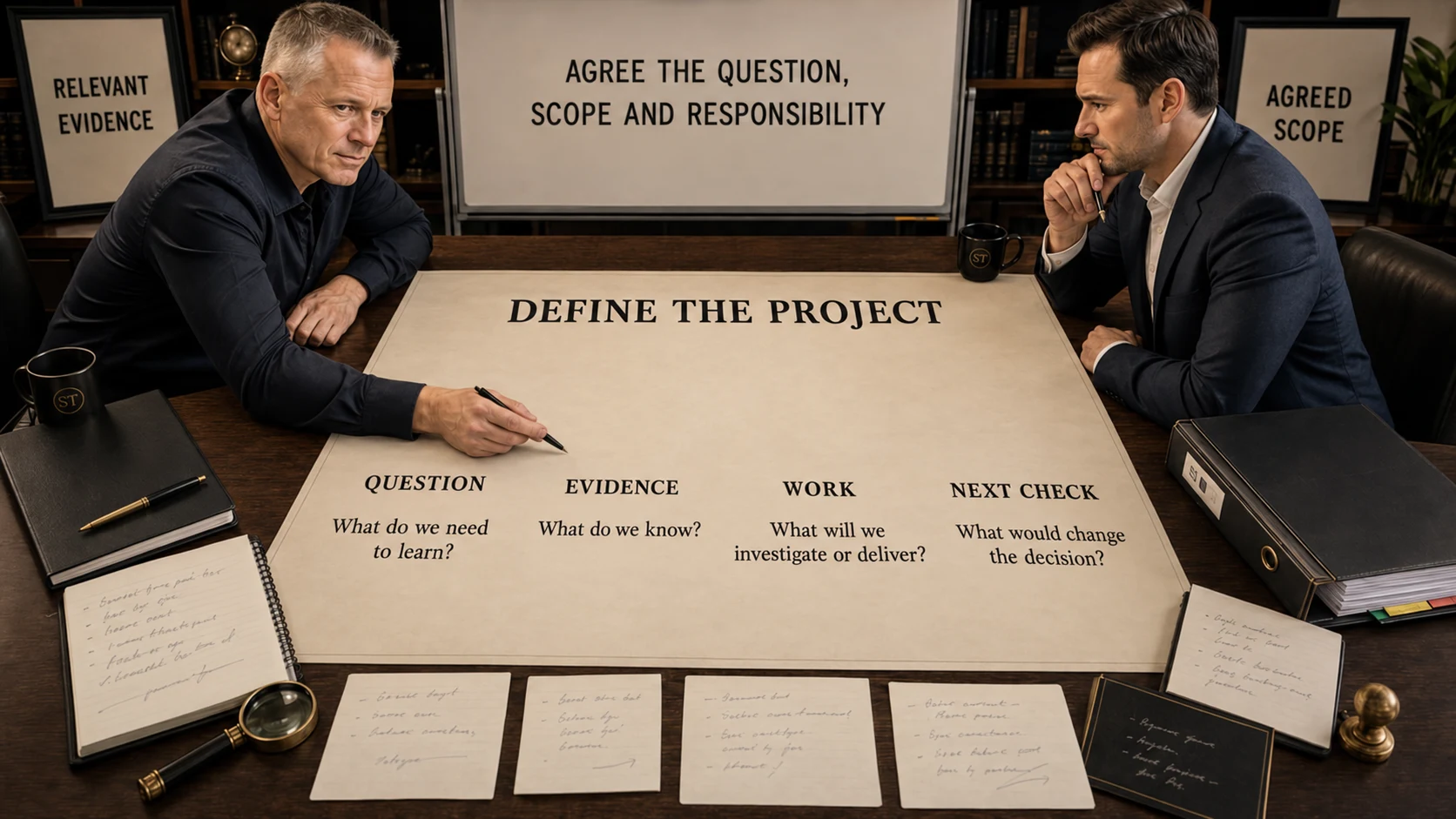
Operator scoping an internal project.

What this work actually is

Running a project firm-style is the discipline of writing the engagement before you do the engagement.

Internal project scoping is the deliberate production of four artifacts before any workstream starts: a brief, a workplan, a deliverable specification, and a test-of-done. The same four documents a competent consulting firm produces, written by the operator who would otherwise hire the firm.

The artifacts are the work, not paperwork. Most failed projects failed at the brief, not the execution. Writing them well saves you the firm fee and gives you the option of bringing one in later with a sharper RFP.

The internal project that has no brief becomes a meeting series. The internal project that has a brief but no test-of-done becomes a slow drift. The internal project that has both becomes the kind of work senior people are willing to be measured on.

The point of running it firm-style is not to imitate a firm. It is to install the friction that a firm's billing rate creates: every week, someone is asking whether the work is on track to the deliverable. Without that friction, internal projects expand to fill the time.

What you need before you start

Four prerequisites. None of them are tools.

01 · Named sponsor

One person whose name is on the outcome.

Not a committee. A single accountable executive, named in the brief, who can say go or stop. Without a named sponsor, scoping is theatre.

02 · A real budget

Time and money committed in writing.

Internal time has a price even when nobody invoices for it. Cost the project at fully loaded rates and put the number in the brief. The number changes how the work is treated.

03 · A standing review cadence

Weekly, thirty minutes, on the calendar.

Every week, the sponsor reviews the workplan against the brief. Without the cadence, the deliverable arrives misaligned and nobody is surprised.

04 · A documented kill criterion

The condition under which the project stops.

Written in the brief. The hardest thing about internal projects is killing them. Pre-committing the kill criterion makes the kill possible.

The full process

Six steps. Three are written before the project starts. Three are run weekly.

  1. 01

    Write the brief.

    Two pages. Problem, why now, the population the problem affects, the cost of not solving it, what success looks like in measurable terms, what is out of scope. The "what is out of scope" line is what stops the project from sprawling in week three.

      Stress-test
    • Can a smart outsider read the brief and predict the deliverable shape?
    • Is the cost-of-not-solving number specific, or hand-waved?
  2. 02

    Write the workplan.

    One page. Workstreams, owners, week-by-week milestones for the first month, milestones in two-week increments after that. No Gantt theatre. The format that lets the sponsor read it in two minutes is the right format.

      Stress-test
    • Is each milestone something an outsider could verify happened?
    • Are owners single people, or "the marketing team"?
  3. 03

    Write the deliverable spec.

    One page. What the final output is, in what format, who reads it, how long it is. If the deliverable is a decision, write the decision question. If the deliverable is a system change, write the acceptance criteria. If the deliverable is a deck, write the table of contents. Specifying the shape forces the team to know what they are building toward.

      Stress-test
    • Could the team start the deliverable today and tell within an hour whether it is on shape?
    • Is the reader of the deliverable named?
  4. 04

    Write the test-of-done.

    Three to five conditions that have to be true for the project to be called complete. Pre-committed. Signed by the sponsor. The reason is structural: at the end of any project, there is pressure to call it done early or to keep going past the value. The test-of-done resolves both arguments before they happen.

      Stress-test
    • Are the conditions observable, or only assertable?
    • If you imagine the deliverable arriving in six weeks, does the test catch the bad version?
  5. 05

    Run the weekly review against the brief.

    Thirty minutes. Sponsor and project lead. Three questions: what shipped this week, what is at risk, what is now out of scope or back in. Decisions get logged in the workplan. The brief and the test-of-done sit on the table; the review is anchored to them, not to the urgency of the week.

      Stress-test
    • Did the review change the workplan, or only acknowledge it?
    • Did anything cross from "out of scope" into "in scope" without an explicit decision?
  6. 06

    Hold the test-of-done at the end.

    Read the test-of-done. Walk through each condition. Mark each met, partial, or unmet. The project is done when the conditions are met. If they are not, decide explicitly: extend with new milestones, descope, or stop. No quiet drifts into a "phase two" that was never agreed.

      Stress-test
    • Did anyone argue against the test-of-done at closeout? If yes, the test was not strong enough at scoping.
    • Is the closeout written down, signed by the sponsor, and filed?

How to know the project is going wrong

Six tells that the scope has slipped.

Tell 01

A new workstream appeared without an explicit decision.

The brief is no longer the contract. Either expand the brief and re-cost, or close the new workstream. Both are valid. Drift is not.

Tell 02

The weekly review is being skipped or shortened.

The sponsor is disengaging. Without active sponsorship, the project will arrive misaligned. Re-establish the cadence or kill the project.

Tell 03

The team is still in research mode in week six.

The brief did not specify the decision the research is for. Pause the workstream and rewrite the deliverable spec until the research has a target.

Tell 04

The sponsor and the team are arguing about what done means.

The test-of-done was not specific enough at scoping. Rewrite it and have the sponsor sign before the next milestone.

Tell 05

The cost number in the brief has not been updated.

Internal projects routinely run two-times the original time. Update the cost number every month. Visibility on the running cost is what triggers the kill conversation if it needs to happen.

Tell 06

A "phase two" has been mentioned more than twice.

Either it is a real next project that needs its own brief, or it is the current scope leaking forward. Force a decision in the next review.

Tools and tactics

A second brain that holds the brief, plan, spec, and test in one place.

Four artifacts in one folder. Read together at every weekly review. The folder is the project.

The Second Brain · project layer

Stan's project stack

One folder per project. Brief, workplan, deliverable spec, test-of-done at the top. Weekly review notes appended in plain text. Decision log captures every scope change with a reason. Closeout document filed at the end.

  • Folder per project, four artifacts pinned at the top.
  • Weekly review notes appended in plain text, dated.
  • Decision log inline, never in chat.
  • Closeout filed signed by the sponsor.

Documented in full inside the engagement · teaser here

Tactic 02

The decision log

One column per scope change: date, what changed, why, who decided. Pinned at the bottom of the workplan. Survives turnover. Pays back at the closeout review.

  • Inline, not in a separate tool.
  • Every scope change goes in.
  • Read at closeout to map cost overrun to the choices that drove it.

Tactic 03

The fully-loaded cost line

Internal hours costed at fully-loaded rates. Updated monthly in the brief. The number is the friction; without it, internal projects feel free.

  • Hours per workstream per week.
  • Loaded rate per role.
  • Running total in the brief, refreshed monthly.

Tactic 04

The kill review

One scheduled checkpoint, halfway through the planned timeline, where the only question is whether to continue. Written into the brief. The default is continue; the value is the explicit re-decision.

  • Calendar block at the midpoint.
  • Sponsor and project lead only.
  • Three options: continue, descope, kill.

Coming soon

Two products held open inside this manual.

Released when the templates have run on enough internal projects to be worth packaging.

In build

The Four-Artifact Project Pack

Templates for brief, workplan, deliverable spec, test-of-done, plus weekly review notes and closeout. Released after two completed internal projects unchanged.

Scoped

The RFP Sharpener

If you decide to bring in a firm later, this turns your scoped artifacts into an RFP that gets you better proposals. Sized as a small downloadable.

Scoped

The Kill-Review Library

Worked examples of midpoint reviews where the right answer was kill, descope, or continue. Released as a paid asset when the case file is large enough.

What this work is not

A firm brings staff and a deck. The substitute brings discipline.

Running it firm-style does not give you a firm.

If the work needs an outside team for capacity, neutrality, or specialist methodology, that is a firm engagement, and the artifacts you produced make the firm sharper, not redundant. The comparison page sets the structural difference.

Read advisor vs. consultant →
Hire a firm when
  • The capacity required exceeds your team for more than a quarter.
  • Neutrality is the asset (M&A integration, restructuring, layoffs).
  • The methodology is specialist and you would not retain the muscle.
  • The board or investors require an outside firm signature on the work.

When the project is the wrong project

Scope it firm-style first.
If the brief keeps coming out wrong, the question is not the project.

Application-gated. Personal reply within 48 hours.

Apply for advisory

Tier 01 from $2,500 · Tier 02 from $4,500 / month · All three tiers