Comparison · Business Coach vs Therapist
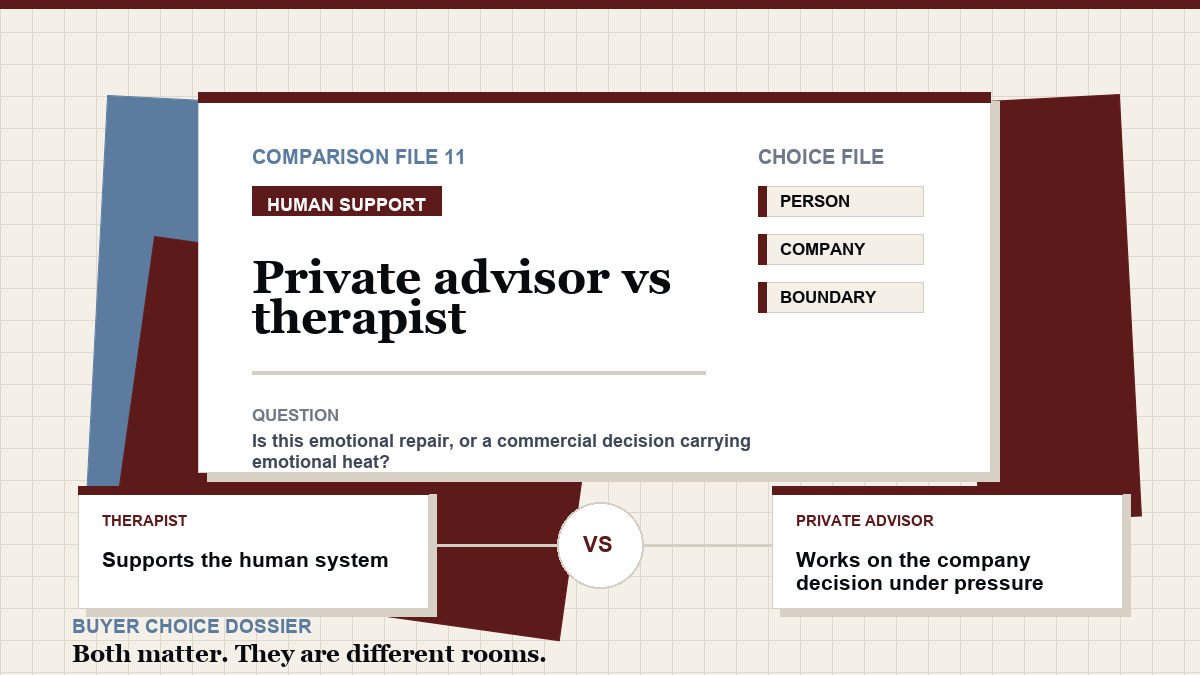
Use a therapist for your interior life. Use a business coach for the business decision your interior life is pointing at. A therapist reviews the operator. A business coach pressure-tests the decision.
A therapist is a licensed mental health professional whose work is the inner life: anxiety, depression, attachment, identity, the repeated situations that predate the company. A business owner coach reviews the operating decision and the structure around it. Both are necessary at different layers. Neither replaces the other, and confusing one for the other is its own kind of cost.
When a therapist is the right call
The weight is showing up as anxiety, depression, or symptom. Sleep gone for months, panic on the drive in, body holding what the calendar will not. This is medical territory. A licensed therapist or physician is the right professional. Business coaching cannot and should not work this layer.
The pattern is older than the business. The way you respond to authority, conflict, success, loss, intimacy. Family-of-origin material. The company is a stage where the pattern shows up; the pattern was there long before. Therapeutic work is the layer that addresses it.
The question is who am I outside the founder seat. Selling the company. Stepping back. Watching the next person run what you built. Children, marriage, mortality. These are real questions, large ones, and they belong in a therapist’s setting, not in the operating decision.
The harm is inside a relationship that matters. Spouse, co-founder, child, parent. Couples or family therapy holds the conversation that the operating frame cannot reach. A business coach can name that the relationship is load-bearing on the decision; the relational work itself is therapy.
When a business coach is the right call
The thing keeping you up is a specific operating decision. A capital event, a partner exit, a strategic acquisition, a structural reorganization. The fatigue is real but the cause is structural, not internal. The business coach pressure-tests the decision and what is being avoided in the framing.
You need someone outside the team reviewing what the team cannot review about itself. The ownership split, the comp pattern, the family member on payroll, the unspoken concession in the term sheet. This is operator-grade reviewing, not psychological insight. A therapist is not trained for it and, structurally, should not be.
The conversation needs to land in the language of the business. Numbers, governance, authority, leverage, exits. A therapist holds a different vocabulary by training. The business coach speaks the language of the decision because the decision is the work.
The cost of doing nothing shows up in the P&L and the calendar. Open decisions compounding, governance gaps widening, talent losing patience. Real money, real time. The business coach pressure-tests the structural cause and the structural response. The therapist’s clock and economy are different by design.
The structural difference
| A therapist | A business coach | |
|---|---|---|
| Layer of work | The self. Inner life, attachment, history, identity, mental health. | The decision and the structure around it. Operator-grade review. |
| Training | Clinical license. Years of supervised practicum. Ethics board. | 21 years of operating across boards, M&A, jurisdictions. |
| Vocabulary | Affect, regulation, attachment, transference, family system. | Ownership split, governance, leverage, exits, principal-agent. |
| What they will not touch | Telling you whether to sell the company. Reviewing a term sheet. | Reviewing depression. Treating trauma. Marital repair. |
| Cadence | Weekly or fortnightly, often for years. Long arc. | Per decision (Business Coaching) or recurring twice-monthly (Ongoing Coaching). Decision arc. |
| Confidentiality | Clinical privilege. Legal floor. | Contractual confidentiality. Strict, but not clinical privilege. |
| Best use | Layer below the seat. The self that will outlast the company. | Layer of the decision. The structural business problem before it lands. |
Therapist is the right setting
Clinical signal. Begin where bodies and inner lives need care. A therapist or physician is the right professional. Once the body is back and the head is clear, business decisions become readable again. Not before.
Business coach is the right call
Decision-shaped. The fatigue is the open file, not the inner life. Business coaching is the path; the work is business coaching.
Both, in parallel
Two layers, two settings, neither replacing the other. The therapist holds the identity question. The business coach tests the deal as a deal. Most senior operators going through a real transition end up here. Mixing the layers, asking the therapist to review the term sheet or the business coach to review the family-of-origin pattern, weakens both. Owner load is the path when both layers are loud at once.
Strong operators in real transitions often use both, in parallel and in different settings. The therapist holds the layer that will outlast the company; the business coach tests the decision in front of you. Mixing the categories or asking either professional to do the other’s work weakens both. If you are reading this page and you are not sure which one you need first, that is itself useful information. Start with whichever signal is louder, and treat the other layer when its time comes. When both layers are loud, see Owner load.
Run the work yourself first
There is no AI-for-X manual for therapists. The clinical and ethical floor sits below what a public manual should normalize. The operator manual is a structural pause before the next consequential decision. Not therapy, and not a substitute for it.
Operator manual · self-review Review your own state before it leaks into the decision → A five-minute structural pause and the line where the page hands you to a therapist or doctor.Apply for business coaching
Stan reviews each request for fit. All corporate work starts with an inquiry and is quoted separately. Stan confirms the people, stakes, scope, and fee in writing before work starts.
ApplyBusiness coaching · $1,500/month 1:1 business work · Request scope
