Manual 12 · Operator self-review
This short self-review helps a serious operator check their own state before signing, sending, hiring, or firing. State leaks into decisions. Naming the leak before it lands is the cheapest insurance there is. Clinical care sits outside this manual, and that boundary is named at the bottom.
Open the protocol When therapy is the right call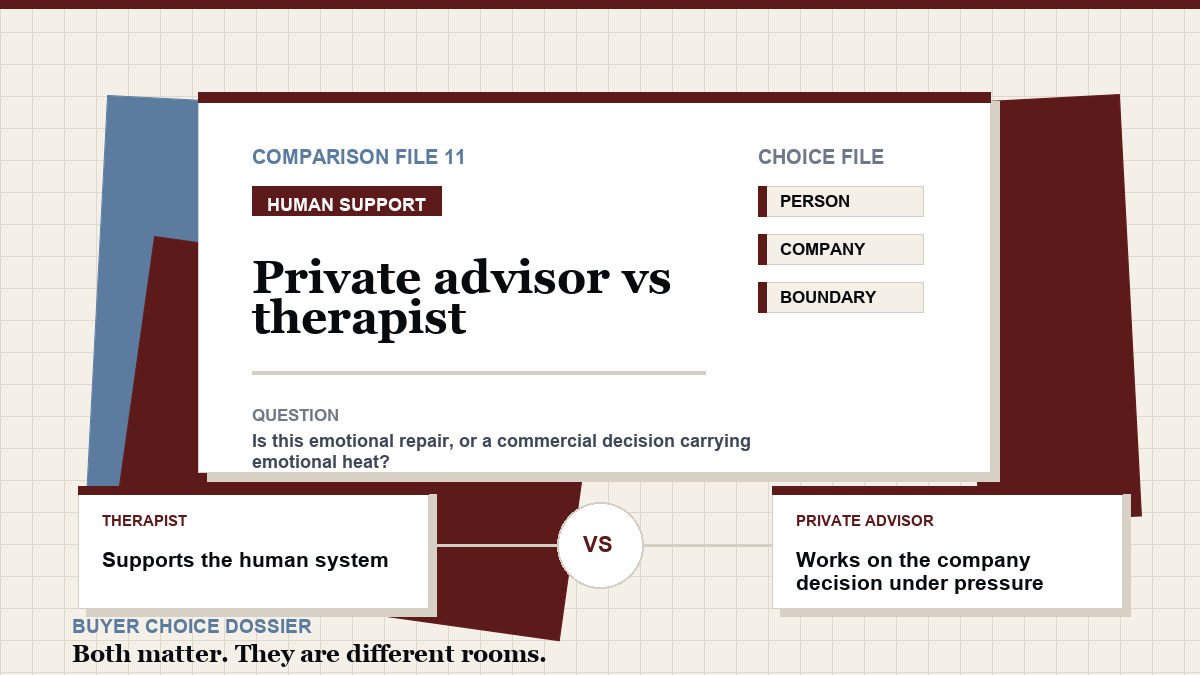
What this work actually is
Operator self-review is a brief, structured pause before a consequential decision in which the operator names what is loaded in their state right now: hunger, sleep debt, last hard conversation, conflict with a co-founder, time of day, money pressure, peer comparison.
The point is not to fix the state. The point is to know which of the next decision's signals are coming from the situation and which are coming from your loaded state.
Most of the worst founder calls are not made under conditions of insufficient information. They are made at 11pm, after a tense board call, on the back of an unreturned email from a key hire, by a person who has not eaten properly in two days. The information was complete. The owner was loaded.
The protocol is short because long is unworkable. Five minutes, on a card or in your phone, before any signing, sending, hiring, or firing. The discipline is the pause itself.
What you need before you start
01 · A written trigger list
Hiring or firing, signing a contract over your threshold, sending an angry email, accepting or rejecting an offer, replying to a regulator, posting publicly. Write the list. The trigger list is what makes the protocol fire.
02 · A pause rule
The pause rule is the only mechanism. Without it, the check is a good intention. With it, it is a contract with yourself.
03 · A roster of humans
Spouse or partner, peer, advisor, doctor, therapist if you have one. Three names. The protocol may produce an outcome that is "do not act alone right now"; the roster is what that outcome calls.
The five-minute protocol
Hungry, thirsty, sleep-deprived, sick, hung over, in pain. Any yes is information. Two yeses is a delay.
What time is it. Where are you. After 9pm and alone is loaded by default for most operators. Long-haul flight, hotel setting, returning from a difficult meeting: each loads.
What was the last hard conversation you had today, and is the decision in front of you a quiet response to it. The displaced response is one of the most common failure modes; naming it usually breaks the spell.
Acute personal money pressure changes how operators review business risk. Acute company runway pressure does too. Name it if it is loaded, and decide whether the call should wait until the pressure is acknowledged but not running the call.
Have you spent the last hour reviewing about another operator's win, raise, or exit. The post-scroll decision is often a half-decision against an imagined peer. The fix is to name the comparison and ask whether the call serves your business or services the comparison.
If the decision is communication, ask whether you would send it after a night of sleep. If the decision is action, ask whether you would take it after a meal and a walk. If the answer is no, the check is asking you to delay. Delay is allowed and almost free.
How to know the protocol is not the right instrument anymore
The same loaded state has been present for more than three weeks.
It is no longer a state. It is a pattern. A licensed professional reviews repeated situations; the self-review does not.
You skipped the check on three consecutive triggers.
The pause rule has decayed. Either restore it with a trusted observer, or treat the decay itself as a signal that the floor of self-review has been reached.
You have started running the check and arguing yourself out of the answer.
The protocol is now self-talked. It needs a witness, not a sharper checklist.
A person on the roster has flagged a concern you minimized.
The roster exists because the operator's own review on themselves has known limits. When a roster member flags, the review is no longer yours alone.
A decision you already made now looks like it ran on a loaded state.
Repair what can be repaired. Add the failure case to the trigger list. Bring the next consequential decision to a witness.
Sleep is broken, weight is moving, drinking has changed, or the body has started saying what the head will not.
The self-review does not address this. A doctor and a licensed therapist do. The page has done its job by getting you here.
Tools and tactics
The state belongs to your life. The check belongs to the decision. Keep them separate.
One card on the phone with the six checkpoints. Trigger list pinned at the top of the second brain. Roster names and contact lines kept current. After-action note when the check changed a decision; pattern review monthly.
Documented in full inside the engagement · teaser here
One default rule: no irreversible communication or action inside the trigger window without a twelve-hour delay. The delay is almost always free. The decisions that are genuinely time-sensitive in fewer than twelve hours are rarer than they feel at the moment.
One ten-minute call to a roster member where you review the decision aloud and listen to your own voice say it. Half the time the call is unnecessary; the act of forming the sentences out loud is the review.
A doctor, a therapist or counselor, and a coach already retained or warm. Not assembled in the moment. The bench exists so the escalation has somewhere to land instantly when the protocol's floor is reached.
What this work is not
Therapy works at the level of the self. The self-review works at the level of the next decision. Both can be true at once. The comparison page sets the structural difference.
Review advisor vs. therapist →When the state check is no longer enough
Stan reviews each request for fit. All corporate work starts with an inquiry and is quoted separately. Stan confirms the people, stakes, scope, and fee in writing before work starts. The business coaching conversation reviews the decision; the bench reviews the self.
Apply for business coachingWork with me · $1,500/month 1:1 business work · Request scope
