Choosing business help
Decision framing clarifies the choice: what you are deciding, what matters and which options deserve attention. Business coaching is a working relationship that can include framing, questioning assumptions, practicing a conversation and checking what happened after action. You may need both. Choose help by the work you need done, rather than treating the decision and the person making it as separate problems.
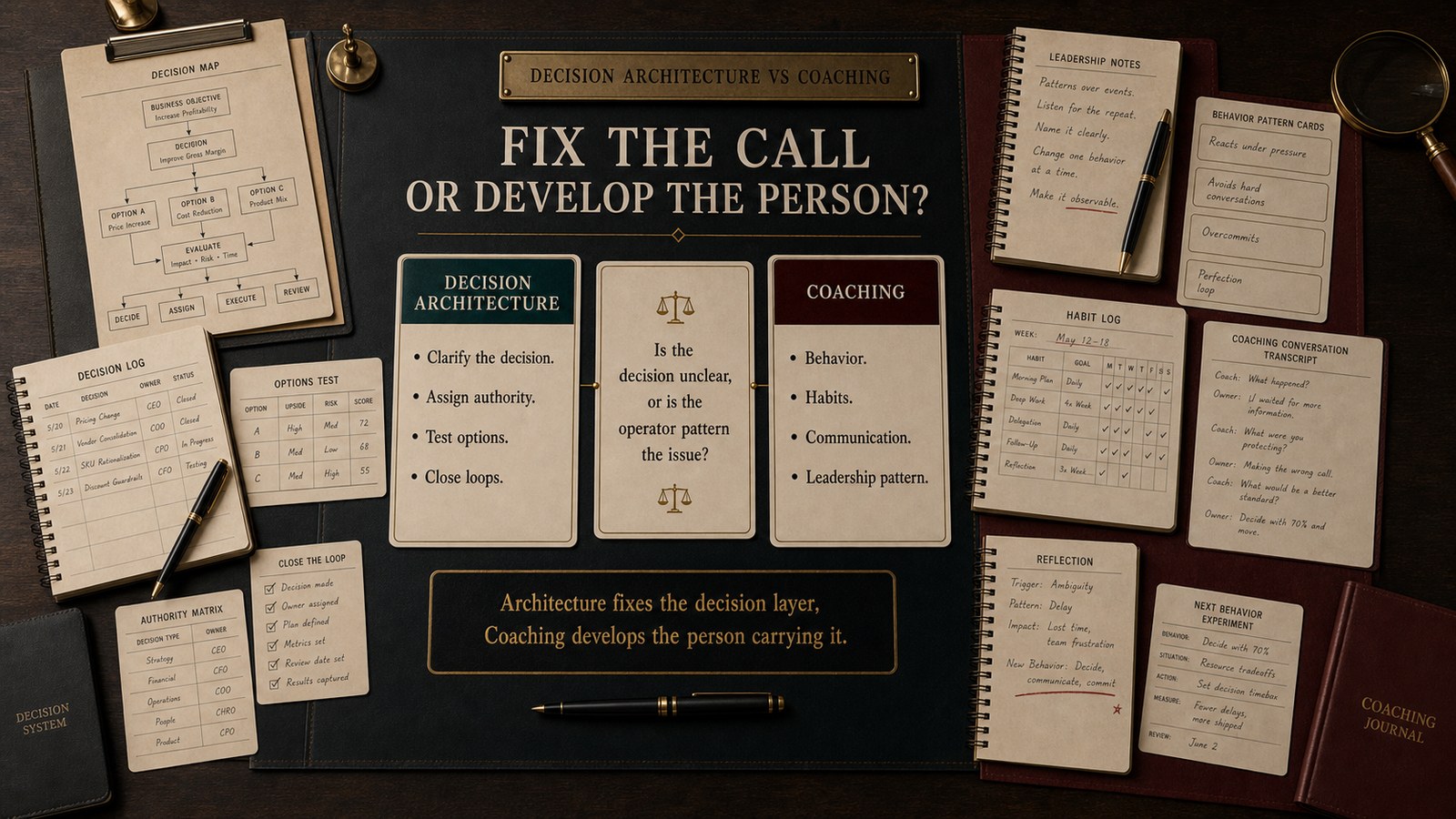
Framing is a technique, not a competing profession. An owner, team, coach or consultant may use it. Decision architecture also concerns who can decide and whose approval is required; a useful conversation does not grant those permissions.
An illustration: an owner is considering a second location. Comparing that expansion with improving the existing operation clarifies the choice. Working through a postponed conversation with the manager may also need attention. Neither makes the other unnecessary.
Clarifying the choice
The proposed solution has become the question.“Which location should we open?” skips whether expansion is the right way to serve more customers. Set out the business need before choosing the address.
Only yes and no are being considered.Compare credible alternatives, such as expanding capacity at the current location, testing another delivery arrangement or delaying the commitment. Each needs its own evidence.
People mean different things by success.More sales, more profit and less owner involvement can require different choices. Make the priorities and acceptable compromises explicit.
One uncertain assumption could change the choice.Identify what is known, what is estimated and what would change the decision. A clearer question does not replace the information needed to answer it.
Working with a coach
You want another person to question your reasoning.A coach can help examine assumptions and alternatives within the agreed work. The coach does not have to accept the initial question as settled.
A necessary conversation keeps getting postponed.Work through what needs to be said, what the other person may know and how you will act on their answer. Check practical obstacles before assuming hesitation is the cause.
A choice has been made, but agreed actions keep slipping.Examine the commitment, the available time and the authority to act. Agree a feasible next step and check what happened; encouragement alone may be insufficient.
You want to improve how you handle future decisions.Compare what you expected with what occurred. A poor outcome may reflect uncertainty, weak execution or a mistaken assumption, so do not judge the decision from its outcome alone.
The work you are choosing
| Decision framing | Business coaching | |
|---|---|---|
| Starting point | A choice needs a clearer purpose, scope or set of alternatives. | An owner wants support with business decisions, action or how they work. |
| What the work involves | Clarify the question, assumptions, priorities and options before further analysis or commitment. | Agree the goal; question, practice, act and check progress. Framing may be part of it. |
| Useful result | A choice the decision-maker can explain, with important unknowns made visible. | Changes in the owner's decisions or actions that can be examined against the agreed goal. |
| Authority | The framing exercise does not grant approval or operating rights. | The owner retains business authority unless a separate role is expressly agreed. |
| Limits | A clear question cannot supply missing facts, expertise or implementation. | The relationship does not automatically include technical analysis, staffing or executive authority. |
Illustrative situations
Clarify options
Compare opening now with improving the current operation or testing demand before a longer commitment. Establish which assumptions need checking. Framing can happen internally or with outside help; it does not require a separate coaching purchase.
Work on follow-through
A coaching conversation can examine what is being avoided or what preparation is missing. Agree the conversation's purpose, then check what the manager actually said and what that changes. New facts may reopen the expansion choice.
Get the missing expertise
Those questions need the relevant qualified professional. Coaching may help organize the questions and subsequent business choices, but it does not substitute for legal, tax or accounting advice.
Before engaging help
Coaching can include structured decision work. In a guest article published by ICF, coach Krasimir Kashinov describes examining a decision and following what happens afterward. The Decision Education Foundation's framing explainer focuses on clarifying the choice itself. Neither makes these activities mutually exclusive.
For the practical steps, use the business decision-making framework. For the relationship, explore what coaching covers.
Work with Stan
Individual one-to-one work is $1,500/month, every two weeks, month to month. Company assignments have a separately agreed scope and quote.
See ways to work