The craft · manual 05For owners with no board, or a board on paper onlyPairs with /comparison/advisor-vs-board

Manual 05 · Self-imposed governance

Govern your own company before a board does it for you.

Until there is a real fiduciary body in the chair across from you, governance is something you build by hand or do not have at all. This manual gives you the four artifacts that hold the founder accountable, the cadence to run them on, and the moment a real board earns the seat.

AudienceFounder, sole owner
CadenceQuarterly · ~half day
Pre-board substituteNot a replacement
Open the four artifacts When a board is the right call
Founder running self-imposed governance.

What this work actually is

Self-imposed governance is the founder borrowing the discipline of a board until a board exists.

Self-imposed governance is a quarterly written exercise that produces four artifacts: an operating brief, a risk register, a capital memo, and a founder-accountability letter. They are written for an imagined fiduciary reader who is not in the room yet.

It is a substitute for governance, not for fiduciary oversight. The substitute breaks down when the company crosses certain structural thresholds, named in the limits section.

The friction of writing these four artifacts is the work. The reader of an operating brief is not your team; it is someone who can fire you. The reader of a risk register is not your insurer; it is someone whose name is on the same liability you are. That imagined reader is what changes the writing.

Owners who run this for one year are recognizable in the next conversation. The numbers are sharper, the trade-offs are named, and the things being avoided are listed instead of hidden.

What you need before you start

Four prerequisites. Mostly written commitments to yourself.

01 · A quarterly half-day

Calendar block, recurring, no meetings.

The four artifacts do not get written in twenty-minute slots. Half a day, alone, every quarter, on the same week of the close cycle.

02 · The five-view monthly read

From /craft/read-your-own-books.

The artifacts pull from the financial reading you already run. Without the read, the artifacts are written from feel.

03 · A sealed reader

One real person who reads the artifacts under NDA.

Not a co-founder. Not your accountant. A peer or advisor who reads, asks two questions, and goes back into their own life. The reader is what the imagined fiduciary becomes when the substitute starts working.

04 · A versioned archive

Q1, Q2, Q3, Q4 in one folder.

Quarter over quarter is the value. The first set is mediocre. The fourth set is recognizably governance-grade if the cadence held.

The four artifacts

Written in this order. Each builds on the last.

  1. 01

    The operating brief.

    Six pages. State of the business, two pages. Last quarter against plan, one page. Next quarter against plan, one page. Decisions taken and decisions deferred, two pages. Written as if to a reader who has never been in your office and reads sixty of these a quarter.

      Stress-test
    • Could a stranger predict the next quarter's emphasis from the brief alone?
    • Are deferred decisions named, or hidden inside softer language?
  2. 02

    The risk register.

    One page. Eight to twelve risks, each with: probability, impact, owner, mitigation, escalation trigger. Concentration risk, key-person risk, regulatory risk, liquidity risk, operational risk. The act of writing the trigger is what makes the register usable.

      Stress-test
    • Does every risk have a trigger that can be observed, or only owned in feeling?
    • What risk is on the register that you have been carrying personally and not naming?
  3. 03

    The capital memo.

    Two pages. Where the cash sits. What it is reserved for. What is being deployed and what return is expected. What is being declined, and why. Capital allocation is the central act of governance; on paper, on a cadence, the discipline forms.

      Stress-test
    • Does each deployment have a stated return horizon and a stated kill criterion?
    • What did you decline this quarter, and would you decline it again on the same logic?
  4. 04

    The founder-accountability letter.

    One page. Written to the imagined fiduciary. What you got right. What you got wrong. What you are protecting that you should not be. What you would expect a fair-minded board to challenge you on. This is the artifact most founders skip. It is also the one that separates self-imposed governance from a status report.

      Stress-test
    • Is the "what I got wrong" section longer than the "what I got right" section, at least once a year?
    • Does the letter name a person, behavior, or decision you would normally not write down?
  5. 05

    Send the package to the sealed reader.

    One reader. Quarterly. NDA in place. Their job is to read all four artifacts and respond with two questions, in writing, within seven days. Not to advise. To question. The two questions are the closest thing to a board pre-meeting you have.

      Stress-test
    • Were the two questions ones you had already asked yourself, or new?
    • Did the reader push on the founder-accountability letter? If not, the letter was too soft.
  6. 06

    File and hold the next quarter against the previous.

    Archive the package. Open it again on the first day of the next governance cycle. Read what you said you would do, what you said you were watching, and what you committed to. Holding yourself to the prior quarter's writing is the entire point of the cadence.

      Stress-test
    • Did the next quarter's brief acknowledge the deferred decisions from the previous one?
    • Did anything from the previous risk register become a real event? If yes, did the trigger fire on time?

How to know the substitute is breaking down

Six tells that the company has outgrown self-governance.

Tell 01

The same risk has appeared on the register four quarters in a row, untreated.

Self-governance can name the risk. Closing it requires accountability you do not yet hold yourself to. A board or a structured advisor brings the pressure that closes it.

Tell 02

Outside capital has entered.

Once there are external shareholders, fiduciary duty is not optional. Self-governance becomes preparation for, not a substitute for, real governance.

Tell 03

A regulated transition is forming: M&A, secondary, employee equity, refinancing.

These transitions need a body that can sign on behalf of the company in a way that survives later scrutiny. The substitute does not extend here.

Tell 04

The founder-accountability letter has stopped naming anything uncomfortable.

Either the company is in an uncharacteristically calm quarter or the letter is being self-edited. Bring in a sealed reader who is willing to push, or formalize the seat.

Tell 05

The capital memo describes what was done, never what was declined.

Capital allocation without naming the alternatives is bookkeeping, not governance. Restore the "declined and why" section before the next cycle.

Tell 06

You skipped the cadence two quarters in a row.

The substitute is not real. Either re-commit to the half-day on the calendar or move to a structured advisor that holds the cadence on your behalf.

Tools and tactics

A second brain that holds the four artifacts across years.

The artifacts are the work. The brain is what makes them carry quarter-over-quarter, year-over-year.

The Second Brain · governance layer

Stan's quarterly stack

One folder per quarter. Four files: brief, register, capital, letter. Reader notes filed alongside. Annual zoom-out reads the four sets across the year and produces a one-page founder report. The compounding asset is the year-on-year diff.

  • Folder per quarter, four artifacts, one reader response.
  • Annual zoom-out on company anniversary.
  • Risk register carried forward, not rewritten.
  • Founder letter archived in plain text for searchability.

Documented in full inside the engagement · teaser here

Tactic 02

The sealed reader bench

Two or three named readers, NDA in place, used in rotation. Avoids any single reader losing edge from over-familiarity.

  • Two or three readers, not one.
  • Rotation across quarters.
  • Each reader briefed on what their two questions are for.

Tactic 03

The deferred-decision register

One page, separate from the risk register. Every decision the brief notes as deferred goes on the register with a date by which the deferral expires. Forces the next quarter to re-engage.

  • One row per deferred decision.
  • Expiry date mandatory.
  • Read at the start of the next quarter's brief, not the end.

Tactic 04

The board-readiness inventory

One page that tracks what the company would need if a board were seated tomorrow: bylaws, share register, indemnification, D&O, board pack template. Updated each quarter. Turns the substitute into preparation.

  • Inventory of governance documents.
  • Status: missing, draft, signed, current.
  • Reviewed each quarter, action items rolled into the brief.

Coming soon

Two products held open inside this manual.

Released when the templates have been used by enough operators to be worth packaging.

In build

The Four-Artifact Pack

Templates for brief, risk register, capital memo, founder letter. Plus the deferred-decision and board-readiness templates. Released after two quarters of stable form.

Scoped

The Founder Letter Library

Worked examples of the founder-accountability letter at different company stages. Used as a calibration set, not a template to copy.

Scoped

The Sealed Reader Engagement

A small structured engagement: Stan reads one quarter's package and returns the two questions. Sized for owners who do not yet have a sealed reader.

What this work is not

A real board has fiduciary duty. This manual does not.

The substitute prepares for a board. It does not stand in the chair.

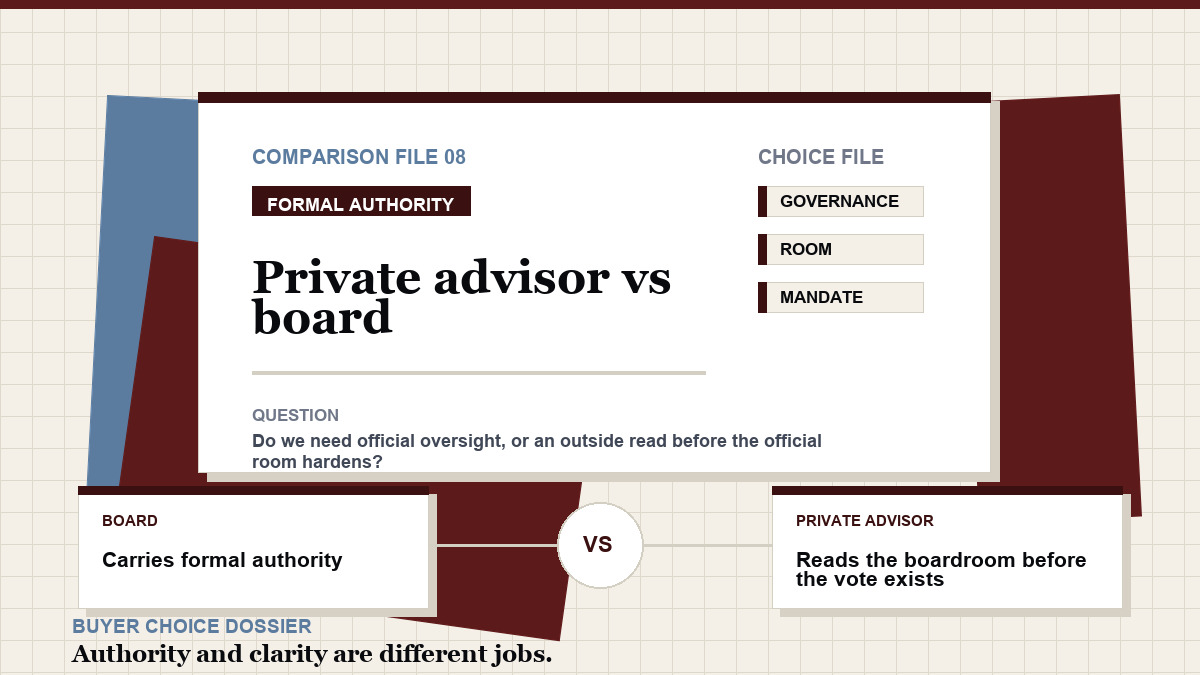
Once the company crosses the thresholds named above, fiduciary oversight is the next move. The comparison page sets the structural difference between an advisor's read and a board's authority.

Read advisor vs. board →
Move from substitute to a real board when
  • External capital is on the cap table.
  • A regulated transition is forming.
  • Two quarters of cadence have slipped and you cannot restore it.
  • The same risk has been live and untreated for four quarters.

When the founder letter has nothing in it

Run the four artifacts for one year.
If the letter is still small, the room is missing.

Application-gated. Personal reply within 48 hours.

Apply for advisory

Tier 01 from $2,500 · Tier 02 from $4,500 / month · All three tiers