Comparison · Business Coach vs Board of Directors
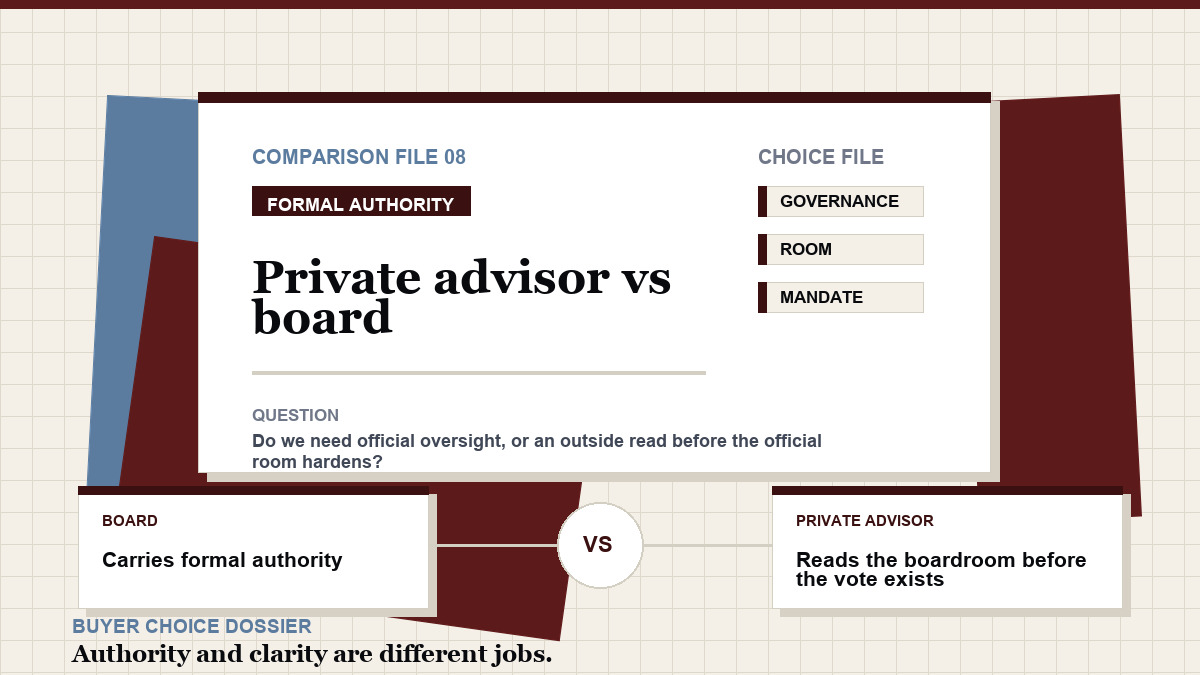
Use a board for governance, oversight, and fiduciary control. Use a business coach for decisions a board has no time or vocabulary for. A board governs the company. A business coach pressure-tests the founder.
A board exists to govern, oversee, and protect the interests of shareholders. A business coach exists to review the founder and the team before the decision lands at the board meeting. Both are necessary on consequential decisions. They are built for different positions in the same conversation.
When the board is the right setting
Decisions with shareholder consequences. Capital events, compensation philosophy, audit oversight, executive succession. The board has the legal authority and the structural standing to govern these. Business coaching cannot replace a fiduciary body.
The decision must be formally approved. Material transactions, equity issuances, debt above threshold, related-party agreements. The work happens in the boardroom under the operating agreement or bylaws. Coaching can prepare the question; the board decides.
The audience for the decision is external. Investors, regulators, future buyers reviewing the company’s governance pattern. The board is the visible signal. Business coaching tests exist before the board reviews happen.
Stakeholders disagree at the ownership level. Family-business splits, partner buyouts, succession ambiguity. A well-composed board with the right outside directors holds these conversations. Business coaching can surface what each principal needs from the conversation; the board mediates.
When a business coach is the right call
The decision has not yet been framed. A board reviews what is presented. If the founder presents the wrong question, the board approves the wrong answer. Coaching sits upstream of the boardroom: surface what the actual decision is before it gets briefed up.
The founder is alone with the question. Even a strong board cannot review what the founder has not yet been able to name. The business coach pressure-tests the founder one-on-one in the gap before the boardroom hears any of it.
The decision moves faster than board cadence allows. Boards meet quarterly, sometimes monthly. A consequential decision often needs structural reviewing inside a week. The business coach is reachable; the board is scheduled.
The board needs renewal or restructure. When the question is who should be ON the board, the board cannot answer it cleanly. The business coach pressure-tests what coverage and composition the operating reality requires. The work lands in the boardroom afterward.
The structural difference
| A board of directors | A business coach | |
|---|---|---|
| Authority | Fiduciary. Legal authority over consequential decisions per bylaws. | None. Reviews, names, and surfaces. Principals decide. |
| Position relative to the decision | Receives the decision in a presented form. Decides on it. | Sits with the decision before it is framed. Helps frame it. |
| Cadence | Scheduled. Quarterly to monthly. Special meetings called for material events. | Per-decision (Business Coaching) or recurring twice-monthly (Ongoing Coaching). Reachable between. |
| Composition | Multiple directors, often with mandated independent seats. Mixed expertise. | One person. Continuity across the engagement. |
| Confidentiality | Inside the company’s governance perimeter. Subject to disclosure rules. | Strict one-on-one or one-setting confidentiality. No legal disclosure obligations. |
| What the founder gets | Oversight, governance, multi-perspective challenge. | A reviewing partner before the boardroom and during the gaps between. |
| Best use | Govern, approve, oversee, mediate at the ownership level. | Frame the decision before it lands at the board meeting. |
The board is the right setting
Material transaction. The board has authority and oversight obligations. The work is the board's. Advisor preparation might inform the brief; approval lives at the board.
Business coach is the right move
Specific live review. No fiduciary body can review its own posture. Business problems is the path; the work is structural and pre-board.
Both, in sequence
Business coaching tests what the deal does to the operator, the ownership split, and the next ten years of optionality, before the boardroom presentation. Board approves the decision after the framing is correct. Wrong sequence (board first, advisor after) ends with the founder defending a deal they have not actually evaluated. Business coaching often shows up nearby.
A strong founder relationship typically includes both. Business coaching sits one-on-one with the founder before the board sees a thing. The board governs, approves, and challenges. Used in sequence they multiply each other. Used in place of each other they fail in opposite directions: the board approves an unframed decision, or coaching tries to substitute for fiduciary oversight. When the team itself is the work, see boards and teams.
Run the work yourself first
Apply for business coaching
Stan reviews each request for fit. All corporate work starts with an inquiry and is quoted separately. Stan confirms the people, stakes, scope, and fee in writing before work starts.
ApplyBusiness coaching · $1,500/month 1:1 business work · Request scope
