Glossary

Approval Matrix

An approval matrix is a structured grid that defines who can approve which decisions, at what threshold, and with whose input or consent.

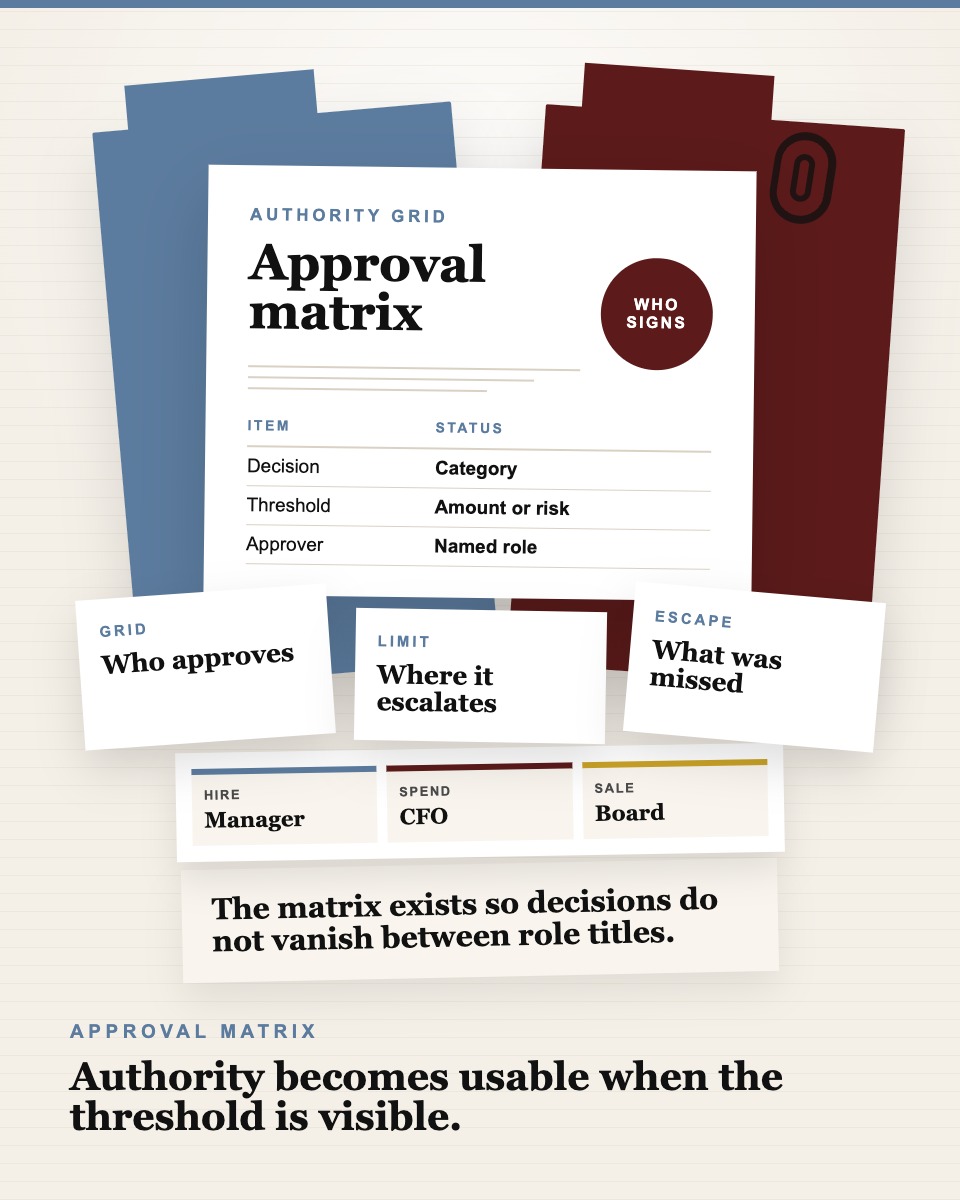
Governance table visual showing an approval matrix grid, decision category columns, and authority threshold rows.
Reference layer. Mechanisms under pressure.

Plain definition

What it means.

An approval matrix is a documented grid that maps decision categories to authority thresholds. It defines who can approve a decision unilaterally, who must be consulted, who must consent, and at what dollar value, scope, or risk level the next level of approval engages.

Approval matrices typically organize by decision category (capital expenditure, hiring, contracts, vendor commitments, customer pricing) and by threshold (under $X manager approves, over $X requires VP, over $Y requires CEO and board). The matrix is most often created during a finance or operations maturity push and lives inside the operating manual or board-approved policy.

An approval matrix is the document that decides which decisions belong to which seat. Without it, decisions default to the room with the most pressure or the loudest voice.

What goes wrong

The failure pattern this term exists to prevent.

The matrix nobody actually used

The approval matrix exists in a finance policy document. Operating teams have not seen it. Decisions get made on calls, in chats, and in informal approvals. The matrix shapes nothing about how decisions actually move. When something goes wrong, the matrix is invoked retroactively, usually unfavorably.

The threshold that became the workaround

The matrix says approvals over $50K require VP sign-off. Operating teams structure spending in $49K increments. The threshold is technically respected. The intent of the matrix is not. Aggregate spending escapes the oversight the threshold was designed to create.

The matrix that fossilized

The approval matrix was set when the company was at twenty employees. The company is now at two hundred. The thresholds have not changed. Decisions that should be made at the operating level still require executive approval. Decisions the matrix never anticipated have no defined path.

The exception that became the rule

A specific decision once required CEO approval as an exception. Over time, the exception became a recurring decision pattern. Each instance still goes to the CEO. The matrix never updated. The CEO has become a permanent approval bottleneck for a decision that should be delegated.

Founder questions

The questions people actually ask.

What does an approval matrix actually contain? An approval matrix typically contains decision categories, dollar or scope thresholds, and the role required to approve at each threshold. It may also identify who must be consulted before approval and who must be informed after. Categories often include capital expenditure, hiring, contracts, pricing, and material commitments.
How is an approval matrix different from a delegation of authority? A delegation of authority defines who has the underlying right to make decisions on behalf of the company. An approval matrix is the specific operating expression of that delegation, with thresholds and category-by-category mapping. The two work together but serve different purposes.
When should an approval matrix be updated? Annually as part of operating planning, after significant org changes, after material growth in revenue or headcount, when new decision categories emerge, or when the existing matrix is producing visible bottlenecks or routine workarounds. The matrix should reflect operating reality, not aspirational structure.
How is the approval matrix enforced in actual operating decisions? Enforcement typically runs through procurement systems, contract management tools, finance review, and policy. The matrix is most effective when its thresholds match real workflows and when teams have been trained to use it. It is least effective when it sits in a policy document nobody has read since onboarding.

If your approval matrix is missing, fossilized, or quietly being worked around, that is a different conversation.

Bring the current matrix, the org chart, and a sample of recent decisions where the routing was unclear.