
Compare ways to work
Coaching or interim leadership?
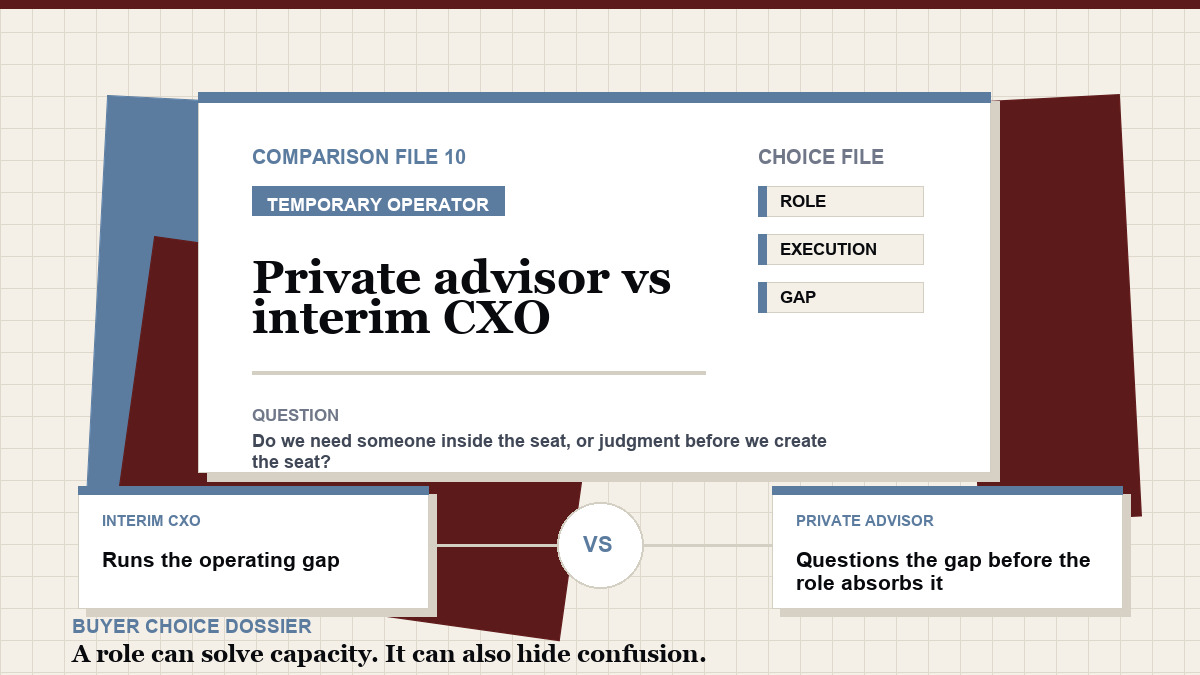
An interim executive takes responsibility for an agreed temporary operating role. Coaching or advisory supports the person leading the work while the company keeps operating authority.
Compare the contribution needed, the decisions involved and the time required. Some situations benefit from both.
Support for the person leading
Coaching or advisory can help a leader examine choices, challenge assumptions and decide what to do next. The leader remains responsible for the decisions and action.
Useful questions include: What is the choice? What evidence would change it? Who needs to act? What is making that difficult?
Responsibility inside the company
An interim executive fills an agreed operating role for a period or assignment. The mandate should specify authority, availability, reporting and the work to be carried through.
The role can include investigating the situation and refining the mandate. It does not require every question to have been settled beforehand. BTG's interim-executive overview describes both vacancies and special initiatives.
Compare the mandate
| Agree this | Coaching or advisory | Interim executive |
|---|---|---|
| Work | Support the leader's thinking and action on agreed questions. | Carry out the agreed responsibilities of the operating role. |
| Authority | The company and its leaders retain operating decisions. | Authority is delegated and documented for the role. |
| Access | Information and participants needed for the agreed support. | People, systems and information needed to perform the role. |
| Availability | A frequency and format suited to the relationship. | Time and presence sufficient for the mandate. |
| Review | Consider whether the support is useful and what should change. | Review operating work, responsibilities and handover. |
Two different situations
Illustrative decision aid
A department has no leader. Staff need decisions about priorities, spending and people. The company may need interim operating responsibility while it resolves the vacancy. Specify the reporting line, decisions delegated, access required and handover.
A capable leader needs outside thinking. The leader is in place and can act, but wants help considering an expansion or changing how the team works. Coaching or advisory may provide the contribution required without transferring the operating role.
Neither sequence is compulsory. The company can obtain outside support while an interim executive is already working.
Before choosing
- What work needs to be done, and who currently owns it?
- Does the outside person need authority to act or a role helping someone else decide?
- What access and availability would make the contribution useful?
- What fee, term and review arrangements fit the actual scope?
- How will responsibility be handed back or carried forward?
Scope your own project can help turn these questions into a working brief. Fractional leadership explains the separate question of part-time responsibility.
Work with Stan
Stan's one-to-one relationship is $1,500/month, every two weeks and month to month. All corporate work starts with an inquiry and is quoted separately.
See ways to work, compare support for the leadership group, or read what to include when discussing an operating role with Stan.