AI-for-X · interim CXOs
An interim is hired for speed under pressure. Speed is the surface where AI both pays the most and harms the most. This manual draws the line for interim CFOs, COOs, CROs, and CMOs: where AI compresses the review-in, where it ships back-office artifacts, and where the seat itself stays human because accountability is the asset.
Read the scope Founder-held function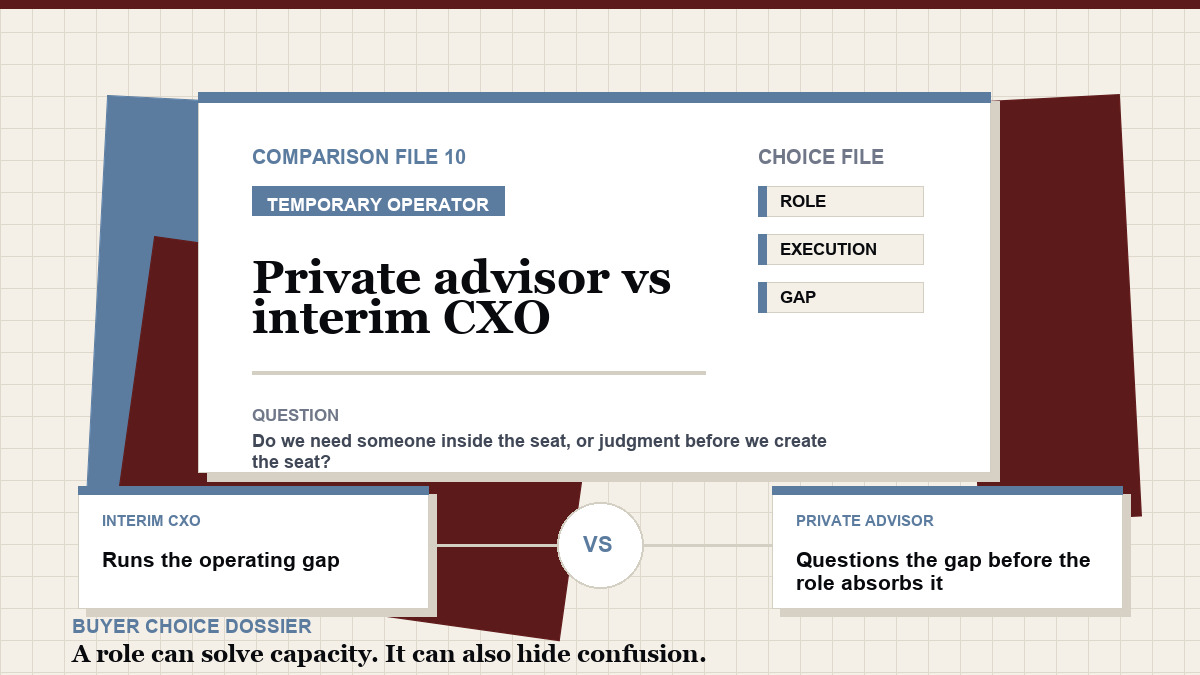
What this work actually is
AI for interim CXOs is the deliberate use of LLMs on the review-in (twelve months of artifacts in three days), artifact production (forecasts, decks, briefings), decision drafting from your notes, stakeholder communications, and the handover document. It runs in the client's tenant or yours under the engagement letter.
The hard floor is client confidence, accountability for the seat's decisions, and the time-pressure failure mode in which fluent-and-wrong output costs the engagement. Workflows that respect the floor compress months into weeks. Workflows that do not get the interim quietly removed at week six.
An interim sells decisive action. A hallucinated assumption shipped at week three is a credibility loss the rest of the mandate cannot recover.
The scope
What changes when this is done well
What you need before you start
01 · AI clause in the engagement letter
Plain English, signed by the client, filed with the engagement letter. Without it, every workflow risk falls back on you.
02 · Tenanted model on the client's terms
Default to the client's tenant if they have one; if not, your tenant under a no-train clause and a data-processing addendum.
03 · A redaction discipline
Even on the tenant. The discipline survives a vendor change and protects you when the engagement ends.
04 · A function voice file
Plus your house tone. Loaded into every drafting brief so the artifacts review as if a serious operator wrote them, because you did, with assist.
05 · A handover-from-day-one rule
The handover is not a week-twelve scramble. It is the byproduct of every workflow run from day one.
The split workflow
Human owns
The first week is the team. AI does not enter. You learn the people, the politics, the unsaid.
AI assists
Board packs, P&L history, key contracts, prior strategy decks, recent investigations. AI produces a four-page business coaching draft. You review, edit, and add the things only the team could surface.
Human owns
What is broken, what is salvageable, what the next leader inherits. Owned by the interim, signed at the end of week three.
AI assists
A first-pass document with candidate findings, candidate main constraints, candidate priorities. The interim challenges every line.
Human owns
Weekly forecasts, monthly close, quarterly board. You sign every output. AI does not.
AI assists
Variance analysis, formula audits, scenario builds. The interim reviews and signs. Used to keep the cadence on time when the team is stretched.
Human owns
Hire, fire, pivot, kill the project, change the supplier. Interim's name on each.
AI assists
You give five lines; AI returns the structured option memo with stress-tests. You edit, decide, sign. Document filed in the handover folder.
Human owns
You walk in. You speak. You answer the questions. AI does not present.
AI assists
Slide outline from your bullets, ghost slides, executive summary first pass, the toughest twenty questions. You walk in prepared.
Human owns
The conversation with the next leader. The decision on what stays, what changes, what the unfinished list is. Owned by the interim.
AI assists
Pull the findings, the decisions log, the artifacts archive, the open items into a ten-page structured document. The interim writes the cover memo and signs.
How to know AI is hurting the engagement
A finding was wrong and the team noticed.
A hallucination got past your review. Repair the document, name the failure to the CEO yourself, tighten the review-in verification rule before week four.
Client material went into a non-tenanted model.
A confidentiality breach. Disclose to the CEO per the engagement letter; review with risk counsel; tighten the workflow.
A decision memo review like it was written by a model.
Voice file slipped or the edit pass was skipped under time pressure. Rewrite the memo in your voice; restore the edit-pass rule.
The handover document is being assembled in week eleven.
The handover-from-day-one rule failed. Restore it for the next mandate; for this one, schedule extra hours and accept the cost.
A board figure was ahead of the latest reforecast because AI carried over an old assumption.
The model audit is not catching version drift. Tighten the audit checklist; never present off a number you have not personally regenerated.
The CEO asked whether AI is in the workflow and you could not answer cleanly.
The engagement-letter clause is too vague. Rewrite, get re-signed, and walk through the workflow log on the next steerco.
Tools and tactics
The brain is the seat's audit trail and the next leader's onboarding kit. Built so the engagement is defensible after you leave.
One folder per mandate. Engagement letter and AI clause pinned at the top. Review-in archive. Business coaching. Decisions log inline. Weekly artifact archive. Handover document built as you go. Personal AI policy filed with the client.
Documented in full inside the engagement · teaser here
Standing rule for the mandate: every finding traces to a named artifact and a named person who confirmed it. The verifier is the interim, not the model. Without it, week-three findings are credibility traps.
One row per consequential decision. Date, decision, option memo link, decision rationale, signer. Built as you go. Becomes the spine of the handover document. Becomes your audit trail when the engagement ends.
One folder, started on day one. Every artifact, every decision, every open item filed against the eventual handover. The handover document is assembled by selection, not by writing.
What this work is not
The throughput is on the review-in and the back office. The seat itself stays human because accountability is what the client is buying. The comparison page sets the structural difference between the seat and the review across from it.
Review advisor vs. interim CXO →When the mandate question is the wrong question
Stan reviews each request for fit. All corporate work starts with an inquiry and is quoted separately. Stan confirms the people, stakes, scope, and fee in writing before work starts.
Apply for business coachingWork with me · $1,500/month 1:1 business work · Request scope
