Manual 03 · AI in a coaching business
For executive, business, and life coaches building a real business. AI belongs in intake, session prep, follow-up assets, and the back office. It does not belong in the team. This is the seven-step manual for putting it where it pays and keeping it out of where it harms, with a second-brain stack tuned for a coaching business.
Open the process The self-coaching manual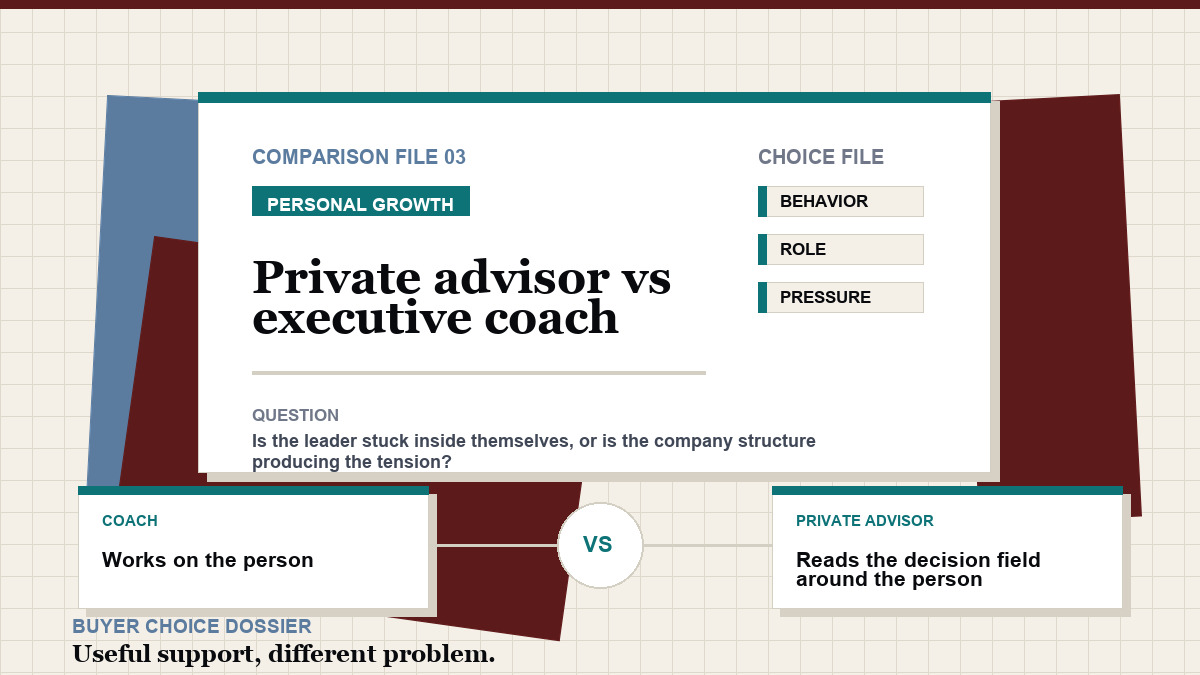
What this work actually is
AI for coaches is the deliberate use of LLMs on the work around the session, not inside it. Intake review, session prep, follow-up summaries, content production, scheduling, billing, content compliance, and the running second brain that holds the business.
The line that does not move: the live coaching session is not transcribed into an LLM, not summarized by an LLM, and not assisted by an LLM in the moment. The team is the work. AI helps everything that is not the team.
Most coaches reach for AI in the wrong place first. They try to use it in session, on the call, or as a real-time co-coach. The result is a worse session and a worse coach. The session degrades because the coach's attention is split. The coach degrades because the muscle that was supposed to grow inside the session was outsourced.
Used in the right places, AI gives a solo coach the operational throughput of a coach with two assistants. Intake forms get summarized in minutes. Session pre-reviews get drafted from prior notes. Follow-up assets ship same-day. The business can hold more clients without the work in the team getting thinner.
What you need before you start
01 · Disclosure clause
Add a clause to your engagement letter naming exactly which workflows use AI and which do not. Intake summaries, yes. Session content, no. Clients sign the disclosure before the first session. Without it, you are leaking trust you cannot recover later.
02 · A redacted-only rule
Initials only, role descriptors, redacted company names. The discipline is mechanical: if the prompt contains a name, the prompt is not sent. Hold this rule even on the paid enterprise tiers; the rule is for your business, not the vendor.
03 · A voice file you wrote yourself
Your tone, your standard turns of phrase, three sentences you would never write, and the lines you refuse to deliver. Loaded into every drafting prompt. Stops the LLM from collapsing your voice into a generic coach voice within three weeks.
04 · A separate workspace
Different login, different chat history, different billing. The business account holds the business second brain. The personal account holds your personal experiments. Mixing them is how voice leaks and how privacy slips.
05 · A weekly review slot
The review is non-negotiable. Review every AI-drafted asset that went to a client this week. Note where the voice slipped, where the pattern over-generalized, where you would have said it differently. Feed the corrections back into the voice file.
The full process
Client fills the intake form. You paste the redacted version into a fixed brief: "Review this intake. Surface three contradictions in the client's framing, the question they are not asking, and the one fact I should re-confirm in the first session." You review the output, mark what you agree with, and walk into session one with a sharper review than you would have had alone.
Before each session, paste your own notes from the previous session into a fixed brief: "Summarize the last session in five bullets. Surface the open thread the client did not close. Predict the question they will arrive with." You review it for thirty seconds before the call. The pre-brief holds continuity that a busy week tends to erode.
No transcription tool, no co-pilot, no real-time AI summarizer. The session is between you and the client. The reason is not technical; it is structural. The coaching offer that is half-watching an AI panel is not coaching. Hold this line even when the tooling makes it easy to break.
You write your own notes. Five minutes. Then you paste the redacted notes into a fixed brief: "Draft a follow-up email in my voice, three paragraphs, capturing the commitments the client made and the one open question for next session." You edit it. It ships before the end of the day. The follow-up that used to take forty minutes now takes ten.
Worksheets, frameworks, between-session prompts, light reviewing. AI drafts. You edit. You ship. The voice file is the leash that keeps these in your tone. Without the voice file, every coach's between-session asset starts looking the same after three months.
Long-form posts, newsletter drafts, podcast outlines. AI drafts from a voice file and a content brief. You edit hard. Anything that goes out under your name reflects how you actually think; if it does not, the throughput is producing the wrong volume of the wrong content.
Scheduling, invoicing, contract triage, tax prep, expense categorization, vendor admin. The cleanest fit for AI in the back office. Build templates and scripts that handle the routine cases; you handle exceptions. The hour a week reclaimed here pays for the rest of the stack.
How to know AI is hurting your business
Two long-time clients say your follow-ups feel different.
They are reviewing the voice slip before you are. Pull the last six follow-ups, compare them to follow-ups from before the AI workflow, and rebuild the voice file from the older ones.
You cannot remember what was said in the last session without re-reviewing the AI summary.
The summary is replacing your memory of the team. The fix is to write your own notes first, then run the AI summary against your notes, not the other way around.
Your content output tripled and your engagement halved.
Volume without voice produces churn. Slow the production cadence and tighten the voice file before you push more out.
A client name appeared in a chat without redaction.
The redacted-only rule failed once. Treat it as the warning shot. Re-write the rule onto the prompt template so the friction is mechanical, not memory-based.
Sessions are getting shorter and follow-ups are getting longer.
The throughput is moving the work in the wrong direction. The work is in the team. If follow-ups are doing the work the team should have done, the AI is masking a session quality issue.
You disclosed AI use to clients and the conversation got short.
Either the disclosure was buried and they only just noticed, or the workflows are over the line for that client. Listen carefully and change the workflow before you change the disclosure.
Tools and tactics
Same principle as the operator second brain. Different shape. Built to hold a roster of long-term relationships without leaking what each one trusted you with.
One file per client, redacted at the source. The voice file pinned at the top of every drafting workflow. Named brief blocks for intake review, session pre-brief, follow-up draft, asset draft, content draft. Weekly review block on Friday afternoon, monthly voice-file refresh, quarterly client-file audit.
Documented in full inside the engagement · teaser here
One page. How you write, three sentences you would never say, three turns of phrase you reach for, the line you refuse to deliver. Loaded as the system prompt for every drafting workflow. The single most load-bearing artifact in the stack.
A short script or text-replacement that strips client names, company names, and identifiers from any text before it reaches the chat box. Built once, used forever. Removes the "did I redact?" friction that is the actual reason the rule eventually breaks.
One paragraph in your engagement letter. Names which workflows use AI, names which do not, and gives the client the right to opt out of any AI-touched workflow. Versioned. Re-issued when workflows change. Kept in the second brain alongside the contract.
What this work is not
This page makes you a sharper business. It does not make AI a coach. The team is the coach's work; everything around the team is where the throughput lives. The comparison page sets the structural difference for the buyer.
Review advisor vs. coach →When the business question is the wrong question
Stan reviews each request for fit. All corporate work starts with an inquiry and is quoted separately. Stan confirms the people, stakes, scope, and fee in writing before work starts. Coaches building a business past the solo ceiling are a recurring engagement category.
Apply for business coachingWork with me · $1,500/month 1:1 business work · Request scope
