AI-for-X · consultants
A consultant is paid for a methodology, a perspective, and a written review. AI flattens the methodology if you let it. Used right, it triples the throughput on the desk research and the deck mechanics, and leaves the methodology and the review where they belong: with you.
Read the scope Scope your own project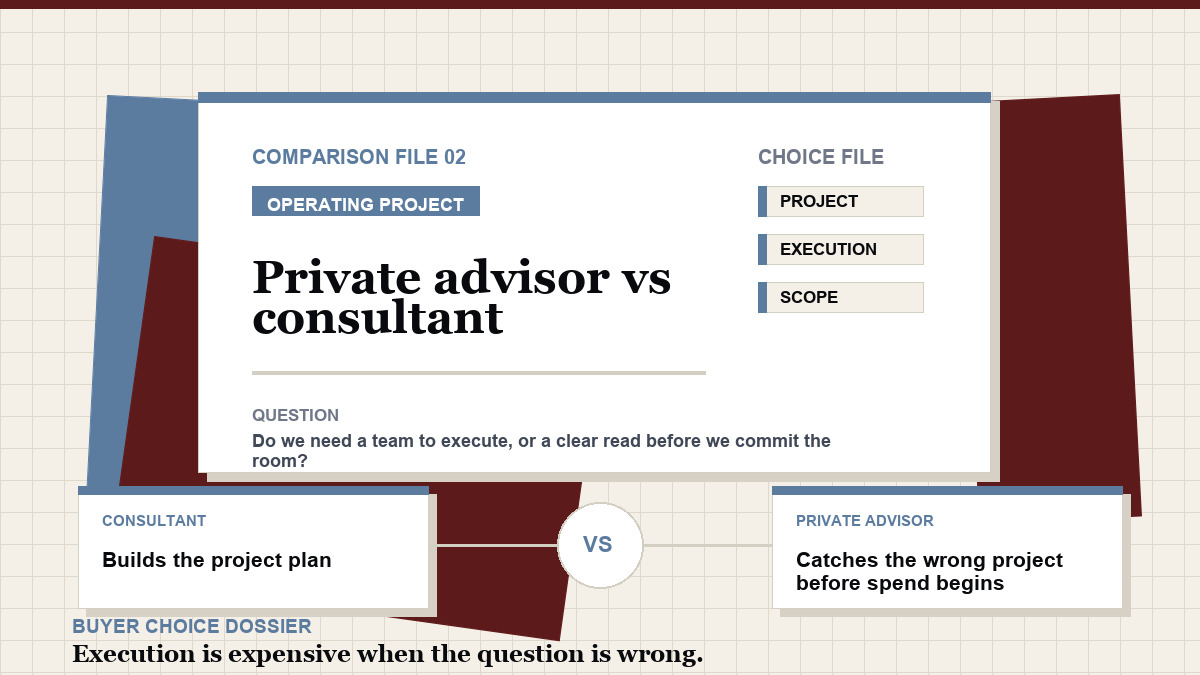
What this work actually is
AI for consultants is the deliberate use of LLMs on the back-of-house: secondary research, hypothesis dev, deck production mechanics, model sanity checks, internal synthesis. The methodology, the review on the team, and the deliverable that earns the next engagement stay with the consultant.
The line that does not move: client-proprietary data does not enter shared models, methodology IP does not get diffused into a public training set, and the deliverable's perspective is not generated, only assisted.
If the deck could have been written by any consultant, the model wrote it. That is the failure case.
The scope
What changes when this is done well
What you need before you start
01 · A written methodology you control
Your methodology is the asset. If it lives only as a system prompt in a shared chat, you are training the next consultant against you. Keep it offline; load it locally per engagement only.
02 · Enterprise-tier model with no-train terms
Review the actual terms. Default to vendors that contractually do not train on inputs and offer a tenant you control.
03 · A redacted-only rule
Initials only, role descriptors, anonymized financials. Even on the paid tier. The rule survives vendor changes.
04 · A voice file
Your phrases, your structure, the lines you do not use. Loaded into every drafting brief. Stops the deliverable from collapsing into a generic consulting voice.
05 · A disclosure clause in the engagement letter
Plain English. Specific workflow names. Opt-out mechanics. Drafted with risk counsel and versioned with the firm policy.
The split workflow
Human owns
From the brief, the kickoff, the team. Owned by the consultant before any prompt is written.
AI assists
From your initial framing, the model generates a wider hypothesis tree to pressure-test against. You prune; you do not adopt.
Human owns
Adapted to the client, the stage, the politics. Your review; not in the prompt.
AI assists
Public sources, framings, candidate competitors, regulatory context. Treated as raw material, not citations.
Human owns
Structure, drivers, assumptions, scenario logic. Owned by the consultant; the model carries the engagement's argument.
AI assists
Review the spreadsheet, flag inconsistencies, propose alternative assumptions, surface where the model breaks. Sanity check, not source of truth.
Human owns
The team is the work. AI is not in the workshop, not transcribed by a third-party tool without consent, not summarizing in real time.
AI assists
You write your own notes first. AI synthesizes against the methodology and surfaces the items you flagged for follow-up.
Human owns
The slide that makes the case. The paragraph the partner reviews. Always you.
AI assists
Outline, slide trackers, draft text from your bullets, formatting cleanup, executive summary first pass.
Human owns
Your name on the deck is your professional warranty. AI does not recommend, deliver, or sign.
AI assists
From the deck, generate the toughest twenty questions and the fragile pages. You walk in prepared instead of surprised.
How to know AI is hurting the firm
A client recognized your deck shape from another consultant's deck.
The methodology has flattened. Pull the voice file, audit the last three engagements, restore the structures that are yours.
Client material went into a non-enterprise model.
Disclose to the client per the engagement letter. Audit the leak. Tighten the redaction macro. Update training.
A research finding in the deck cannot be traced to a real source.
A hallucinated stat or quote made it through. Pull the deck, repair the slide, name the failure in the engagement log so it does not repeat.
Two engagements in a row, the recommendation feels formulaic.
The model is generating the conclusion and you are editing it. Reverse the flow: write the recommendation first, ask AI for the strongest counter, then revise.
A junior is shipping synthesis without a senior review.
Supervision has slipped. Restore the senior-on-every-output rule for the next quarter and audit the gap.
The voice file has not been refreshed in six months.
The leash is decaying. Every engagement teaches you something new about how you actually write; the file should track that.
Tools and tactics
The methodology is the asset. The brain protects it, files it, and reuses it without diffusing it.
One folder per engagement, redacted at the source. Methodology library kept locally, loaded per engagement only. Voice file pinned to every drafting brief. Five named brief blocks: research, hypothesis-tree, deck mechanics, model audit, post-workshop synthesis. Engagement log captures every AI-touched workflow with output and verifier.
Documented in full inside the engagement · teaser here
Your frameworks, in a folder you control. Loaded per engagement as a system prompt with a one-time tenant. Never in a shared library. Never as a saved system prompt outside your tenant. The vault is your professional moat.
Find-and-replace template tied to your client roster. Strips names, company names, and identifiers before any paste. Built once, used forever. Removes the friction that breaks the redaction rule.
Standing brief that takes a deck or memo and generates the toughest twenty questions, the slides most likely to be challenged, and the chart most likely to be misread. Used the night before every steerco.
What this work is not
If the client needs a methodology that is not yours, that is a different consultant. If the client needs neutrality, that is a firm. The comparison page sets the structural difference.
Review advisor vs. consultant →When the throughput question is the wrong question
Stan reviews each request for fit. All corporate work starts with an inquiry and is quoted separately. Stan confirms the people, stakes, scope, and fee in writing before work starts.
Apply for business coachingWork with me · $1,500/month 1:1 business work · Request scope
