Product · active
You have spent years thinking about the number. You have spent almost no time on the morning after you hit it, when the company is no longer yours and the calendar is suddenly empty. That gap is where seller's remorse lives, and it is the most common regret among owners who got the price they wanted. This pack makes you write the day after, in detail, at three months, one year, and three years, before you let anyone start the deal.
Apply for business coaching Read the manual it comes from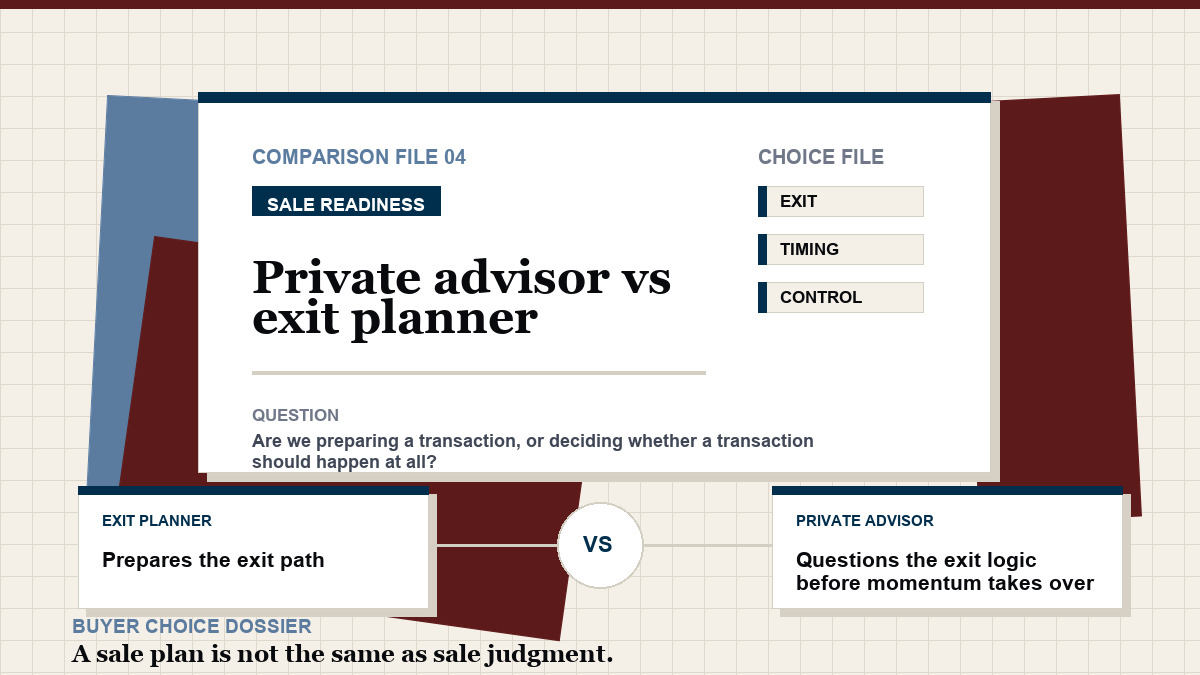
The problem you actually have
Every conversation about your exit has been about the number, the multiple, the structure, the tax. All deal. None of it has been about the Tuesday three months after close, when there is no team to lead, no fire to put out, and the thing that organized your identity for fifteen years is gone. Owners who never plan that Tuesday are the ones who buy a worse business out of boredom, blow up the earn-out by refusing to let go, or quietly wish they had never sold.
The planner cannot fix this. Their job ends at the wire transfer. What you want on the other side, and whether the deal you are chasing actually delivers it, is pre-work only you can do, and almost no one does it until it is too late to shape the deal around the answer.
The deal is the easy part to plan. The day after is the part that decides whether you got it right.
This pack forces the work while you still have 18 to 36 months to act on what you learn. You write what the day after looks like, you test whether the deal you want actually produces it, and you change the deal, or yourself, while there is still time.
Who it is for, and who it is not
You are 18 to 36 months from a serious exit conversation. The business is a real one with real value. You have thought hard about the price and almost nothing about what you do on the other side, or whether the people closest to you are ready for the version of you that comes after the sale.
Why this, and not the planner's intake questionnaire
A good exit planner will hand you a thorough questionnaire. It is built to engineer the transaction: your number, your timeline, your structure preferences. It is not built to find out whether the life on the other side of that transaction is one you actually want, because that is not the planner's job and not where their fee comes from.
This pack starts from the opposite end. It works backward from the life to the deal.
Difference 01
Not a vague vision. The day three months after, one year after, three years after, in concrete detail: what you do, who you see, what you have stopped being. Specific dates force specific answers, and the specific answers are where the surprises live.
Difference 02
Once the day-after is on paper, you check the deal you are chasing against it. A three-year earn-out that keeps you running the company is a different thing once you have written that you wanted to be gone in six months. The pack catches that conflict while you can still change the deal.
Difference 03
The spouse-and-partner check is built in, because the person who shares your life and the person who shares your ownership split both live in the day-after too. Most exit regret that looks financial is actually a conversation that never happened. This makes it happen 18 months early, not the week of signing.
What is inside
One folder. Three versions of the same document written at three time horizons, plus the protocol for the conversation with your spouse and your partners. You write them in order, because the three-month answer and the three-year answer are rarely the same person, and the gap between them is the finding.
day-after/
  three-months   # the first morning. honeymoon, or the void you did not expect
  one-year       # past the novelty. what actually fills the week
  three-years    # the long view. who you have become without the company
  spouse-check   # the protocol for the conversation you keep postponing
  deal-test      # hold the deal you want against the life you wrote
Three mornings, one hard conversation, one test. Written 18 months early, while you can still act on them.
The first morning after close, in detail. For some owners this is relief. For many it is the void nobody warned them about. Writing it now tells you which one you are, while there is time to build something to land in.
Past the novelty of having time. What actually fills your week when the company is no longer the answer. This is where you find out whether you were running toward a life or just away from a job.
The long view. Who you have become with the company three years behind you. This one surfaces the identity question the deal will not answer, the one that decides whether you stay sold or claw your way back in.
The protocol for the conversation you keep postponing. Your spouse has a day-after too, and so does every partner on the ownership split. The pack walks you through having those conversations now, in calm, instead of in the pressure of a live deal.
You hold the deal you are chasing against the three documents. Earn-out length, role post-close, timeline. Where the deal and the life conflict, you have months to change one of them. That is the whole payoff of doing this early.
Illustrative review
Say you have been chasing the highest number, and the highest number comes with a three-year earn-out that keeps you running the company. Walk the pack.
Travel, rest, time with family. Easy to write, and the earn-out does not bother you yet, because you are picturing a break, not a job.
You try to write the year and realize that under the earn-out you are still in the chair, running someone else's company by their rules, with your name on results you no longer fully control. The document you wanted to write and the deal you are chasing do not match.
The conversation surfaces that your spouse was counting on you being out, not on three more years of you running a company you no longer own. Better to learn that now than in year one of the earn-out.
You decide a slightly lower number with a clean break beats the top number with three years of strings. You have 18 months to make the business sellable on those terms, which is exactly the de-keying work the manual covers next. The pack changed the deal before the deal existed.
Without the pack, you chase the top number, hit it, and discover the conflict in month one of the earn-out, when it is far too late and far too expensive to fix.
What you walk away with
The biggest return is time. Done 18 to 36 months out, the day-after document does not just prepare you emotionally, it changes what deal you build toward and what you do to the business to make that deal possible. Owners who write it early exit into a life they chose. Owners who skip it exit into whatever the deal happened to leave them.
Seller's remorse is rarely about price. It is about the empty Tuesday nobody planned. Writing it in advance is the cheapest insurance against it there is.
The one-year document quietly answers whether you want a life after the company or just an escape from it. Those lead to very different deals.
Your spouse and partners get to shape the day-after too, early, which prevents the late conversation that derails more deals than any term sheet.
How you grow it
Month one
Skip ahead to the one-year version. It is the most revealing, because it is past the holiday and into the real question. One honest page here usually changes how seriously you take the rest.
Quarter one
Fill in the three-month and three-year documents, then hold your target deal against them. Most owners find one real conflict in the first pass. That conflict is your pre-work agenda.
Within six months
Use the protocol while there is no deal pressure. The calm version of this conversation is worth ten of the version that happens the week a term sheet lands.
Then
Where the deal you now want needs a business that runs without you, that is the De-Keying Roadmap. The day-after document tells you what to build toward; de-keying builds it.
Discuss these separately with the people whose plans are affected. A spouse’s expectations and an owner’s contractual rights are different questions; do not treat this worksheet as agreement to a sale.
Write each person’s answer in their own words. Finish with agreed points, open differences and a next conversation date. Do not record silence as agreement.
Use it now
Use the day-after documents to force the life-after-exit question into the deal before price and momentum narrow the decision.
Write the one-year document, the day-after document, the spouse-and-partner read, and the deal test from the structures on this page. Keep the answers concrete enough to challenge a transaction.
Use the page for the pre-work. Use coaching when the deal conflicts with the owner's role, obligations, or life after closing.
What this is not
This pack makes sure the person signing knows what they are signing into. It does not value the business, structure the deal, run diligence, or negotiate terms. That is the exit planner, the banker, and the lawyer, and you will still need all three. The pack makes you the owner who can brief them well and sign without regret. The manual names that line, and the coaching is where the owner-side judgment gets pressure-tested.
Back to the manual →When the work is live
Stan reviews each request for fit. All corporate work starts with an inquiry and is quoted separately. Stan confirms the people, stakes, scope, and fee in writing before work starts. The page provides the pre-work structure; an engagement reviews the live exit decision.
Apply for business coachingWork with me · $1,500/month 1:1 business work · Request scope
