Product · active
Draft and challenge prompts for strategy, board preparation, term sheets, supplier quotes and a business-sale conversation. Each comes with a worked illustration.
Download prompt guide (PDF) Read the manual it comes from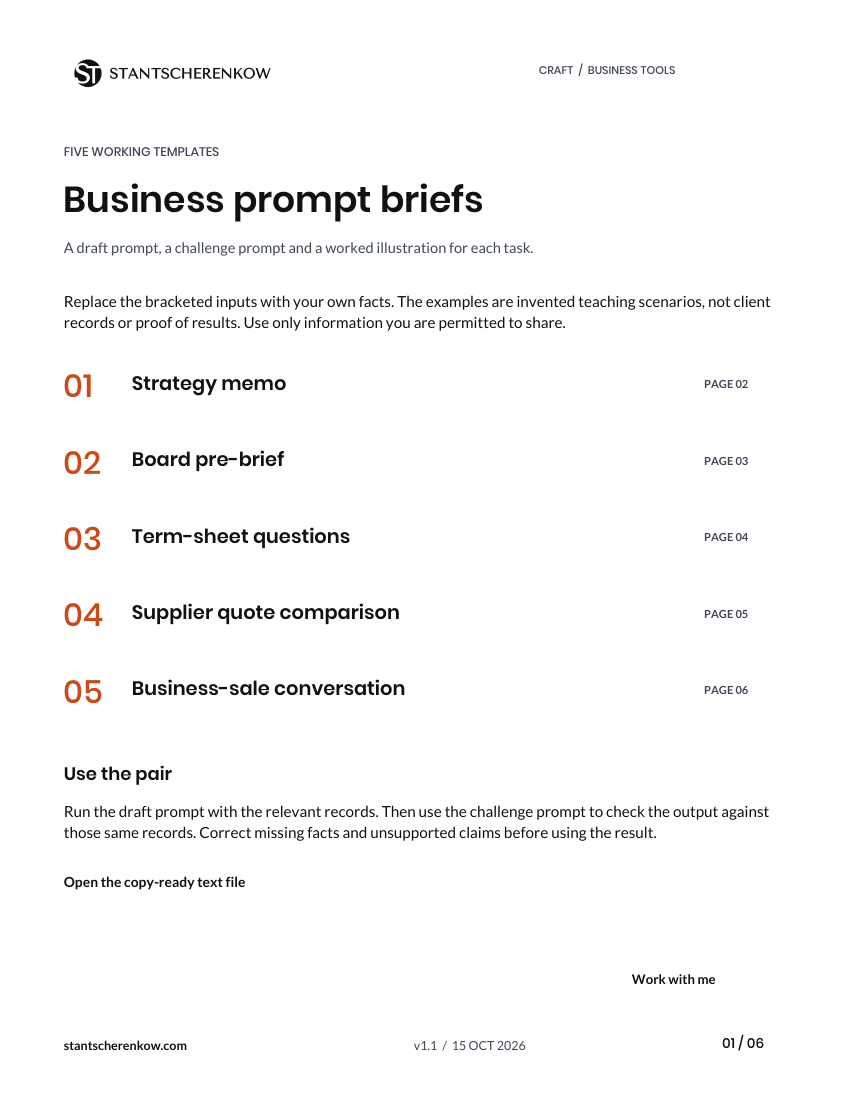
Jump to the five copyable briefs and worked examples. No signup is required.
Choose the smallest brief that fits the work. A saved prompt can preserve the format and boundaries, but it cannot keep prices, contracts, business facts or permissions current.
Run the draft prompt first. Then give the challenge prompt the same source material and the draft. Check the answer yourself against the records. A model checking another model is not independent evidence.
Version 1.1, October 15, 2026. Replace the bracketed inputs. The examples below are invented teaching scenarios, not client records or proof of results. Use only information you are permitted to share.
Download the six-page guide (PDF)
Download all five briefs (TXT) for copying into your AI tool. The PDF includes the same prompts and examples, with links to each brief.
Help draft a one-page business memo. Audience: the owner deciding [decision] by [date]. Use only the facts I supply below. List the decision, available facts and their dates, options including waiting, costs and constraints, unresolved questions, and one proposed next step. Separate fact from assumption. If a missing fact could change the choice, ask for it before recommending. Do not invent demand, customers, savings or outcomes. Inputs: [situation, source facts, options, limits].
Review the memo against the supplied facts. Which option was dismissed without evidence? Which assumption changes the recommendation if false? Identify invented numbers, missing sources and irreversible commitments. Return the specific sentence to fix and the evidence needed. Do not reward confident wording.
Illustrative input: five buyers asked for a smaller $200 workshop; none has paid. Preparing it takes six hours. An existing service costs $1,500.
Example output: Test a paid reservation before preparing the workshop. Five requests establish interest, not five sales. The effect on the existing service remains unknown.
Verdict: Usable as a test proposal after the owner confirms capacity. Not evidence of validated demand.
Draft a pre-meeting note for [board or owners]. The decision is [decision], with authority held by [person/body]. Use these supplied records: [records and dates]. Write: decision requested, current position, options, financial and operating consequences, relevant constraints, questions requiring specialist review, and the exact approval sought. Attach source labels to every number. Flag missing information; do not infer a vote, approval, legal duty or consensus.
Act as a reader checking the pre-brief, not as a director giving approval. Trace every number to an input. Name any result presented as certain, any missing alternative, and any question the stated decision authority has not answered. Return corrections before a recommendation.
Illustrative input: equipment quote $40,000; available cash $75,000; minimum operating cash $50,000; no financing agreed.
Example output: A cash purchase would leave $35,000 before other receipts or payments, $15,000 below the stated minimum. Ask for the payment schedule and a current cash forecast before approval.
Verdict: Arithmetic is checkable. Approval remains open; available cash is not a complete forecast.
Help prepare questions for qualified legal and financial advisers about this supplied term sheet: [text with clause numbers]. Make a plain-language issue list covering control, payment timing, obligations, exit rights and unresolved definitions. Quote the relevant clause before each question. Distinguish written terms from inference. Do not declare a clause standard, enforceable, safe or acceptable. If the full agreement or jurisdiction is missing, say so. End with unanswered questions for the advisers, not a recommendation to sign.
Check every quoted clause against the input. Identify an obligation the summary omitted, an undefined term it treated as settled, and any legal conclusion it is not entitled to make. Separate genuine ambiguity from missing source text.
Illustrative input: clause 4 says payment is subject to satisfactory due diligence; no deadline or satisfaction test is supplied.
Example output: Question for counsel: who determines satisfaction, by what criteria and by what date, and what happens if the parties disagree? The excerpt does not answer those questions.
Verdict: Useful question list. No legal conclusion or permission to sign.
Compare supplier quotes for [purchase] using only [supplied quotes]. List the same requirements for each: included work, quantities, price and currency, taxes or exclusions, delivery date, payment schedule, support and cancellation terms. Mark a missing item unknown rather than assuming it is included. Identify the questions needed to make the quotes comparable. Do not name a winner until required differences are resolved.
Check whether the lowest price excludes something another quote includes. Recalculate totals from the supplied quantities. Find any unmatched delivery, support or payment condition. Return the smallest follow-up question set that prevents a misleading comparison.
Illustrative input: A quotes $8,000 plus delivery; B quotes $8,600 including delivery. Neither quote gives A's delivery cost.
Example output: A is cheaper only if delivery is less than $600, assuming the remaining scope matches. Ask A for the delivered total and both suppliers for the same installation scope.
Verdict: Comparison remains incomplete. Do not claim a $600 saving.
Prepare an owner for a discussion about a possible business sale. Inputs: [owner goals, confirmed buyer request, known terms, non-negotiables, unknowns]. Draft an opening statement, questions about responsibilities and timing, points to take to legal/tax/transaction advisers, and a closing summary that records what is agreed and what remains open. Do not invent buyer motives, valuation, willingness to pay or a likely reaction. Label possible responses as possibilities, not predictions. Do not accept terms or draft binding commitments.
Find where the draft assumes the other side agrees, hides a conflict between price and the owner's intended role, or makes an unauthorized commitment. Check that the closing summary distinguishes discussion from agreement.
Illustrative input: owner wants to stop operating within six months; buyer asks for a three-year operating commitment; price is not agreed.
Example output: Opening: I want to understand whether there is a structure that fits a six-month handover. Your three-year operating request conflicts with that goal. Which responsibilities require that period, and what alternatives would you consider?
Verdict: Usable discussion opening after the owner checks the facts. No deal or outcome is implied.
Who it is for
If your week contains memos, owner reviews, supplier quotes, deal terms and sale discussions, these are the briefs that turn AI from a blank box into a junior who already knows the format. It assumes you have reviewed the manual and understand why the adversary and the verdict matter as much as the brief.
It is not for someone who wants a prompt for everything. Five briefs that you actually load beat five hundred you scroll past. The system is deliberately small.
Use it now
Use this page to understand the pattern, trigger, and owner-side decision before using coaching to examine the live operating facts.
The page gives you five briefs and the control pattern attached to each one: context, task, constraints, adversary, and verdict. Use the smallest brief that fits the work, then judge the result before it enters the business.
Use the briefs here for drafting and pressure-testing. Use coaching when the difficult part is the question, the stakes, or the final call.
What this is not
A strong brief gets you a faster, cleaner draft and a stress-test that catches the obvious failures. It does not tell you whether the memo is answering the right question, or whether the term you accepted is the one that costs you the company in three years. That review belongs to a person in the situation. The manual names the line; the coaching is where it gets crossed.
Back to the manual →When the work is live
Stan reviews each request for fit. All corporate work starts with an inquiry and is quoted separately. Stan confirms the people, stakes, scope, and fee in writing before work starts. The page provides the brief system; an engagement reviews its use on the live decision.
Apply for business coachingWork with me · $1,500/month 1:1 business work · Request scope
