Glossary

Business Judgment Rule

The business judgment rule is a legal doctrine that protects directors and officers from liability for decisions made in good faith, with reasonable diligence, and without conflict.

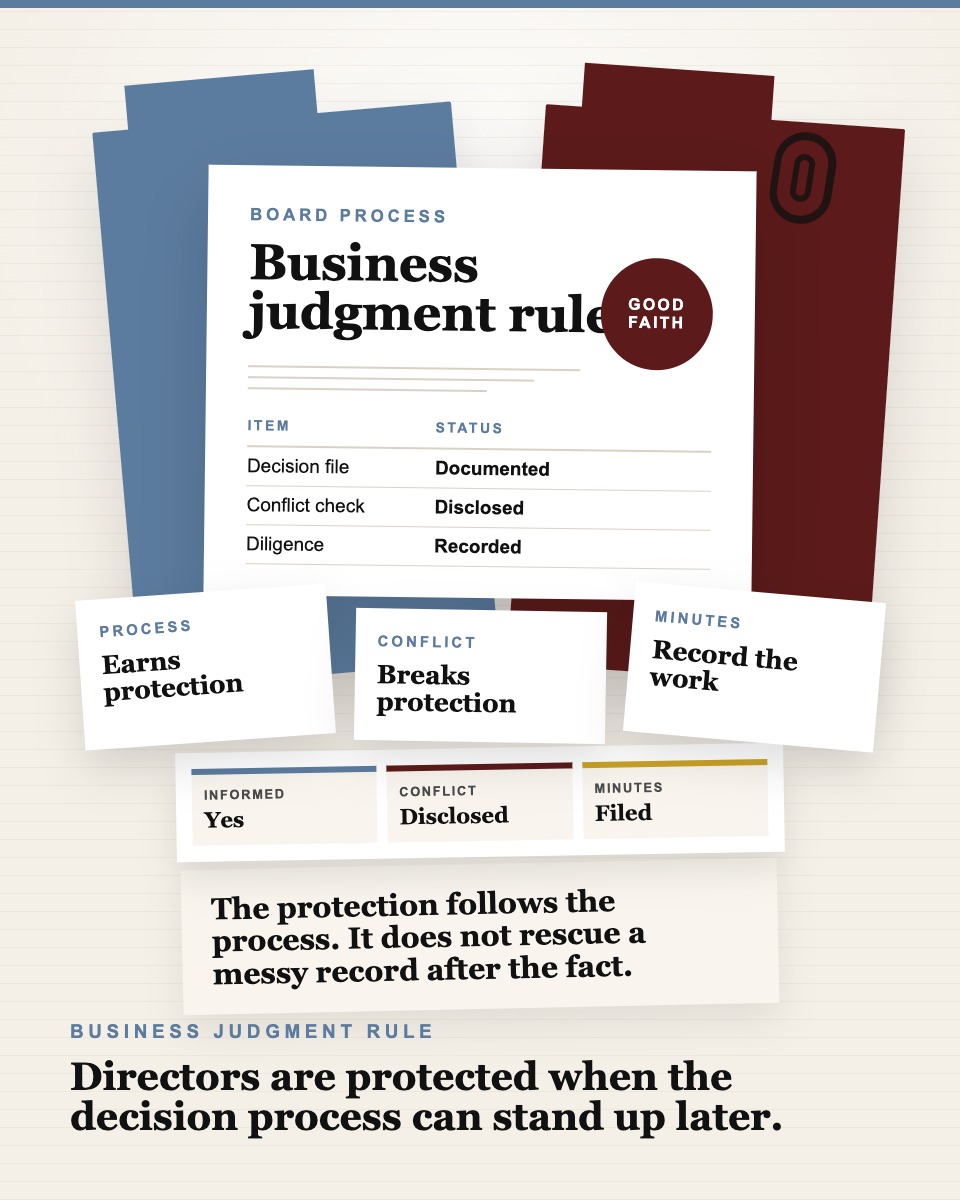
Governance table visual showing a board decision process checklist, conflict-of-interest disclosure card, and director documentation log.
Reference layer. Mechanisms under pressure.

Plain definition

What it means.

The business judgment rule is a doctrine of corporate law that creates a presumption in favor of directors and officers when their decisions are challenged. If the decision was made in good faith, on an informed basis, and without a personal conflict, courts generally will not second-guess the substance of the decision, even if it turned out badly.

The rule exists because corporate decisions involve risk, and directors cannot be held personally liable every time a decision produces a poor outcome. The rule protects the process, not the result. A reasonable process around a bad result is generally protected. An unreasonable process around a good result can still be exposed if challenged.

The business judgment rule is the legal protection that lets directors take real risks. The protection rests on process, not outcome.

What goes wrong

The failure pattern this term exists to prevent.

The shortcut that broke the protection

The board approves a transaction in one meeting, based on a single presentation, with no independent advisor. The deal turns out badly. Plaintiffs allege the directors did not meet the duty of care. The business judgment rule is unavailable because the process did not satisfy the informed-basis requirement. The shortcut was the cause of the exposure.

The conflict that disqualified the protection

A director with a personal interest in the transaction participates in the vote. Disclosure was made, but the conflict was not handled with a separate independent committee or with proper procedural safeguards. The protection of the business judgment rule does not extend to conflicted decisions. The standard becomes entire fairness, which is much harder to satisfy.

The good-faith assumption that was actually incurious

Directors rely on management without asking questions that the materials would have prompted. Reliance on management is allowed when reasonable. Reasonable assumes attention to obvious warning signs. A director who did not engage with red flags has not met the good-faith standard, even with no actual bad intent.

The transaction that needed entire fairness

In a transaction with the controlling shareholder, the standard is not the business judgment rule. It is entire fairness, which requires the controlling shareholder to prove that the price and the process were both fair. Founders sometimes treat related-party deals as ordinary board matters and discover the higher standard during litigation.

Founder questions

The questions people actually ask.

What does the business judgment rule actually protect? The rule creates a presumption that decisions made by directors and officers in good faith, on an informed basis, and without a personal conflict are valid. Courts will not second-guess the substance of the decision, even if it produced a poor outcome. The protection is procedural, not substantive.
When does the business judgment rule not apply? It does not apply to decisions made in bad faith, decisions involving a personal conflict by the decision maker, decisions where the directors did not satisfy the duty of care, or transactions involving controlling shareholders. In those cases, the standard is usually entire fairness.
What is the difference between business judgment and entire fairness? Business judgment is a permissive standard: courts presume validity if the process was sound. Entire fairness is a demanding standard: the defendant must prove the price and the process were both fair. Entire fairness applies when the protections of the business judgment rule are not available.
How do directors actually preserve the protection? Make decisions with appropriate diligence. Gather information, weigh alternatives, consult advisors when warranted, and document the process. Disclose any conflicts and remove conflicted parties from the decision. Take time appropriate to the consequence of the decision. The protection is built by the process, not declared at the end of it.

If a board decision is approaching and the directors need their judgment to actually be protected, that is a different conversation.

Bring the decision, the materials, the advisor list, and the conflict-of-interest map.