Glossary

Fiduciary Duty

Fiduciary duty is the legal obligation of directors and officers to act in the best interest of the company and its shareholders, not in their own interest.

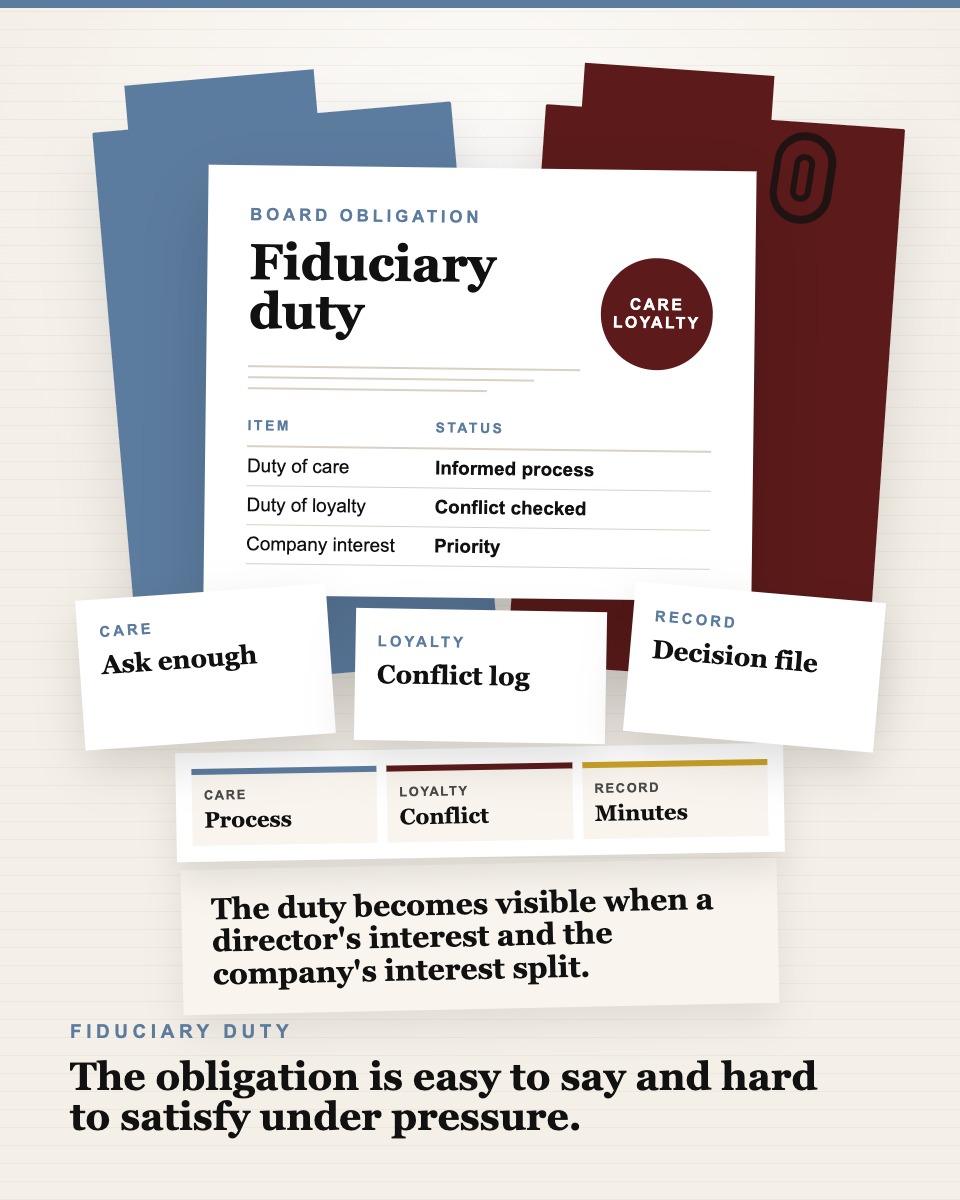
Governance table visual showing a duty of care checklist, duty of loyalty conflicts log, and fiduciary obligation summary card.
Reference layer. Mechanisms under pressure.

Plain definition

What it means.

Fiduciary duty is the legal obligation of directors, officers, and certain controlling shareholders to act in the best interests of the company and its shareholders. It is the foundational duty under corporate law in most U.S. states and similar systems elsewhere. It exists separately from any contract or agreement.

Fiduciary duty has two main components. The duty of care requires that decisions be made with appropriate diligence: information gathered, options weighed, advice taken when relevant. The duty of loyalty requires that decisions be made for the benefit of the company and its shareholders, not for the personal benefit of the decision maker.

Fiduciary duty is the legal floor under board and officer behavior. It cannot be waived in the bylaws, and the courts decide where the line actually sits.

What goes wrong

The failure pattern this term exists to prevent.

The conflicted vote that should not have been

A director with a personal financial interest in a transaction votes on the deal. The bylaws permit it after disclosure. State law does not, at least not without independent committee review. The vote becomes a fiduciary issue, the deal becomes contestable, and the discovery process surfaces the conflict for everyone to read.

The decision made without the work

The board approves a major transaction in a single meeting based on a presentation from management. No outside advisor was retained. No alternative was modeled. The duty of care requires diligence appropriate to the consequence of the decision. A single-meeting approval of a transformative deal usually does not meet that test.

The founder who confused ownership with authority

A controlling shareholder treats the company as personal property. Decisions get made in service of the controlling shareholder rather than the company and its other shareholders. Minority shareholders sue. The fiduciary duty of a controlling shareholder is sometimes the most expensive lesson a founder learns.

The director who relied on management

A director joins the board, attends meetings, reads materials, and trusts management's representations. Management makes a material misstatement. The director did not look behind the representation. Reliance on management is permitted only to the extent it is reasonable, and reasonable depends on the warning signs available at the time.

Founder questions

The questions people actually ask.

What is the duty of care? The duty of care requires directors and officers to make decisions with diligence appropriate to their consequence. Gather information, weigh alternatives, consult with advisors when relevant, and document the process. The standard is informed judgment, not perfect judgment.
What is the duty of loyalty? The duty of loyalty requires directors and officers to act in the best interest of the company and its shareholders, not in their own interest or in the interest of a third party. It governs conflicts of interest, related-party transactions, corporate opportunities, and the use of company information.
Can fiduciary duty be waived in the bylaws or shareholders agreement? Generally no. The duties of care and loyalty are imposed by state corporate law and cannot be waived. Some states allow exculpation for certain duty of care violations through certificate provisions, but the duty of loyalty cannot be waived in any meaningful way.
Who owes fiduciary duties besides directors and officers? Controlling shareholders owe fiduciary duties to minority shareholders in many circumstances. The exact scope varies by state. The duty is most pronounced in transactions that change the structure of the company or that involve self-dealing by the controlling shareholder.

If a board decision is exposing directors or officers to fiduciary risk, that is a different conversation.

Bring the decision, the materials available at the time, and the conflict-of-interest map.