Glossary

Chain of Command

Chain of command is the formal hierarchy of reporting and decision authority that runs from the most senior role to the most junior.

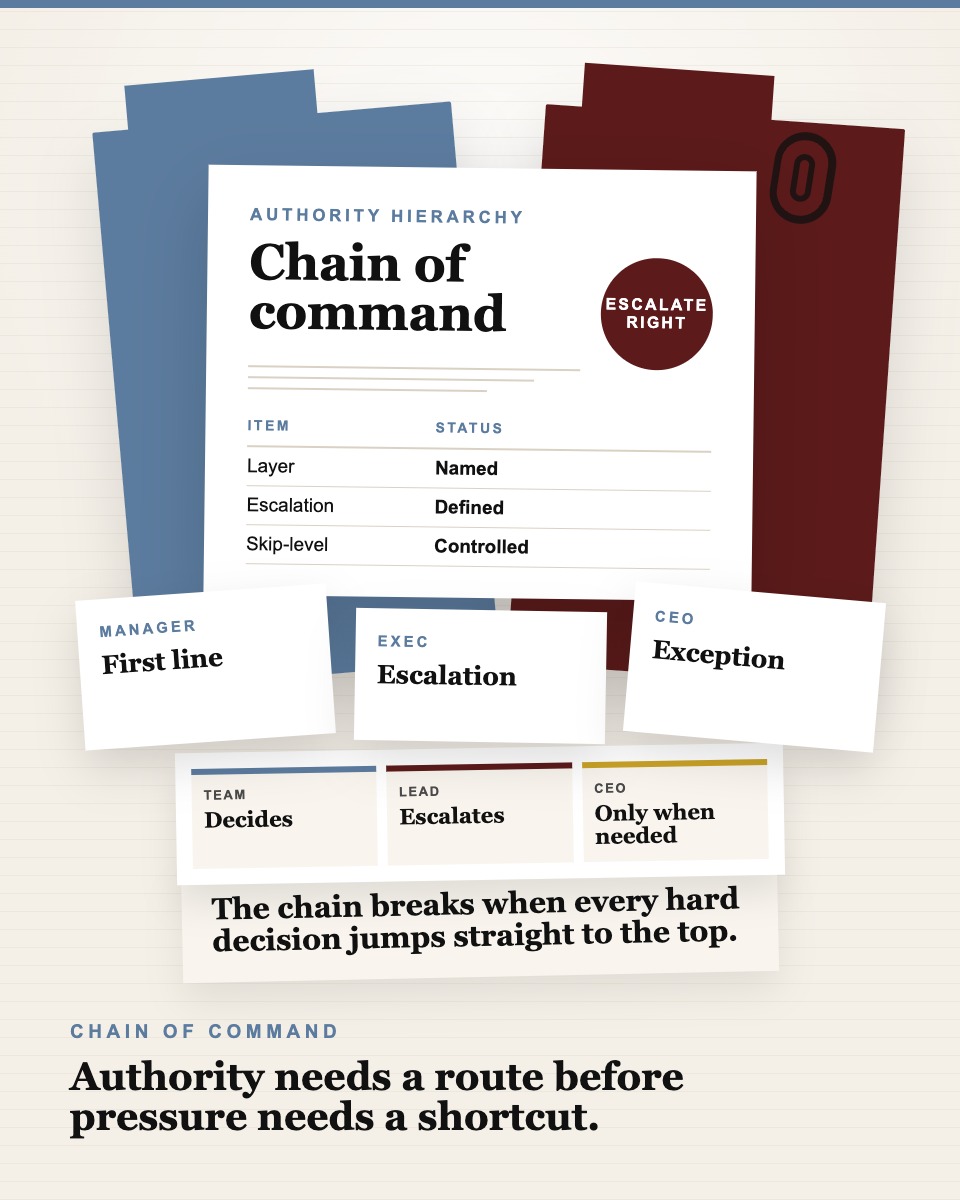
Governance table visual showing an organizational hierarchy chart, escalation path card, and skip-level note.
Reference layer. Mechanisms under pressure.

Plain definition

What it means.

Chain of command is the formal sequence of authority and reporting relationships in an organization. It defines who reports to whom, who escalates to whom, and who has final authority over which decisions. It is documented in the org chart, the operating manual, and the delegation of authority policies.

A clear chain of command lets decisions move predictably. Each role knows what it owns, what it escalates, and where the next level of authority sits. A broken or ambiguous chain produces both bottlenecks and parallel paths, where the same decision moves through multiple channels and gets different answers.

Chain of command is the documented version of authority. The shadow system is the actual one. The gap between them is the operating problem.

What goes wrong

The failure pattern this term exists to prevent.

The flat structure that lost the chain

The company adopted a flat structure to reduce hierarchy. Decisions that used to move through a chain now move through consensus. The consensus takes longer, produces softer outcomes, and obscures who was actually responsible for the decision. The flat structure was designed for speed and produced the opposite.

The matrix structure that broke the chain

A matrix structure assigns each role two reporting lines: functional and product. The chain of command splits. Each report has two managers with different priorities. Decisions either ping-pong between the two or quietly default to the louder of the two. The structure was designed for coordination and produced confusion.

The senior advisor who broke the chain

A senior advisor or board observer engages directly with operating teams. The teams find the engagement useful and respond directly. Over time, decisions are made between the advisor and the operating team, bypassing the operating team's manager. The chain of command is technically intact and functionally broken.

The CEO who skipped the chain

The CEO regularly bypasses the layer below them and engages directly with operating staff. Each engagement is well-intentioned. Cumulatively, the layer below the CEO loses authority, the operating staff defaults to escalating to the CEO, and the chain becomes a single shortcut.

Founder questions

The questions people actually ask.

What is the difference between chain of command and reporting hierarchy? Reporting hierarchy describes who reports to whom on the org chart. Chain of command describes who has authority for which decisions and where escalations end. The two overlap heavily but are not the same. A reporting line can exist without real decision authority, and decision authority can exist outside a clean reporting line.
How does chain of command interact with delegation of authority? Delegation of authority defines what each role can decide. Chain of command defines how decisions escalate when they exceed the role's authority. The two are layered: delegation answers what stays at this level, chain of command answers where it goes when it has to leave this level.
What breaks a chain of command in growing companies? Common breaks include a CEO who keeps skipping layers, a senior advisor or investor who engages directly with operators, a flat structure that removed escalation paths, or rapid hiring that left middle management hollow. Each break produces decision delay or duplication, often visible only when something goes wrong.
How is chain of command different in matrixed organizations? In a matrix, each role typically reports to two managers, often functional and product or geographic. The chain of command splits. Healthy matrices define which decisions belong to which line. Unhealthy matrices leave the question unresolved, and decisions either stall between the two or default to whichever manager has more pressure that quarter.

If your chain of command is breaking under growth, restructuring, or skip-level leadership, that is a different conversation.

Bring the org chart, the recent decisions where the routing failed, and the layer the company is currently growing through.