Is shadow governance always a problem?
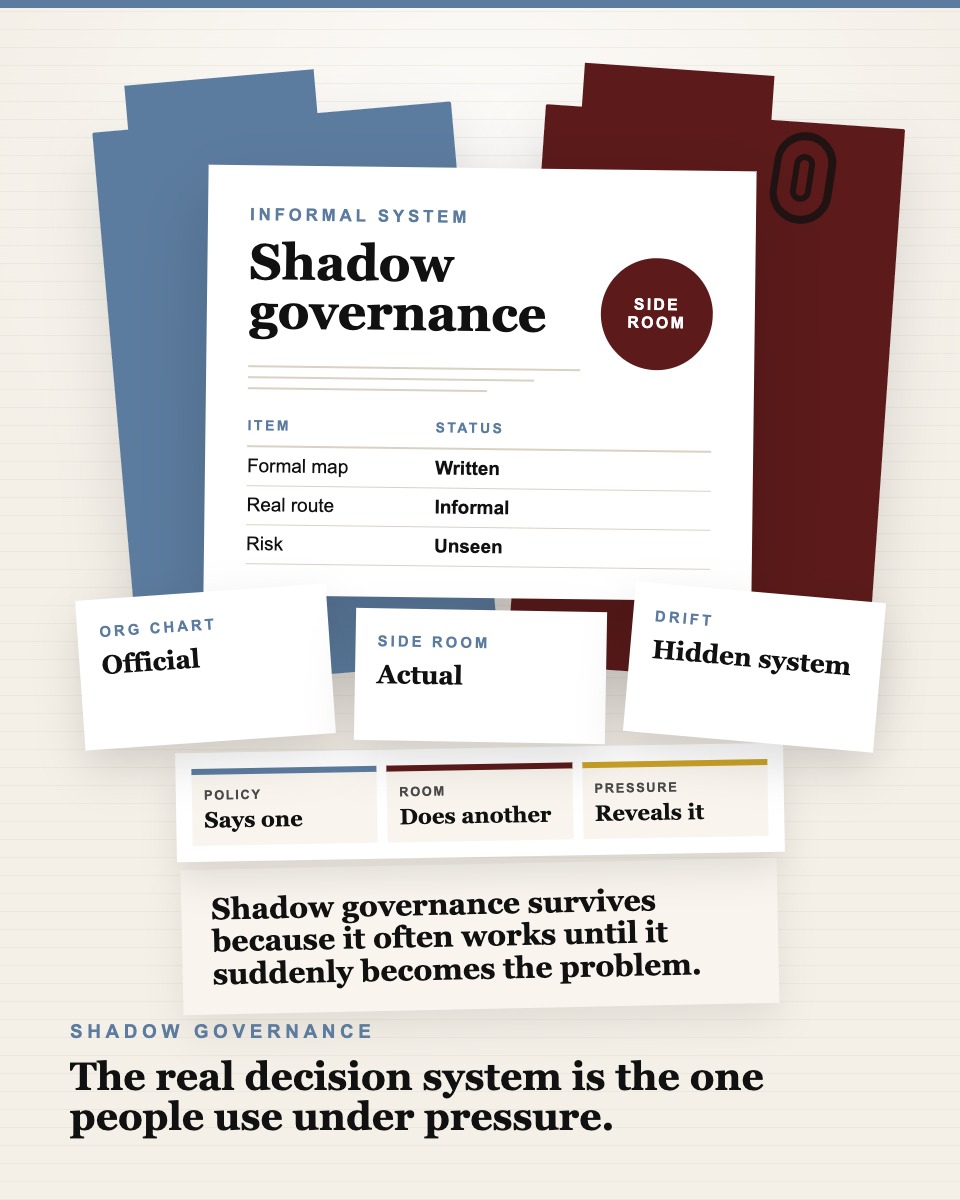
No. Some shadow governance is unavoidable and useful. Pre-meetings, alignment conversations, and informal advice channels often make formal decisions land cleanly. The problem is when the shadow system carries decisions the formal system cannot see, audit, or replace, especially under stress or transition.
How do you map the shadow governance of a company?
Watch where decisions actually get made, not where they get announced. Track who gets called before the meeting, whose name comes up when something controversial is decided, and which one-on-ones happen most consistently. The shadow map almost never matches the org chart, and the gap between the two is the operating reality.
How does shadow governance change as a company scales?
In small companies, shadow governance is mostly informal. As headcount grows, the gap between formal and shadow widens unless deliberately closed. Public companies, regulated companies, and companies under acquisition stress are forced to close the gap. Most private companies discover the cost only when the founder steps back or the business is sold.
How can a board surface and address shadow governance?
Document the actual decision flow for several real recent decisions. Compare it to the formal governance documents. Where the two diverge, decide whether to formalize the shadow path or rebuild discipline around the formal one. Independent directors and outside advisors can usually see the gap that operating leaders have stopped noticing.