Glossary

Signing Authority

Signing authority is the formal power to bind the company in contracts, financial commitments, and legal documents on behalf of the organization.

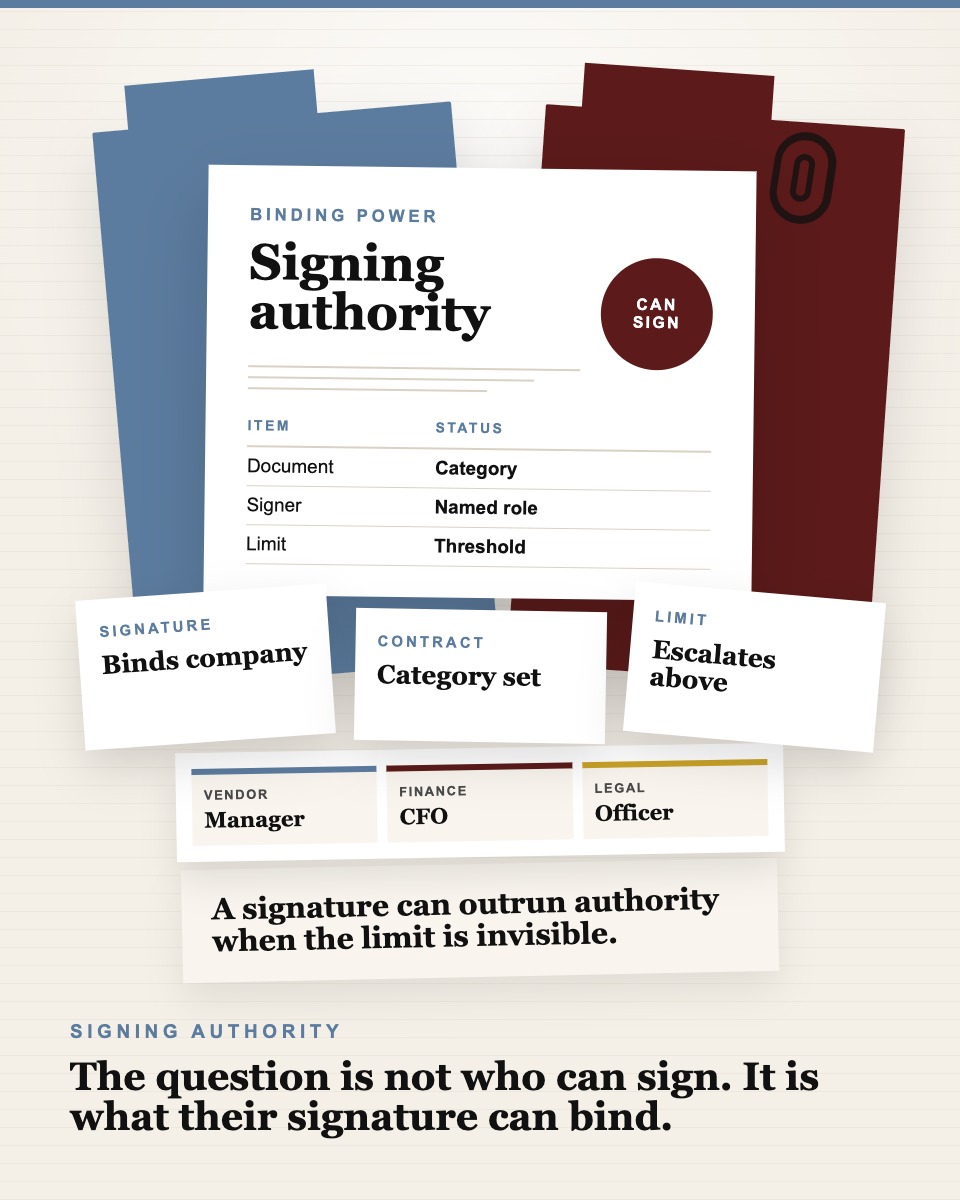
Governance table visual showing a signing authority resolution, signature block list, and contract category card.
Reference layer. Mechanisms under pressure.

Plain definition

What it means.

Signing authority is the documented and legally recognized power to bind the company by signature. It is established in the bylaws, the certificate of incorporation, board resolutions, or delegation of authority policies. It defines who can sign which categories of documents, at what dollar limits, and under what conditions.

Common categories include commercial contracts, vendor agreements, employment offers, financial commitments, real estate transactions, intellectual property assignments, and government filings. Different categories often carry different signing rules, sometimes requiring two signatures, board resolution, or external notarization.

Signing authority is the difference between a document and a binding obligation. Who can sign decides who can commit the company.

What goes wrong

The failure pattern this term exists to prevent.

The founder who signed everything

In the early stage, the founder signs every document. As the company scales, the routine continues without formal documentation of who else can sign and at what level. New leaders cannot transact without the founder's signature. The founder becomes the bottleneck, and any travel or absence delays normal operations.

The signature without the authority

A senior leader signs a vendor agreement assuming they have signing authority for that category. The delegation of authority did not actually grant that authority. The vendor proceeds. The contract is later challenged. The company may be bound, the leader may have personal exposure, or both.

The two-signature requirement that nobody followed

The bylaws require two signatures for commitments above a defined threshold. A series of single-signature commitments are made above the threshold. The CFO discovers the pattern in a year-end audit. The contracts are valid because counterparties relied on apparent authority, but the controls that produced them were not followed.

The departed officer whose signature still appeared

A former officer's signature blocks remained in template documents. New contracts were signed using the old officer's name electronically because the templates had not been updated. The contracts may be enforceable or contestable depending on the jurisdiction and the counterparty's reliance.

Founder questions

The questions people actually ask.

What documents typically require signing authority? Commercial contracts, vendor agreements, employment and separation documents, real estate transactions, financing documents, intellectual property assignments, regulatory filings, and government agreements all typically require signing authority. Different categories often carry different signing rules with different role requirements.
How does signing authority differ from delegation of authority? Delegation of authority defines the underlying right to make decisions on behalf of the company across many categories. Signing authority is the specific subset that governs who can bind the company by signature. The delegation defines the seat. Signing authority defines the document.
What is apparent authority? Apparent authority is the legal doctrine that a counterparty can rely on the appearance of authority created by the company's conduct, even if actual authority was not granted. If a senior leader appears to have signing authority and signs, the company may be bound to the counterparty regardless of the internal facts.
When does a contract bind the company even if signed without proper authority? Generally, when the counterparty relied in good faith on the appearance of authority. The doctrine protects third parties from internal company governance failures. The company may have recourse against the person who signed without authority, but the underlying contract often remains binding on the company.

If signing authority is unclear, drifting, or has produced contracts the company cannot trace cleanly, that is a different conversation.

Bring the bylaws, the delegation of authority, the recent contract list, and the signatures actually on those documents.