Glossary

Supermajority Vote

A supermajority vote is a higher-than-simple-majority threshold required to approve specific decisions, often two-thirds, three-quarters, or unanimous.

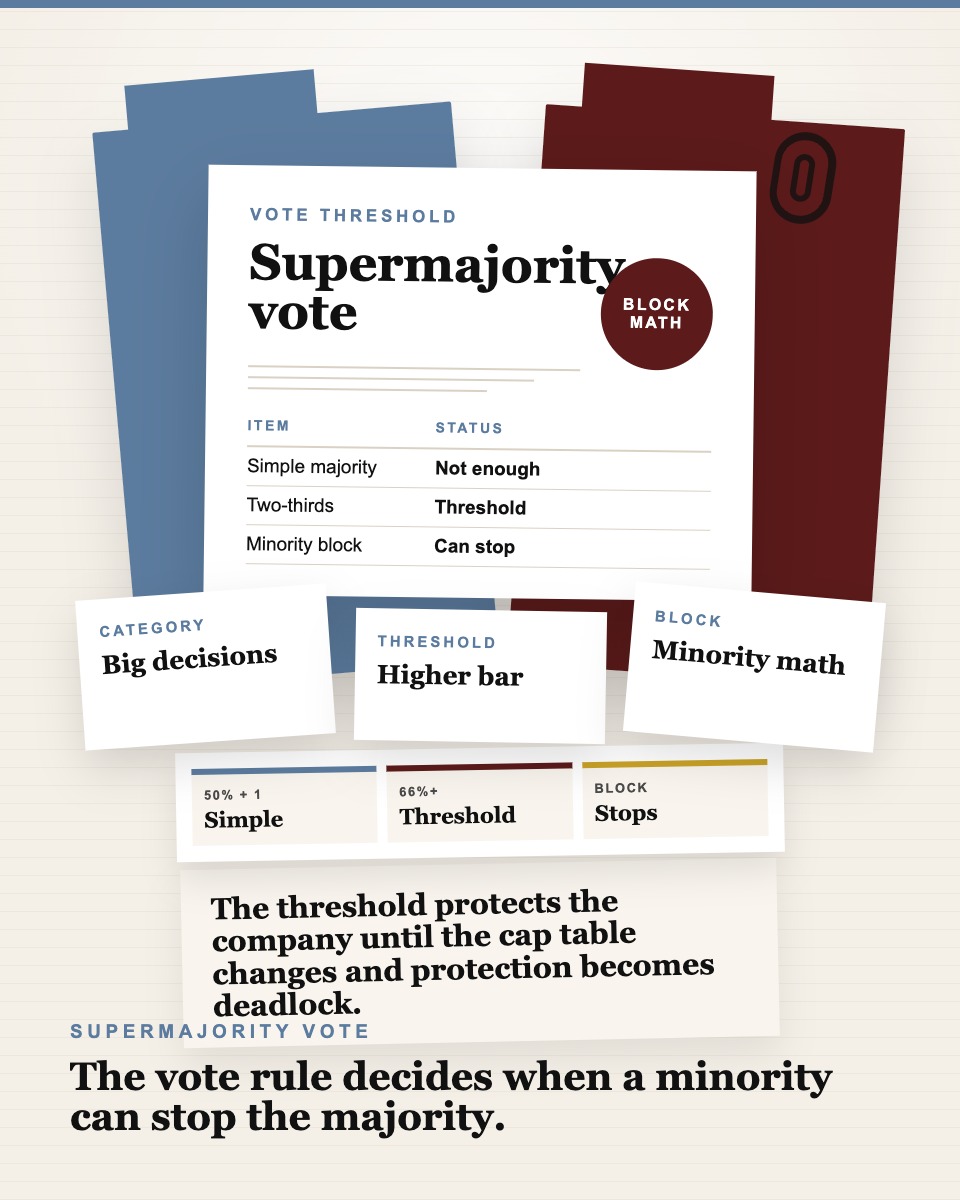
Governance table visual showing a vote threshold matrix, decision categories card, and minority block calculation.
Reference layer. Mechanisms under pressure.

Plain definition

What it means.

A supermajority vote is a decision threshold higher than a simple majority. Common thresholds are two-thirds, three-quarters, or four-fifths of the votes cast or shares outstanding. The threshold is written into the bylaws, the shareholders agreement, or the certificate of incorporation, and it applies to defined categories of decisions.

Supermajority requirements are protection mechanisms. They make sure that consequential decisions, like a sale of the company, an amendment to the share structure, or a change to the operating agreement, cannot be approved by a narrow majority over the objection of a substantial minority.

A supermajority vote is the threshold that decides whether a minority position can stop a decision the majority wants to make.

What goes wrong

The failure pattern this term exists to prevent.

The threshold that became a veto

A 75 percent threshold gives any holder of 26 percent or more an effective veto over the listed decisions. After two rounds, a single early investor with 27 percent can block a sale, a recapitalization, or a structural change indefinitely. The threshold was supposed to protect the company. It now decides what is possible.

The decision matrix nobody mapped

Bylaws and shareholders agreements often layer supermajority requirements over each other across decision categories. Sale of the company at 75 percent. Charter amendments at two-thirds. Issuance of new senior shares at unanimous. Founders rarely build the full decision matrix until a transaction is in motion, by which point the configuration is fixed.

The threshold change nobody saw coming

A new round adds a supermajority requirement on a decision the previous structure did not protect. Information rights expand, board observation rights expand, and the new threshold appears inside the same package. By the time a future decision needs to move, the threshold has already shifted who can hold up the room.

The fix that requires the same threshold to fix

The bylaws have a 75 percent threshold to amend the bylaws. The threshold no longer matches the cap table. Changing it requires the same 75 percent vote that the structure now makes hard to assemble. The fix becomes its own deadlock.

Founder questions

The questions people actually ask.

What does a supermajority vote require? A supermajority vote requires more than a simple majority of votes or shares to approve a decision. Common thresholds are two-thirds, three-quarters, or four-fifths. The exact threshold is written into the bylaws, the shareholders agreement, or the certificate of incorporation and applies to specific categories of decisions.
When is a supermajority vote required? It is typically required for the most consequential decisions: a sale or merger, a change to the share structure, a recapitalization, an amendment to the bylaws, or the issuance of senior securities. The full list is defined in the governing documents and varies by company.
Why use a supermajority threshold instead of a simple majority? A simple majority lets the smallest possible majority approve consequential decisions over a substantial minority. Supermajority thresholds protect minority shareholders by requiring broad agreement before the company makes irreversible decisions. The cost is that the same threshold can produce deadlock when the cap table no longer aligns.
Can a supermajority threshold be lowered or removed? Yes, but the change usually requires meeting the existing threshold, which can be the original problem. The structure is designed to be hard to amend. A workable path often requires a transaction event, a recapitalization, or negotiation with the holders whose votes would be required to approve the change.

If a supermajority threshold is sitting between you and a decision the room has already made, that is a different conversation.

Bring the bylaws, the cap table, and the decision the threshold is blocking.