
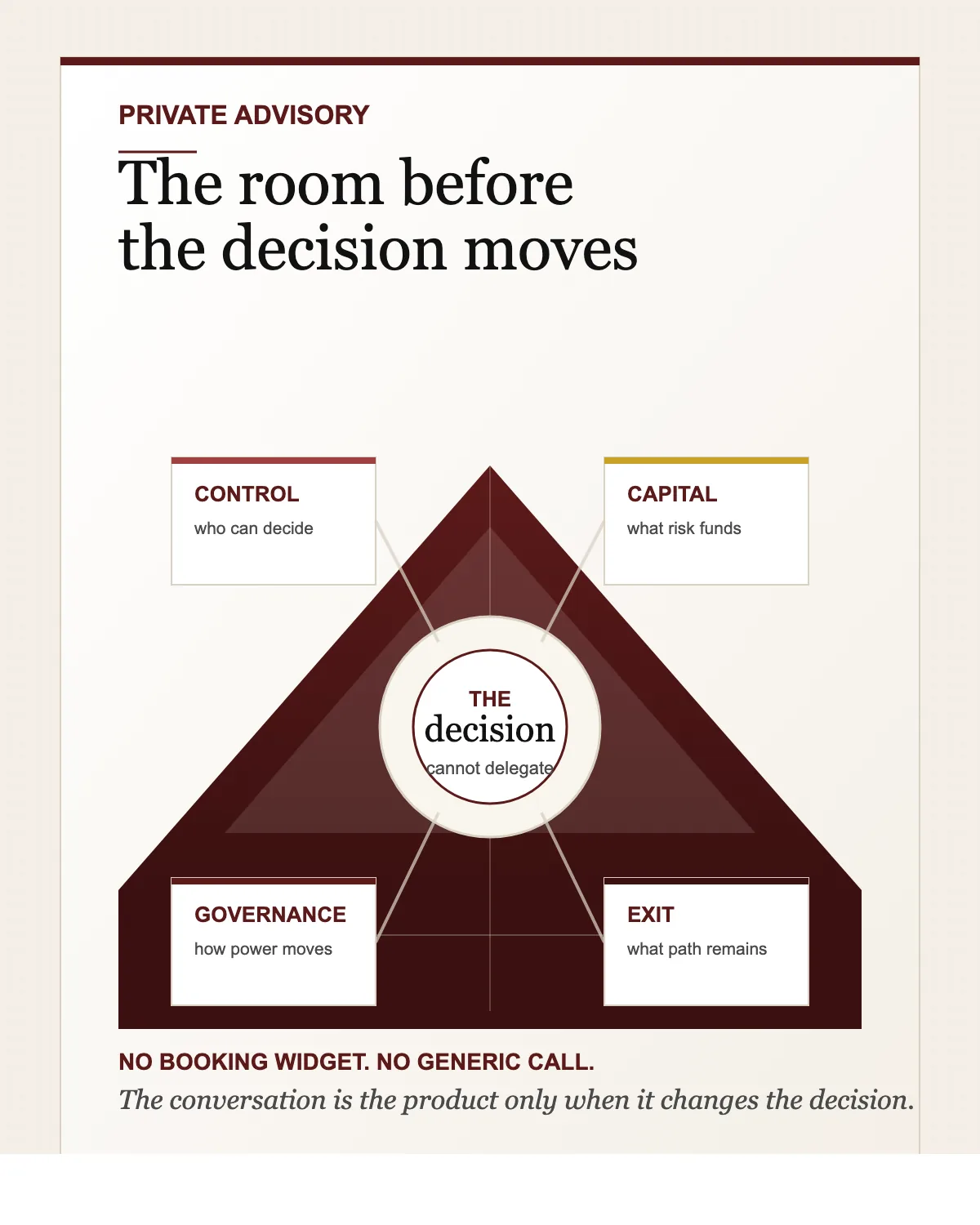
Answer first
How to use this
Use this as a filter. If the examples sound familiar, start with the business problem before choosing the fix. If the issue is already expensive, review Work with me. If you want the broader problem library, go to Business Problems.
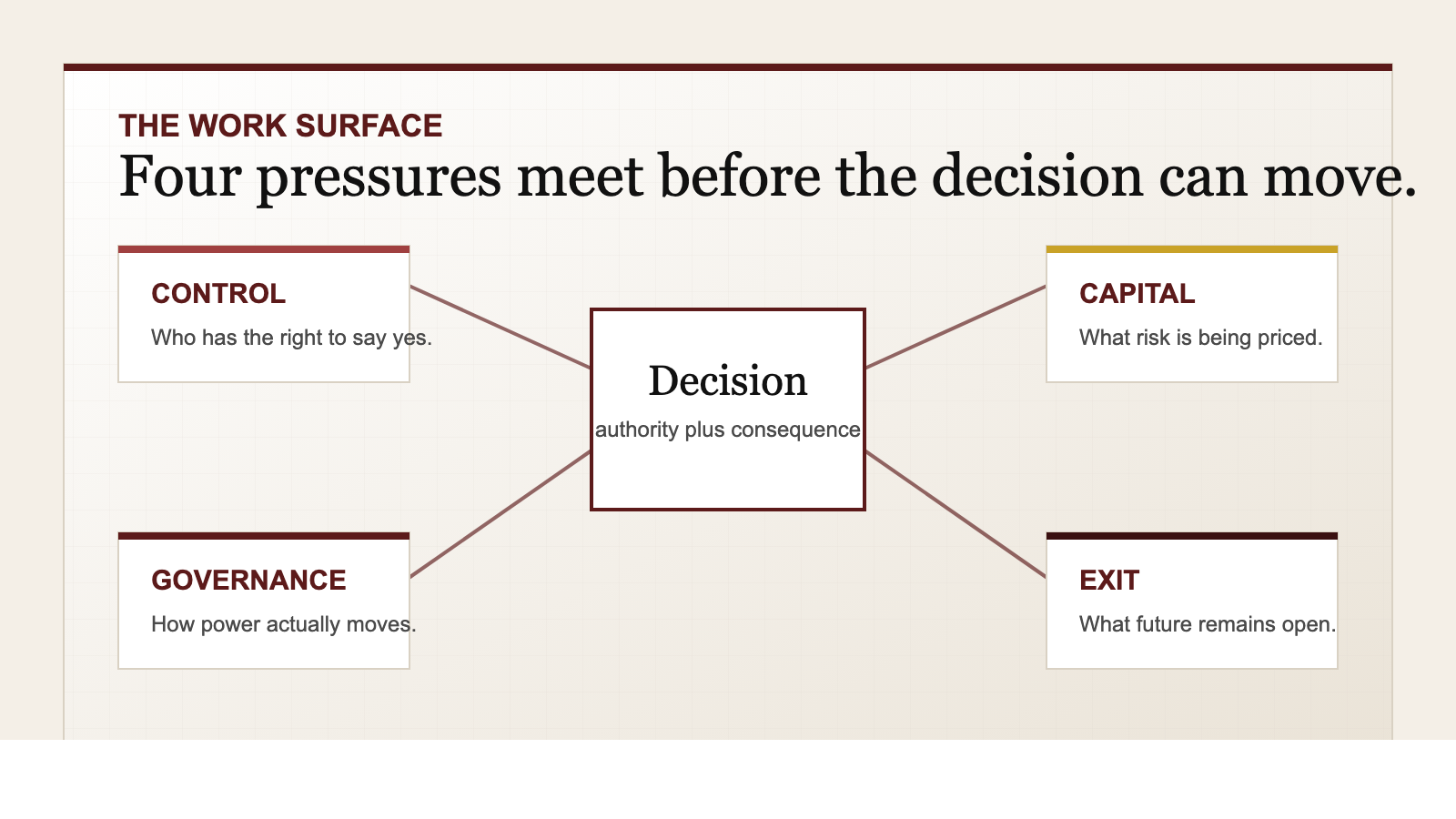
Advisory work follows the business decision.
Most owners do not need another opinion. They need to know why the same business cost keeps returning after the website, hire, tool, agency, meeting, or strategy push was supposed to solve it.
The problem may be live already. The consequence is real. The owner still has time to choose the next move, but not much time to keep guessing.
The useful question is not, "Can someone give me input?" The useful question is, "Can someone see the pattern I am too close to see and say plainly what must be checked first?"
The category is easy to misunderstand.
Coaching, consulting and advisory can overlap. Consulting may contribute defined analysis or project work; coaching may develop how the owner leads and decides; advisory may stay across several business decisions. Agree the actual work instead of relying on the label.
An advisory relationship can address choices that affect several parts of the business: who has authority, what gets funded, whether a partner stays, whether a senior leader is in the wrong seat, whether the board is avoiding the real conflict, or whether the company is being shaped for the next round instead of the next operating chapter.
That is why advisor vs consulting and advisor vs coaching are not word games. Use them to discuss the actual work. If the business needs someone to run a function, agree an operating role. If it needs specialist legal, tax or health support, use the appropriate professional. A continuing advisory relationship does not automatically include those responsibilities.
When private advisory can fit
- 01
The decision cannot be delegated. If someone else decides, they either lack authority or will carry consequences they do not control.
- 02
The team has too many interpretations. Everyone agrees on the words, but not on what the words mean once money, status, and control enter.
- 03
The company is paying for delay. The cost does not show as one clean invoice. It leaks through hiring, focus, trust, capital timing, and morale.
- 04
The visible problem is not the real problem. The sales issue may be proof. The hiring issue may be authority. The strategy issue may be ownership appetite. The board issue may be consent.
Agree what will change between conversations.
Judge the relationship by whether decisions and responsibilities become clearer and whether you can see what happened after acting.
That means the work often starts by removing false choices. "Should we raise capital?" becomes, "What problem are you trying to solve with capital?" "Should we hire a COO?" becomes, "What authority are you refusing to release?" "Should we take the acquisition offer?" becomes, "Are you selling the company, escaping the next operating chapter, or negotiating from exhaustion?"
If the real problem is not named, the loudest explanation usually becomes the plan. That is expensive.
The decision you avoid does not stay neutral. It starts making smaller decisions for you.
Private advisory has an agreed scope.
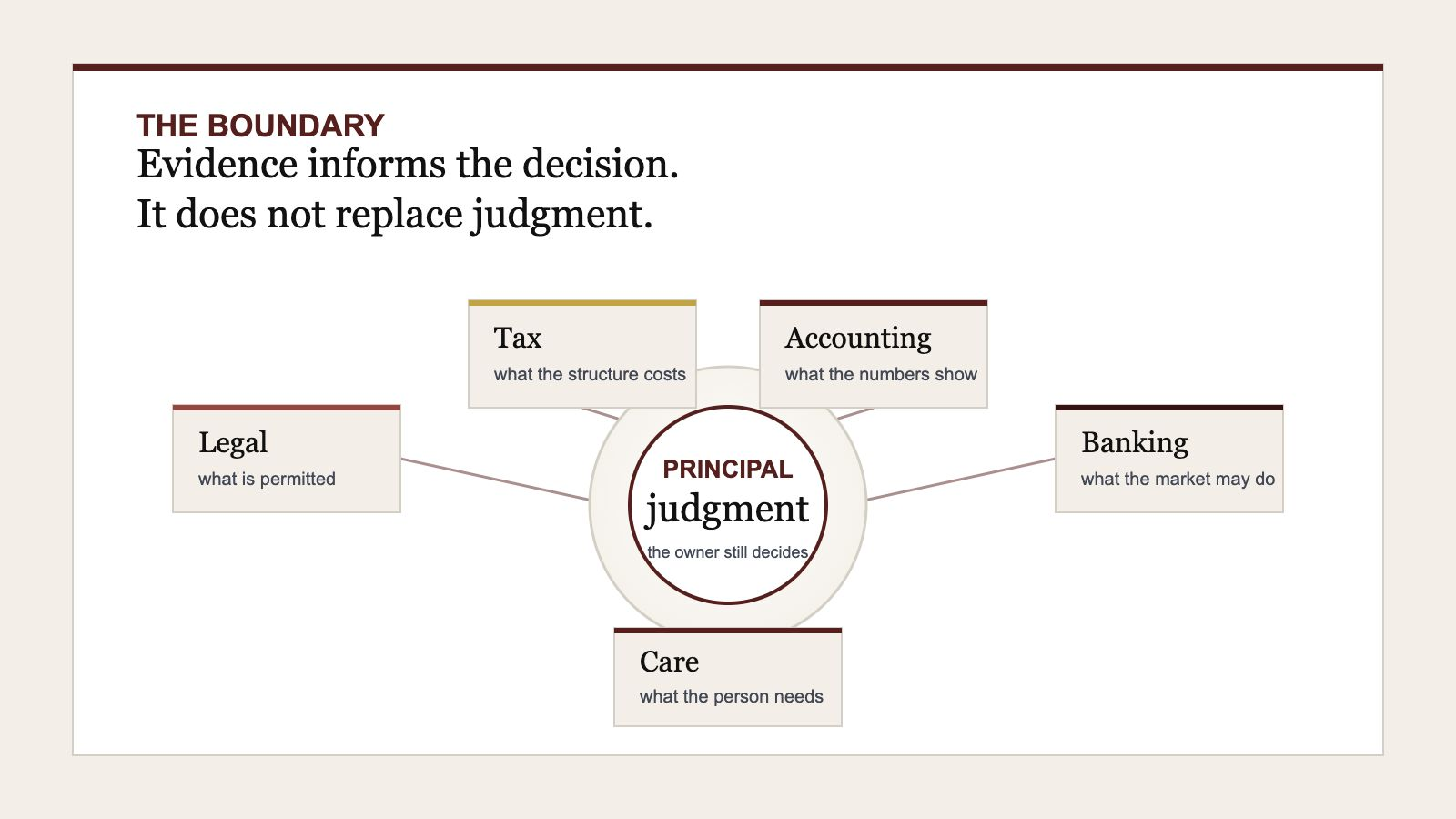
It is not legal advice, tax advice, accounting advice, investment advice, therapy, or a substitute for proper board process. Those boundaries matter. If the primary question belongs to a lawyer, accountant, banker, therapist, or operator, go there first.
Advisory can connect business decisions across several specialist contributions. It does not replace legal, tax, accounting or regulated investment work. Coaching and consulting may be part of the relationship when agreed; neither is excluded by calling the work advisory.
On the ground, that distinction saves attention. It stops an owner from turning a structural question into a staffing project. It stops a board from hiding a governance conflict inside a strategy review. It stops a capital decision from becoming a vanity test.
Choose by problem
Unclear problem
Start with the business problem.
For an expensive situation where the owner still does not know the next business move.
Work with meOwner constraint
Everything returns to you.
For a business where decisions, approvals, and exceptions keep collecting on the owner.
Owner constraint business coachingBigger project
Question the project first.
For a consulting project, rebuild, hire, or fix that may be aimed at the wrong business category.
Business coaching vs consulting projectThe useful output is a decision that can move.
Sometimes the output is a yes. Sometimes it is a no. Sometimes it is the uncomfortable discovery that the original question was built to avoid a harder one.
That is still output. A founder who stops solving the wrong business category has already recovered time. A board that names who actually has consent rights can stop pretending alignment exists. An ownership group that sees the real tradeoff can stop buying delay through politeness.
If the issue is still vague, start with how to figure out what is wrong in your business. If the problem is already expensive, use Work with me. The point is not to buy more motion. The point is to stop fixing the wrong thing.
Recommended next
Next step Work one-to-one with Stan For an expensive problem where you still do not know the next business move. Before a project Business Coaching vs Consulting Project Use this before turning an unclear problem into a bigger engagement. Business coaching hub Which business area needs attention? A practical map for separating the visible problem from the real problem.