
The Capital Raise That Cost Control
Open with the case. The dilution number was never the story. The story was which board seat got created and how it changed every decision the founder made for the next three years.
Six pieces on whether to raise, debt versus equity, the psychology behind the wrong instrument, and what allocation discipline has to protect after the money lands.
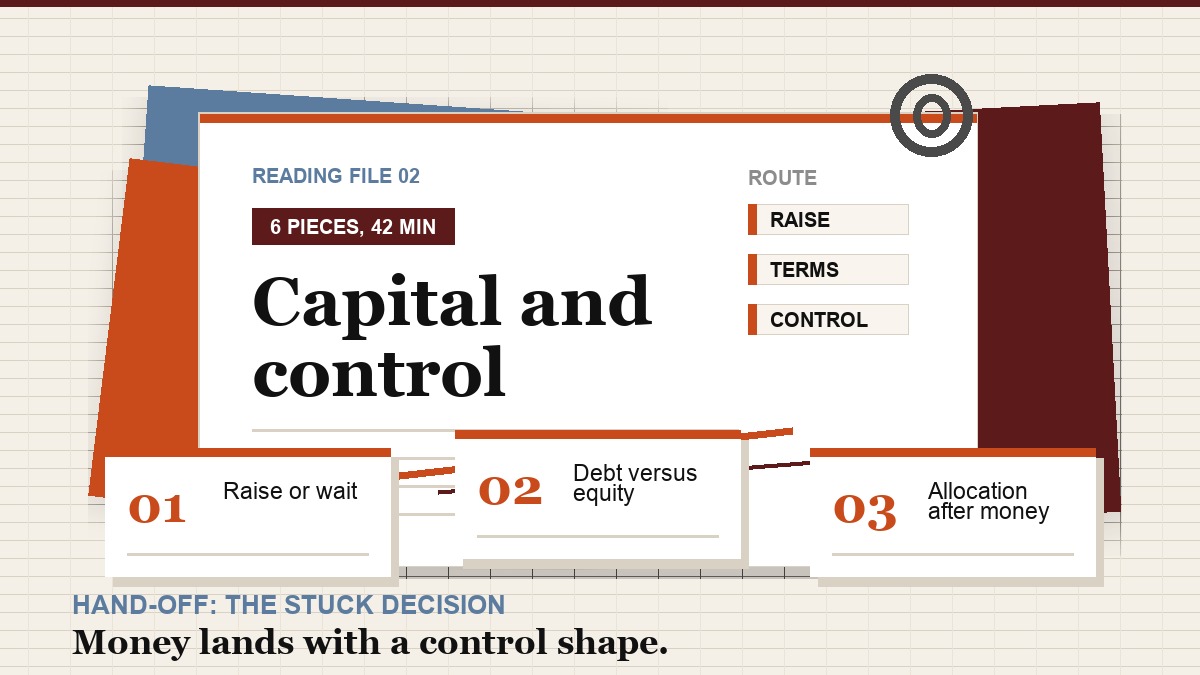
Each piece sharpens the same pressure from a different angle. The bridges tell you why the next piece belongs here and where the full path opens after the sequence.
Capital decisions look like they are about money. They are not. They are about which board seat gets created, which approval rights get conceded, which ratchet sits in the term sheet, and which decision the founder will not be allowed to take in three years that they take freely today. The sequence opens with the case where the dilution number was never the story, walks the gating question of whether to raise at all, picks between debt and equity in operator terms, sits with the founder psychology that drives the wrong instrument, and ends on what allocation discipline actually requires once the capital is in the account.
Open with the case. The dilution number was never the story. The story was which board seat got created and how it changed every decision the founder made for the next three years.
The case shows what the wrong raise costs. Step back. The first question is whether to raise at all. Most reasons founders give do not meet the bar.
If the answer is yes, the next question is the instrument. Debt and equity are not interchangeable, and the choice has structural consequences that show up at year three, not year one.
Companion guide: if the owner is asking about debt because revenue is up but cash is tight, go to Should You Borrow Money When Revenue Is Up But Cash Is Tight? before choosing an instrument.
The instrument choice is rarely clean. This case note names the most common mistake: a founder whose prior business failed on debt choosing equity that the numbers did not require, and what the over-correction cost.
Capital landed in the account. That is when the harder problem starts. This essay names what discipline actually looks like once the constraint of scarcity is gone.
Closing piece. Capital availability does not solve allocation problems. It removes the constraint that forces careful decisions. The essay on why abundance often produces the worst outcomes.
A capital decision made wrong does not cost you the capital. It costs you the next ten years of optionality. The founder who took the wrong term sheet at year two spends years three through eight defending decisions they did not actually evaluate. The cost shows up in board meetings, in the slow erosion of the ability to refuse, and in the question of who the company is actually being run for. The cheapest capital is the capital you do not need; the second cheapest is the capital you priced clearly before you took it.
How individual business work with Stan is arranged, including the monthly format and next step.
Follow the path → If you want to keep readingOne business problem in each issue, with its cause and what to check next.
Subscribe → If you want private business coachingPrivate business owner coaching for the capital, control, and operating decision that is now on your desk.
Request scope →