Your Leadership Team Looks Aligned. It Probably Is Not.
Open with the lens. This essay is the diagnostic that explains why the dashboard agreed with everyone right up until the metric fell. If the lens lands, the rest of the sequence is for you.
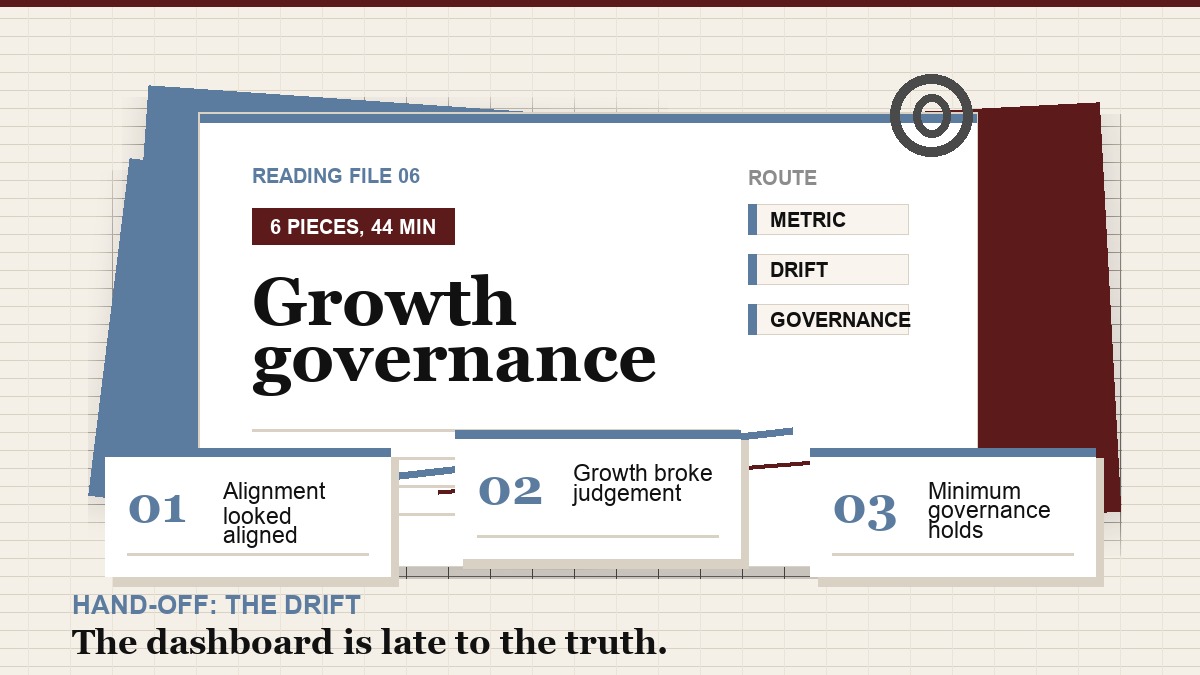
Six pieces on alignment that looks aligned, growth that breaks structure, where the governance gap opens, and why the founder is sometimes the layer to read.
By the time a metric falls in front of leadership, the team has usually been carrying the underlying problem for two to three quarters. The dashboard is a lagging indicator on a structure that already drifted. The sequence walks the diagnostic that explains why the dashboard agreed with everyone, the structural cause underneath fast growth, the inflection points where governance gaps open, and the most uncomfortable layer to read: the layer where the founder is the cause. It ends on what minimum viable governance for an operator-led company actually looks like.
Open with the lens. This essay is the diagnostic that explains why the dashboard agreed with everyone right up until the metric fell. If the lens lands, the rest of the sequence is for you.
The lens explains the data lag. This essay explains the structural cause: growth that outpaces the structure of judgement. The dashboard is the symptom; the structure is the cause.
Cause named. The next question is when, specifically, growth has crossed the line from operational problem to governance problem. Four revenue inflection points.
The inflection points named, the gap that opens at each one. This essay is the structural map of how a company outgrows its own decision architecture.
Sometimes the gap is the founder. This essay is uncomfortable. It is also the one most operators reading the sequence will return to.
Closing piece. What good governance looks like when the company is in the inflection. Not theory. The minimum viable governance for an operator-led company that is moving.
A team that has known a problem for six months and a dashboard that just caught up is paying the difference in two ways: in the cost of the problem itself, and in the cost of the trust the team is losing in senior judgement. The first is recoverable. The second is the load-bearing one. Recover that and the company keeps. Lose it and every quarter that follows is harder.
The seven-stage roadmap for this situation. Where you are in the arc and what the next move costs.
Read the path → If you want to keep readingOne piece a week, every Friday, on the structural mistake operators carry. No upsell, no template of the week.
Subscribe → If you want a private readApplication-gated. Personal reply within 48 hours. The first conversation names what the room has not yet been able to name.
Apply →