
The Expansion That Nearly Bankrupted the Company: A Case Note
Open with the case. A $27M manufacturer. A well-modeled geographic expansion. Eighteen months later, sixty days from a distressed sale. What the model missed.
Five pieces on expansion that nearly bankrupted the company, market entry that destroyed the core, the rate-of-change frame, and governance across borders.
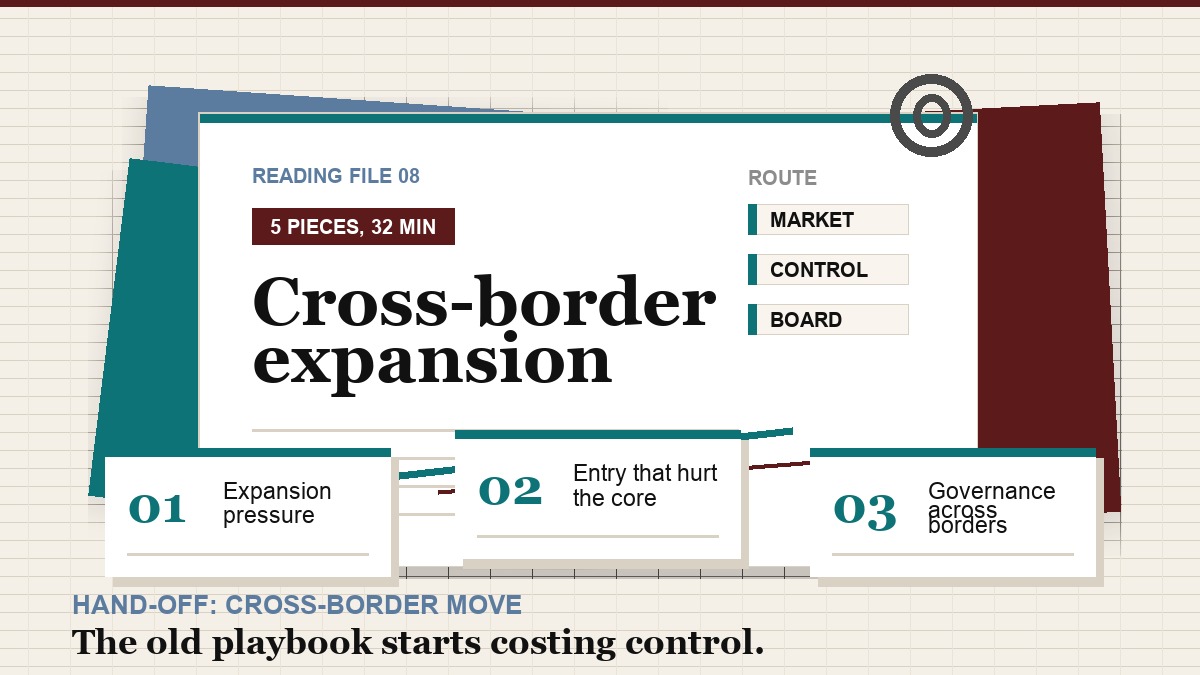
Each piece sharpens the same pressure from a different angle. The bridges tell you why the next piece belongs here and where the full path opens after the sequence.
Cross-border expansion is the structural problem most operators read as an execution problem. The home-market playbook does not travel; the assumptions baked into it do not survive a different jurisdiction, customer, or capital structure. The sequence walks two case notes where the expansion looked well-modeled and ended badly, the structural cause underneath, the question of how ownership and control transfer across borders, and the governance layer that fails first when each jurisdiction has its own advisor and none of them are coordinating.
Open with the case. A $27M manufacturer. A well-modeled geographic expansion. Eighteen months later, sixty days from a distressed sale. What the model missed.
Second case. A $28M engineering firm entered utilities to diversify. Eighteen months later the new market was winning and the core had lost its best clients. The structural mistake was not the market choice.
Two case notes named. This essay is the structural cause underneath. Cross-border expansion compounds the same rate-of-change problem that breaks companies inside one market, with the additional cost of jurisdictional translation lag.
Cause named. The structural question that follows: ownership and control across borders are not the same question. Each jurisdiction structures the relationship differently, and a clean transfer in one is a control collapse in another.
Closing piece. General preparation for offering or accepting a board seat: contribution, information, conflicts, responsibilities and actual decision rules. Local legal advice is still needed for a cross-border appointment.
Cross-border decisions made through the home-market lens fail in a recognizable arc. Quarter one looks fine because the home-market playbook is doing the work. Quarter three looks confusing because the structure of the new market is starting to push back. Quarter six looks like a turnaround project. The cost is rarely the failed market entry; the cost is what the operator did to the home-market business while the failed entry consumed leadership attention. The home market is paying for the new market's lessons.
The seven-stage roadmap for this situation. Where you are in the arc and what the next move costs.
Review the path → If you want to keep reviewingOne business problem in each issue, with its cause and what to check next.
Subscribe → If you want a private reviewIndividual one-to-one business work is $1,500/month, every two weeks and month to month.
Request scope →