
When Should You Sell Your Business?
Open with the gating question. Sell when the offer reflects a value the business is unlikely to exceed, or when ownership costs more than it returns. Two clean conditions, neither of them obvious.
Six pieces on the gating question, when refusing the offer is right, the value frame, the operating program buyers pay for, private equity preparedness, and what waiting actually costs.
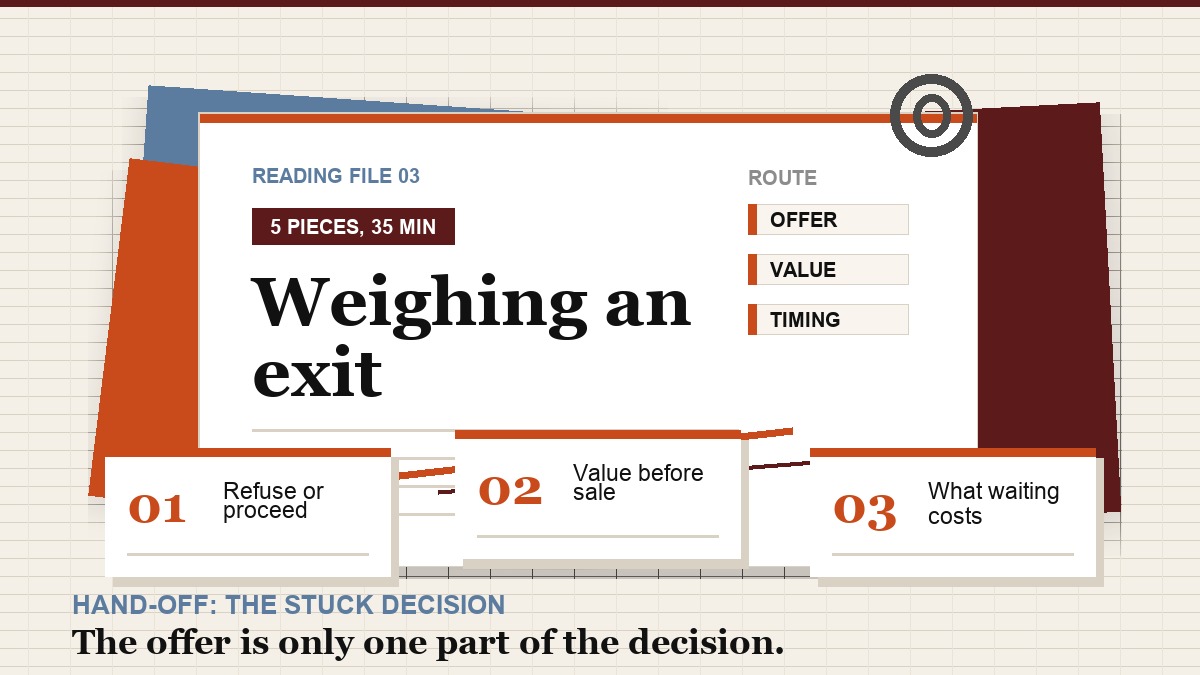
Each piece sharpens the same pressure from a different angle. The bridges tell you why the next piece belongs here and where the full path opens after the sequence.
An exit decision is rarely a decision about the offer. It is a decision about whether ownership still serves the operator, whether the next decade of work is the work the operator wants, and what value the business is unlikely to exceed if held. The sequence walks the gating question, the structural conditions under which refusing is the right move, what valuation actually means before a sale, the multi-year operational program acquirers actually pay for, and a case note in which the deferral of the decision did not avoid the conflict; it funded it.
Open with the gating question. Sell when the offer reflects a value the business is unlikely to exceed, or when ownership costs more than it returns. Two clean conditions, neither of them obvious.
The gating question runs both ways. Refusing is the right move under specific structural conditions. This guide names them, and what an offer signals beyond the price.
Before refusing or accepting, the operator needs a value frame that is independent of the offer. This guide gives the private-company valuation frame an operator needs before the offer becomes the anchor.
Value frame in place, the next layer is what acquirers actually pay for. Exit planning is a three-to-five year operational program, not a transaction process. This guide is the program.
Before a PE offer becomes the anchor, check whether the business is transferable or still depends on the owner's invisible operating system.
Closing piece. The deferral of an exit decision rarely avoids the conflict. This case note names what the deferral actually funds, in a $31M family construction business with two adult children and six years of waiting.
Every quarter an exit decision stays open, the value of the business and the cost of holding it move toward each other. The operator does not see the convergence because the metrics are quarterly and the convergence is structural. By the time the gap closes, the offer that was under consideration at month three is no longer under consideration, and the company has become harder to sell, not easier. The decision is rarely whether to sell. The decision is whether to keep paying the bill the open question is writing.
How individual business work with Stan is arranged, including the monthly format and next step.
Review the path → If you want to keep reviewingOne business problem in each issue, with its cause and what to check next.
Subscribe → If you want a private reviewIndividual one-to-one business work is $1,500/month, every two weeks and month to month.
Request scope →