You Cannot Spot Bad Business Advice Without a Real Standard
The fake is not where training starts.

Not the fake note.
The missing original.
That is the problem.
I learned this with money before I had language for it.
During the Euro changeover in 2002, the training was not a tour of every fake note on earth. It was the original again and again. Real note. Real note. Real note. Weight. Texture. Pressure. Ink. Edge. Habit.
Years later in Spain, a fake 50 did not arrive with a warning label. It just felt wrong.
That is how real discernment works.
How does studying the original improve judgment?
Studying the original improves judgment because it trains the body to notice the substitute before the mind builds a checklist. Counterfeit detection does not start with every fake. It starts with repeated contact with the real note, real source, real standard, or real decision until the imitation feels wrong.
Weak judgment studies the counterfeit all day and still gets fooled. It collects warning signs. It makes lists. It watches every new trick. What could go wrong? One better fake arrives and the whole system resets.
The stronger move is less exciting.
Study the original until the substitute feels physically off. Not intellectually suspicious. Physically off.
That rule applies far outside money.
Review the signed agreement before the summary. Review the customer words before the persona. Review the invoice before the dashboard. Review the original source before the citation chain. Review the operating standard before the employee explanation.
Boring work. Serious work.
A company that does not know the original accepts substitutes with confidence. The fake customer quote sounds close enough. The fake strategy memo sounds sharp enough. The fake expert sounds fluent enough. The fake citation looks formatted enough.
Enough is how weak settings get robbed.
AI made this more visible because output can now imitate the surface of seriousness at high speed. A paragraph can sound sourced. A citation can look real. A strategy can borrow the rhythm of expertise. The page can carry the posture of proof without carrying proof.
The person living on summaries has no alarm.
The person who knows the original source gets irritated earlier. Something does not match. The claim is too clean. The sequence is off. The citation does not smell like the document it claims to cite. The customer language sounds like a model guessing at pain instead of a buyer describing pressure.
That irritation is not cynicism. It is coaching judgment trained by contact with the real thing.
This is why original-first discernment belongs inside owner coaching. The reference standard has to exist before the business evaluates substitutes.
No reference standard, no judgment.
A founder sees the same pattern in hiring. The polished candidate has learned the language of ownership. Strong words. Calm posture. Good costume. If the founder has never studied the original behavior of ownership, the costume wins.
A brand team sees it in quality. The imitation version borrows visual signals from a real category, but the grain is wrong. The product does not carry the discipline underneath the look.
A leadership team sees it in decisions. The substitute decision has the shape of decisiveness. Meeting held. Deck made. Option named. But nobody has carried consequence, removed an option, or changed the operating rule.
Fake decisions circulate too.
Meeting held. Deck made. Option named. Everyone nods. Sounds serious. Then nothing in the company changes.
That was not a decision. That was a setting performing decision.
I catch myself wanting the shortcut too. Give me the list of warning signs. Give me the tool. Give me the scan. Fine. But the shortcut is weak if I have not handled the original.
The boring protection is boring reference work. Keep touching the original. Keep reviewing the document nobody wants to review. Keep returning to the source before the summary becomes reality.
That is not academic neatness. It is self-defense.
A person who knows the original will still make mistakes. Of course. But the mistake changes. The person is fooled by a better fake, not by every fluent substitute with a clean layout.
That is progress.
Discernment is not suspicion.
Discernment is familiarity with what is real.
Most settings want a faster way to spot fakes.
The faster way is slow first. Of course nobody likes that answer. It is still the answer.
Old story
Learn every warning sign of the fake.
Real mechanism
Study the real thing until the fake feels physically off.
THE VERY SERIOUS TRANSLATION
Official version
The best defense is a comprehensive counterfeit checklist.
Translation
Very thorough. One better fake and the checklist needs therapy.
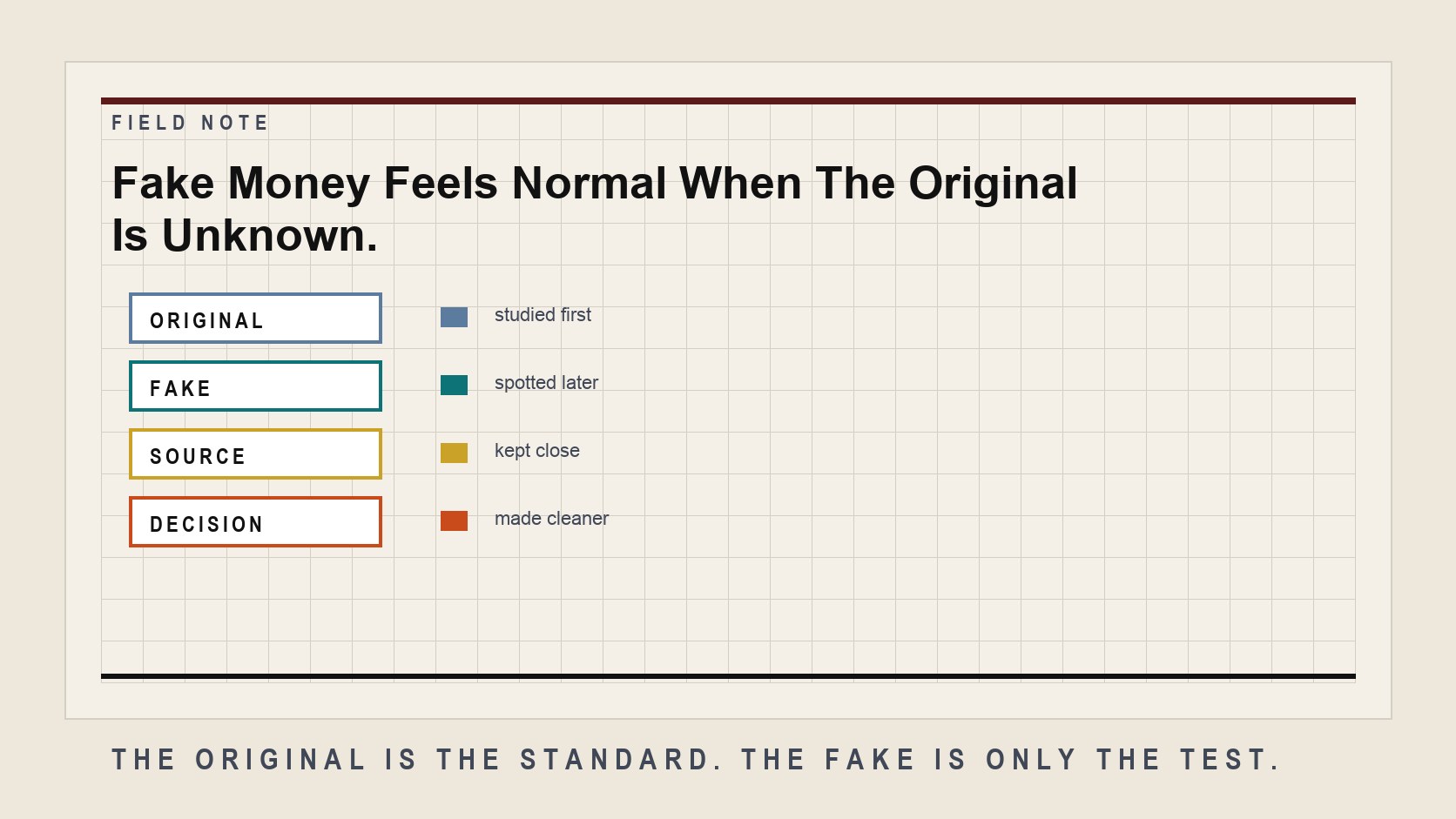
The original is the standard. The fake is only the test.

One sharp business case in each issue.
For owners building the next stage: growth, money, team movement, offers, pricing, and the decision that keeps returning.
- Owner-led companies
- One case
- No daily noise
Subscribe to the Log
If the pattern is already active, do not keep reviewing as theatre.
If the counterfeit pattern is already active in your documents, hiring, strategy, or AI-citation work, start with the two Atlas pages underneath this issue. They turn the money metaphor into a decision system.