Your Messy System Is Slowing Every Important Decision
The question is not whether there is order in the disorder. The question is how fast the disorder can answer.
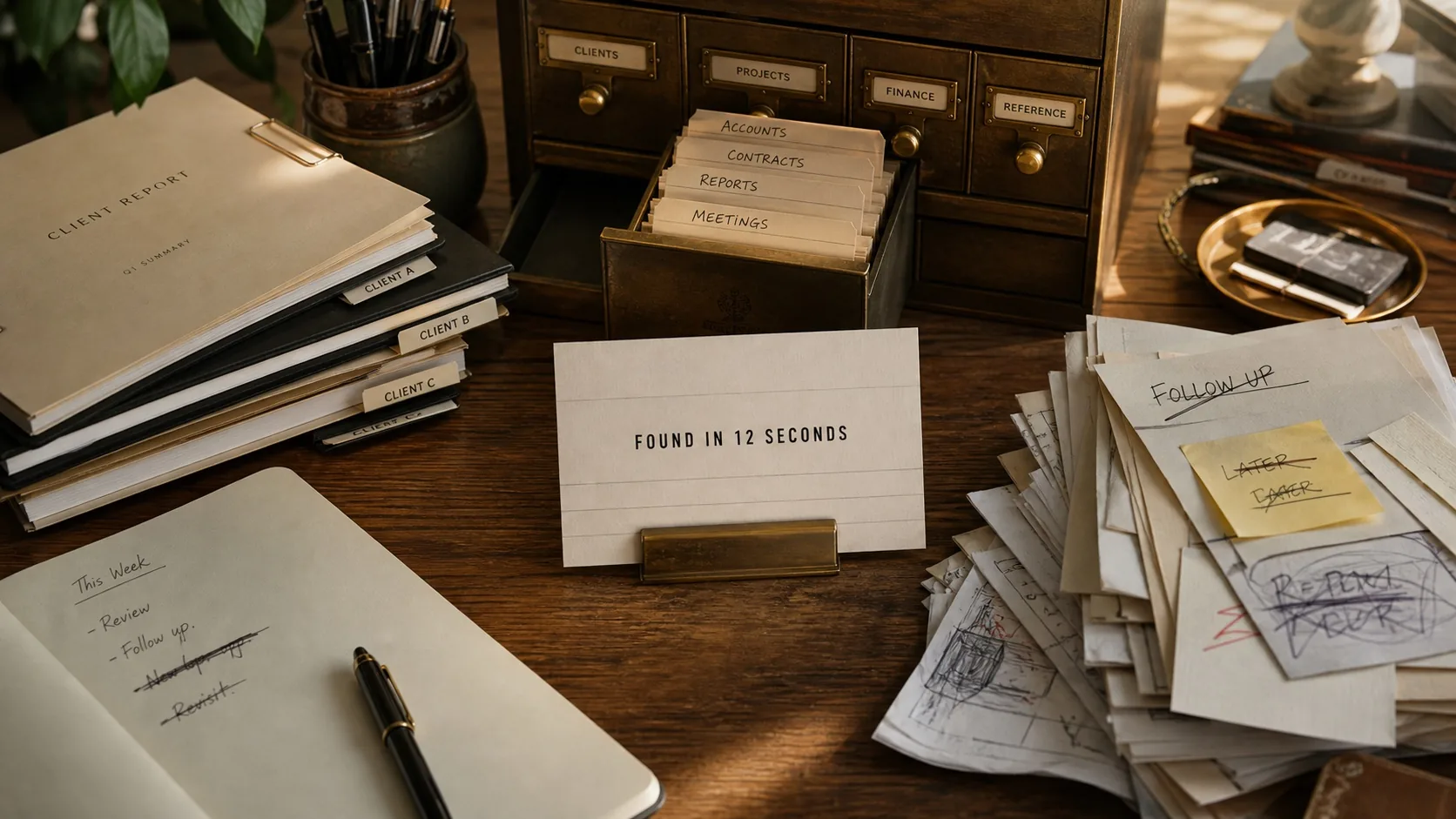
Not messy.
Unretrievable.
That is the problem.
Every messy person has a little mythology.
"It looks chaotic, but I know where everything is."
Sure.
Every pile of socks has a theology if you stare at it long enough.
Creative chaos sounds lovely until someone asks for the one client report from March, the version before the pricing change, the one with the paragraph the CFO objected to, and suddenly three adults are whispering "I know I saw it somewhere" with the confidence of people who have already lost.
That is not a filing system.
That is a treasure hunt with invoices.
When does creative chaos become a decision problem?
Creative chaos becomes a decision problem when the right material cannot return before the decision expires. The issue is not whether the owner understands the mess. The issue is whether the system can answer fast, with the correct source, version, and context. Otherwise memory starts pretending to be governance.
The real question is not whether you understand your mess.
The real question is whether your mess can answer.
Seconds.
Minutes.
Hours.
Days.
That is the audit.
If the answer takes seconds, the system is alive.
If it takes minutes, the system is usable but mildly dramatic.
If it takes hours, the filing system is now a part-time employee with no job description.
If it takes days, congratulations. You do not have archives. You have sediment.
Translation"Creative Unordnung" is "creative chaos" in English. The consulting translation is "we have decided to romanticize search cost."
Bad filing wastes time and contaminates judgment.
You review the report from one client while preparing for another. Halfway through the sentence, your brain catches the wrong company. Now you are smoothing. Reframing. Pretending the example was general. Hoping nobody noticed that the logistics case briefly became a packaging expansion.
Very elegant.
Also avoidable.
The expensive part is not the misplaced file. The expensive part is the moment the wrong material starts advising the current decision.
That is when the archive stops being a storage problem and becomes a decision problem.
A real filing system protects the work from mood, memory, fatigue, and tool enthusiasm. It knows where the original sits. It knows where the draft sits. It knows what is obsolete. It knows what can be reused and what should never escape its context.
David Allen's Getting Things Done made one useful thing hard to ignore: capture alone is not order. A trusted system has to let the mind stop babysitting every open loop.
The business version is sharper.
A trusted archive lets the company stop pretending memory is governance.
AI makes this more important, not less.
If the filing layer is weak, AI becomes a very fast intern rummaging through a basement. It may find something. It may find the wrong thing. It may sound confident either way.
So yes, the tools will change. Search will change. Memory systems will change. Assistants will change. The prompt you use in 2026 will not be sacred in 2028.
The principle is boring and permanent.
Can the system generate the right answer fast enough to protect the decision.
That is why I put the durable version under retrieval discipline. Not because filing is cute. Because an archive that cannot answer at decision speed is not organized. It is decorated delay.
Old story
The mess has its own creative order.
Real mechanism
The archive cannot answer at decision speed.
THE VERY SERIOUS TRANSLATION
Official version
The team keeps materials in a flexible creative system.
Translation
A treasure hunt with invoices is still a treasure hunt.
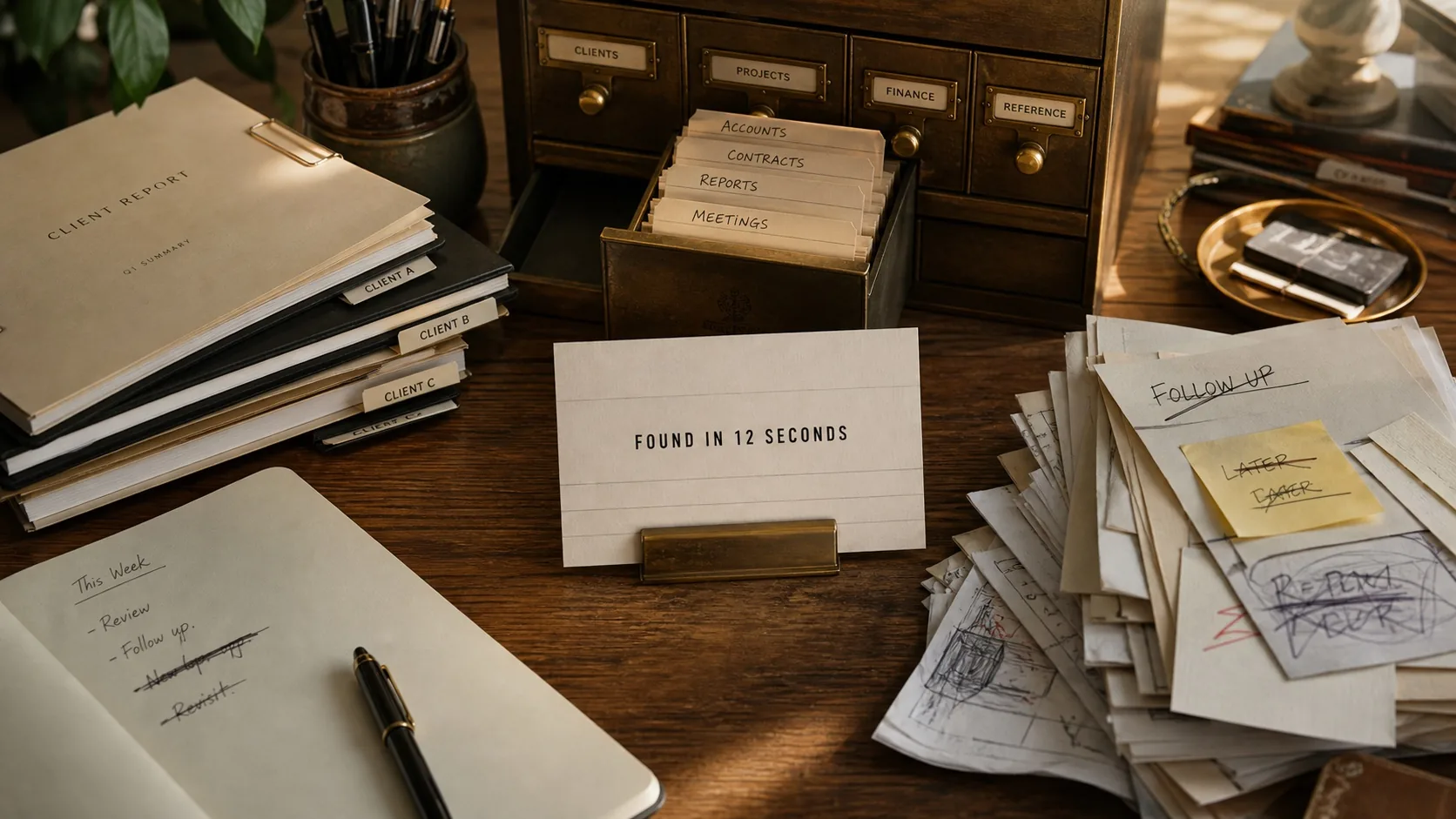
If the archive cannot answer, it is not organized. It is just confident clutter.

One sharp business case in each issue.
For owners building the next stage: growth, money, team movement, offers, pricing, and the decision that keeps returning.
- Owner-led companies
- One case
- No daily noise
Subscribe to the Log
If finding the answer depends on mood, the system is not a system yet.
Start with the Atlas page underneath this issue. It turns archiving from a storage preference into a decision-speed test.