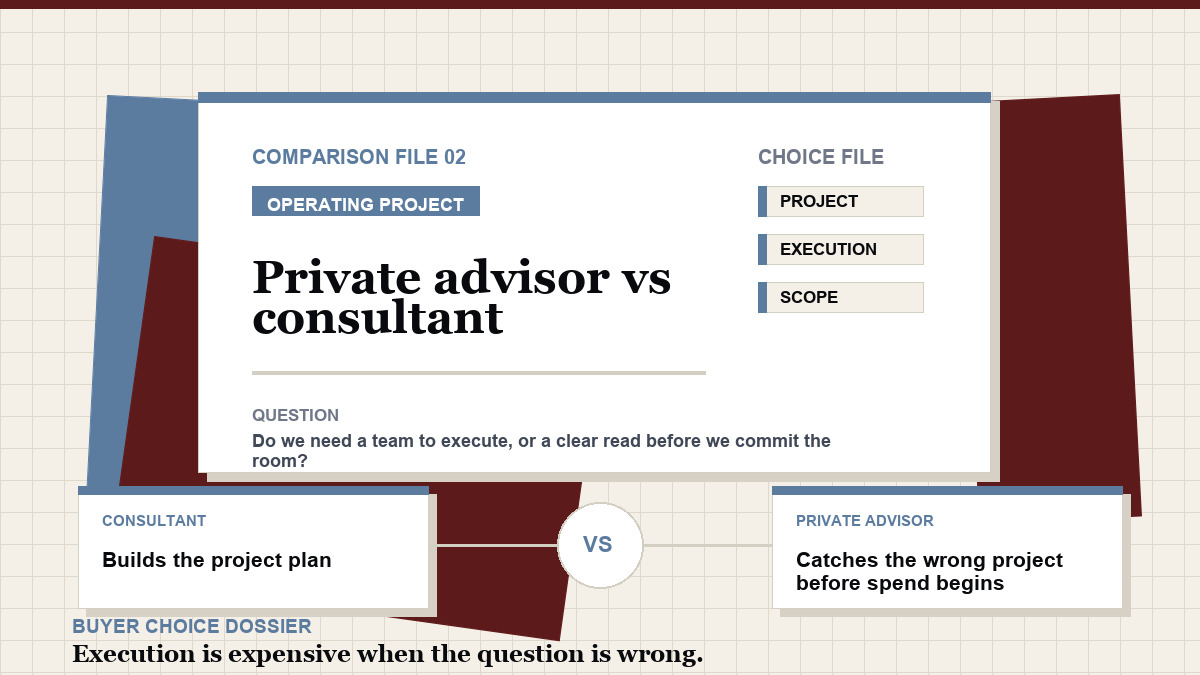
Private Advisor vs Consultant

Private Advisor vs Consultant

Short answer

Choose a consultant if you have a defined problem and want a deliverable. Choose a private advisor if you have an undefined decision and want it read. Consulting ships a recommendation. Advisory closes the decision.

A consulting firm sells a staffed engagement with defined scope and a document at the end. A private advisor sells access to a single person's judgment in real time. Knowing which one the company actually needs changes what gets built, and what gets avoided.

Comparison dossier for Private Advisor vs Consultant.
Bring the decision

Buyer language first

If you searched “business advisor vs consultant,” start here.

A consultant is best when the problem is already named and the company needs a project. A private advisor is best when the owner is still trying to read the decision itself.

  • business advisor vs consultant
  • consulting vs advisory
  • business consultant vs advisor
  • when to hire a consultant
  • when to hire a business advisor
Consultant

Use one for a defined project: research, process, implementation, benchmarking, report, or workstream. The brief is already stable.

Private advisor

Use one before the project exists. The work is to read the decision, pressure-test the frame, and stop the wrong scope from becoming expensive.

Diagnosis first

Choose the help after the problem is named.

Use this when Consultant Advisor Coach Business Problem Review
Problem clarity The problem is already defined and scoped. The owner needs judgment on the decision or direction. The person needs behavior, leadership, or accountability support. The owner does not yet know what is actually wrong or what to fix first.
First output Project plan, analysis, implementation support, or deliverable. A clearer read on the decision and trade-off. Personal development, habit, or leadership work. A plain diagnosis of the business problem, what to check first, and what not to fix yet.
Risk if used too early The firm executes the wrong scope well. The work becomes advice without enough problem definition. The business problem gets treated like a personal performance issue. The review should come before a larger engagement, not pretend to replace one.
Best next step Hire after scope and success measure are clear. Use after the decision needs owner-level judgment. Use when the constraint is the leader's behavior or cadence. Start with Business Problem Review when the help category is still unclear.

When consulting is right

Four situations where a staffed engagement is the right call.

When the advisor is right

Four situations where a staffed engagement is not the missing piece.

Structural differences

The same situation. Two different jobs.

Dimension Consulting Firm Private Advisor
Primary job Produce a structured recommendation against a defined brief Catch the structural mistake before the brief is written
Product Deliverable, report, engagement deck An accurate read on a live situation, named in the moment
Team Staffed engagement with multiple consultants One person. No team. No staffing model.
Timing Begins after the problem is framed Begins before the frame is set
Accountability Delivery against engagement scope Accuracy of the read
Speed Weeks to months of structured work Conversations. Often days.
Replaces the other? No. An advisor cannot execute a scoped project. No. A consulting firm cannot examine the frame.

Real situations

The same founder. Different problems. Different answers.

Consulting is right

A mid-market company needs a post-merger integration plan with twelve workstreams and a PMO.

The scope is clear. The deliverable is a living document. Internal capacity is thin. A consulting firm is the right answer. A private advisor has no meaningful role running the workstreams, and pretending otherwise would be expensive theatre.

Advisor is right

A founder is three weeks from committing $18M to a market expansion.

The commercial case checks out on paper. Something is off, and the founder cannot name it. A consulting firm cannot be engaged in time, and even if they could, the work they would produce is another deck against the same frame. What is needed is an examination of the frame itself: is this the right expansion at all, at this moment, for this founder. The decision behind it is the kind documented in the stuck decision. Examining that belongs to a private advisor, not to a staffed engagement.

Both, in sequence

A platform company is considering a carve-out.

The strategic question is whether the carve-out fits what the founder is actually trying to build. That question belongs to an advisor. Once the direction is clear, the operational work of carve-out execution (financial separation, TSA, buyer process, stranded cost management) belongs to a consulting firm with genuine carve-out experience. The sequence is not interchangeable. Engaging the firm before the decision is made produces the correct carve-out of the wrong asset.

Who to choose when

The question that splits them cleanly.

Choose the consulting firm when

  • The problem is operational and implementable
  • You need a documented artifact as the output
  • Data collection or benchmarking at scale is required
  • The decision has already been made, the question is how to execute
  • You have the internal capacity to absorb a structured recommendation

Choose the advisor when

  • The decision itself has not been made
  • The frame of the question has not been examined
  • You need a read fast, measured in conversations
  • The missing piece is judgment, not analysis
  • You need someone who will question the brief

Most founders who engage a consulting firm before examining the decision frame end up paying twice. Once for the engagement. Once for the consequences of acting on the correct output to the wrong question. The sequence is structural. The advisor goes first.

Common questions

Plain answers before you buy the wrong help.

What is the difference between a business advisor and a consultant?

A consultant usually works on a defined project and produces a deliverable. A private business advisor helps the owner read a live decision before the brief, project, or scope is locked.

When should I hire a consultant?

Hire a consultant when the problem is defined, the output is clear, and the company needs research, process design, implementation support, or a documented artifact.

When should I hire a private advisor?

Hire a private advisor when the decision is still unclear, the question itself may be wrong, the window is short, and the owner needs judgment before buying a larger solution.

Can I use both a consultant and an advisor?

Yes. Often the advisor belongs first, while the decision is being framed. A consultant belongs later, once the company knows what work actually needs to be done.

Where to go next

Run the work yourself first

Two manuals from /craft sit next to this comparison.

Private Advisory

The decision is already forming.
Bring it before the brief closes wrong.

Short application. Direct reply within 48 hours. The first conversation examines whether the brief you are about to write is the correct one.

Apply now

Principal Circle $4,500 / month  ·  Operating Partner by application  ·  Ways to Work