Comparison · Business Coach vs LinkedIn Influencer
Use useful public content to learn, compare ideas or answer a general question. Consider private business coaching when you want someone to examine your situation with you. The same person may publish and coach; assess the content and the service separately.
Public content can teach a method, offer a useful perspective or show how someone thinks. A private engagement can examine the details you choose to share and continue as your business changes. Neither format proves expertise, independence or a good result. Look at the evidence, incentives and agreed responsibilities.
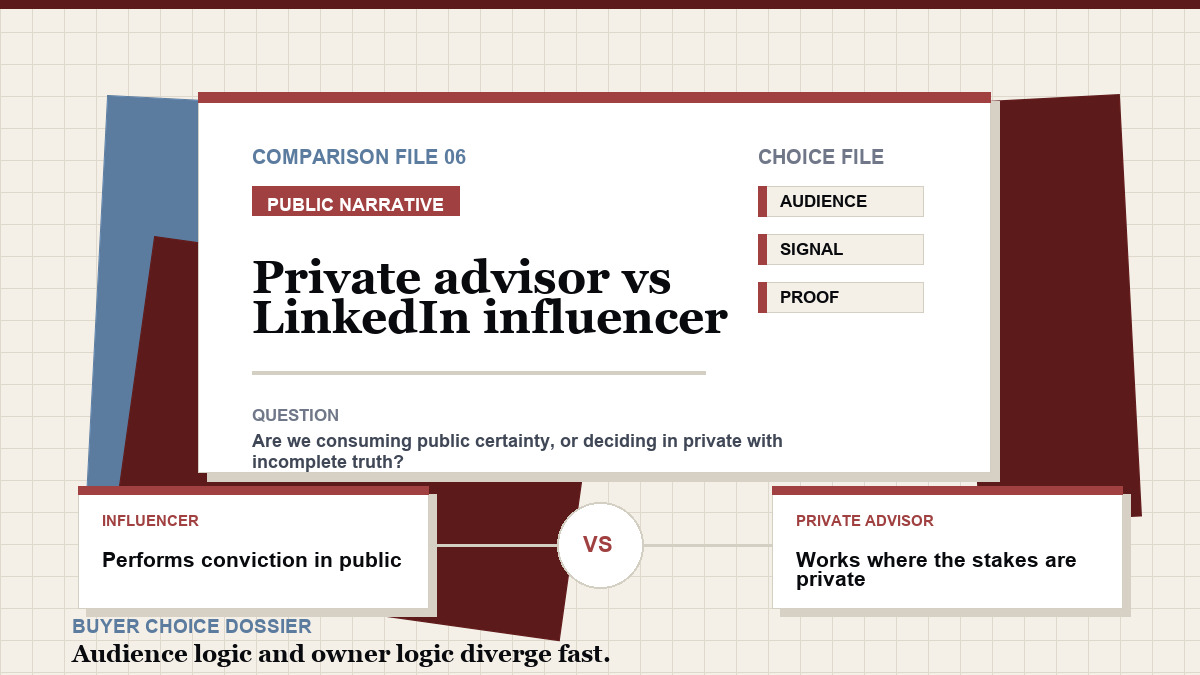
When the influencer is the right input
Recognizing a pattern in your own situation. A well-written LinkedIn post or paid newsletter names a pattern that the operator has been carrying without language for it. The recognition is real. Same as a good essay or book. Cheap, fast, valuable.
Acquiring the language of a domain. Reading a thoughtful operator on cap-grid mechanics, board dynamics, or sales-org structure builds the vocabulary you need to brief a lawyer, a VC, or a future hire. The content is the introduction, not the destination.
Sampling many takes on a question. When you do not yet know whose framing fits your situation, reading multiple thinkers on the same question is useful. The content surface lets you compare frames before committing to one.
Building understanding over time. Save useful explanations, compare their assumptions and test them against what you observe. Reading a large number of posts does not by itself establish sound judgment.
When a business coach is the right call
Your question depends on particular facts. An article may explain a supplier change. Your decision also involves your contract, stock, customer promises and available cash. Private help can examine those details with you; the provider still needs relevant expertise.
The decision is moving in real time. A post is a frozen take from when it was written, against a generalized situation. A business coach can review what you are saying right now, what you are not saying, and how the situation has evolved between calls.
You want continuing work on the business. A useful article remains available to revisit. Ongoing coaching can add conversations about what happened after you acted. Confirm the meeting cadence, record keeping and follow-up rather than assuming every service includes them.
You need agreed responsibilities. Public writers and paid coaches can both have commercial incentives. Before paying, agree what the provider will do, what evidence they need and what remains your responsibility. A private conversation does not transfer your decision to the coach.
The structural difference
| LinkedIn / paid newsletter | A business coach | |
|---|---|---|
| Audience | A public or subscriber audience; size varies. | The participants agreed for the private engagement. |
| Output | A post, an essay, an issue. Generalizable take. | A review of your specific situation and your specific decision. |
| Continuity | Articles and archives can be revisited. Personal follow-up is not implied by access to content. | Continuity and follow-up depend on the agreed service. |
| Direction of review | From the writer’s frame outward to a generalized audience. | From your situation inward to its structural shape. |
| Revenue model | May include subscriptions, ads, sponsorships, courses or sales of other services. | A monthly fee or an agreed project fee, depending on the provider and scope. Clarify deliverables and fees before starting. |
| Cost of being wrong | A reader can act on bad information. Check sources, limitations and incentives before relying on it. | Advice can also be wrong. Agree responsibilities and review the work; payment is not a guarantee. |
| Best use | Recognition, vocabulary, range of frames, multi-year scaffolding | Business work using your context, with follow-through as agreed |
Influencer is the right input
General-pattern question. Read three thoughtful operators on Series A board dynamics. Build the vocabulary. The content surface is the right input. Do not pay for coaching when a good post answers the question.
Business coach is the right move
A post cannot establish why this particular person is quiet. Prepare the facts and speak with them where appropriate. A coach may help you prepare that conversation; neither the coach nor a post can infer the answer from silence alone. Explore business questions.
Both, in sequence
Read relevant explanations to prepare your questions. If you need help applying them, compare providers with experience of that work. Public learning and private help can be used together; neither must always come first. Owner workload may be part of the discussion.
Public content and business coaching can complement each other. You do not need to buy coaching simply because a question matters. Use the help that contributes something useful to the work, with clear scope and responsibilities. See ways to work.
Run the work yourself first
Apply for business coaching
Stan reviews each request for fit. All corporate work starts with an inquiry and is quoted separately. Stan confirms the people, stakes, scope, and fee in writing before work starts.
ApplyBusiness coaching · $1,500/month 1:1 business work · Request scope
