Fractional Leadership vs Training
Fractional leadership runs the function this quarter. Training builds the in-house capability to run it next year.
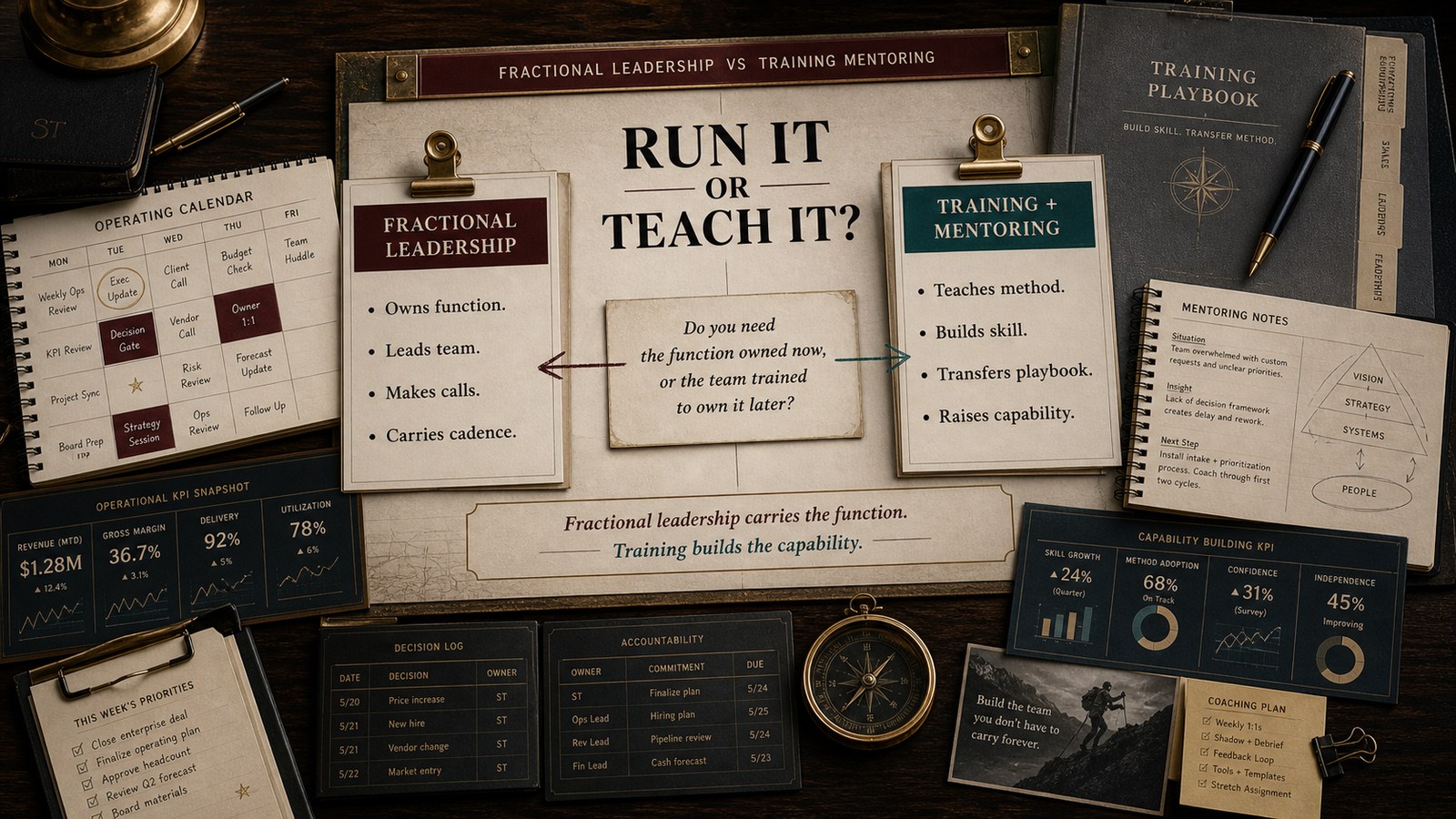
These two roles are easily substituted when the founder thinks "training" can replace operational ownership. It cannot.
The CEO buys a sales training program. The sales VP seat is still open. After eight weeks the team is now better trained and still leaderless. The numbers say the same thing they said before.
When Fractional leadership is right
The seat is empty.Training assumes a person in the seat. There is not one.
Operations are failing in real time.Cannot wait for a curriculum.
Eight-week horizon.Training is a longer arc.
Day-to-day decisions need to be made now.A seat. Not a class.
When Training is right
The seat is filled. The person needs a specific skill.Sales technique. Operations methodology. Finance literacy.
Repeatable motion to teach across the team.Sales motion. Onboarding. Retention.
Junior team needs to grow into more responsibility.Curriculum and mentor.
Knowledge transfer before a senior leaves.Mentor catches what would vanish.
Structural differences
| Fractional leadership | Training | |
|---|---|---|
| Subject of the work | The function | The people in the function |
| What gets built | Output this week | Capability over months |
| Engagement shape | Operator in the seat 2-3 days per week | Curriculum, mentor sessions, repetition |
| When it ends | When the function has a permanent owner | When the skill is demonstrated |
| What fails when wrong | Operator running a function that should be teachable | A trained team running into an empty seat |
Real situations
Fractional leadership is the answer
Fractional. Training is not the answer to an empty seat.
Training is the answer
Train them.
Neither is the answer yet
Wrong substitution. Fill the seat first.
Who to choose when
Training does not fill an empty seat. Fractional leadership · Training and mentoring.
When coaching fits
If the question is one layer above the comparison on this page, business coaching sits with the operator before money goes out the door.
See ways to work