Review your own books · owner financial review
Profit, margin, aging, cash and concentration in one editable workbook. Replace the illustrative figures with your own records; formulas calculate the results.
Download workbook (XLSX) Jump to Q&A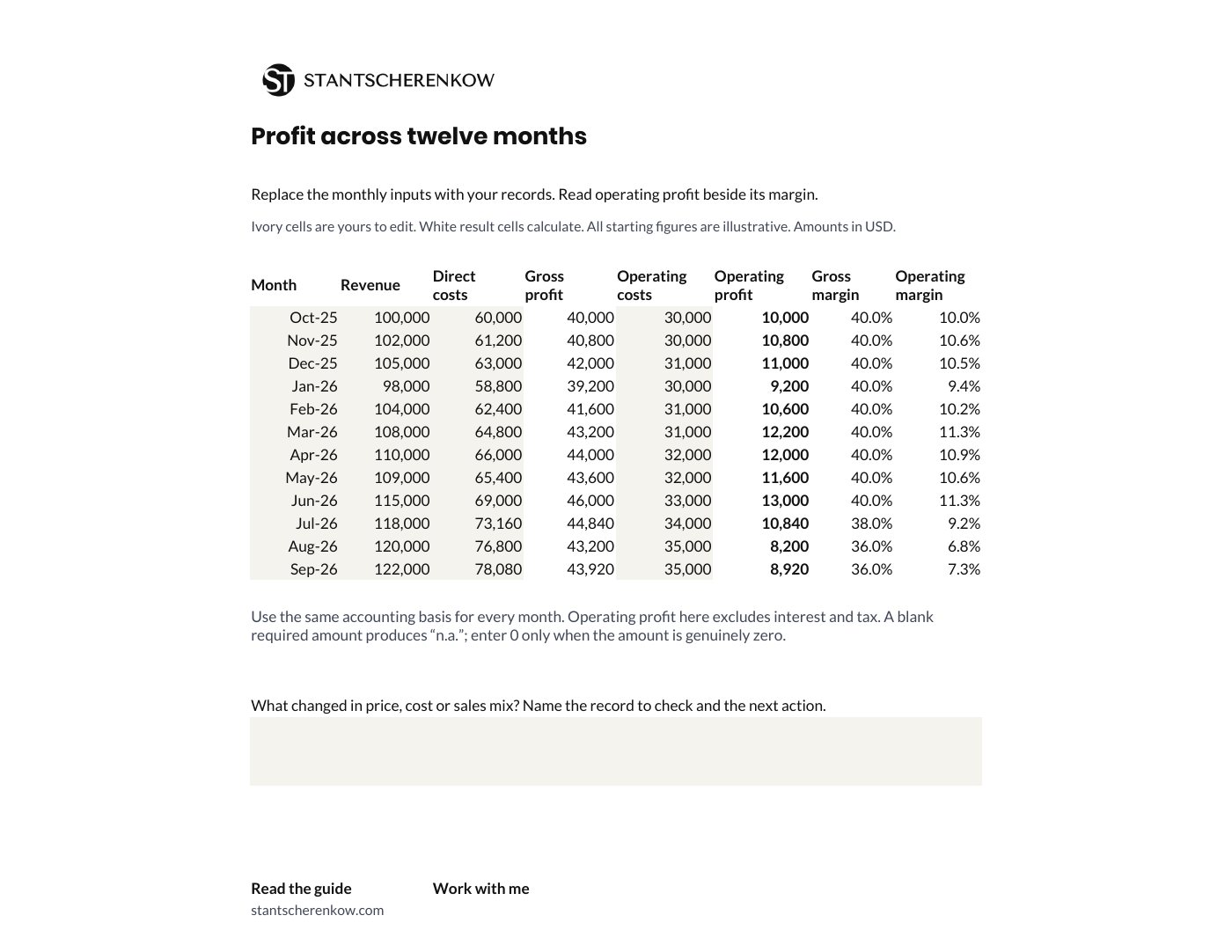
Download the five-view spreadsheet (XLSX)
Five tabs: Profit, Margin, Aging, Cash and Concentration. The starting numbers are clearly labeled illustrations. Replace the shaded inputs with your records; the formulas calculate margins, aging totals, weekly cash and concentration.
The workbook does not import from accounting software. Keep each report on the same accounting basis and period. Dates and concentration watchpoints are editable. Read the instructions beside the inputs.
Short answer
The bank balance tells you what already happened. The five-view review helps you examine trends and expected cash timing. You pull trailing profit, margin, aging, a thirteen-week cash projection, and concentration, and each one ends in a question you answer in writing.
The point is not tidy books. The point is timing. You can compare margin changes and expected cash low points, then investigate the causes and timing.
Profit is twelve months wide, so the line that stepped up and stayed is obvious instead of buried in one busy month.
A customer past 25%, a supplier past 40%, a lender past 70% each trips a written action instead of staying a worry.
Three questions go out before the close, so they arrive with observations instead of raw outputs.
Why this exists
You check the bank balance every morning. Six seconds, and it tells you almost nothing about what is coming. By the time the balance moves, the thing that moved it happened weeks ago, somewhere you were not looking. The receivable slid from sixty days to ninety. The top product gave up a margin point. One customer crept to thirty-eight percent of revenue. None of it was hidden. It was in the books. You were reviewing the balance.
Review the reports with the people who can explain the records and the operating assumptions.
The five views
The line that was flat for nine months and then stepped. The column view hides it. Across, it is obvious, and the step is the signal.
Revenue up with margin down is a warning, not a win, and it is invisible at the company level. Catch it on the line that actually pays.
Both in the same buckets, side by side. Anything that crossed from sixty days into ninety is the collection call you make this week.
Cash plus receipts minus payments, week by week, with your floor as a line. The lowest projected week depends on the dates and amounts you enter.
Top customers, suppliers, lender. Cross 25%, 40%, or 70% and the sheet names the conversation it is time to have.
A number with no action attached is just a worry with better formatting.
Who it is for
You own or run the business, the books get filed on time, and you review the bank balance daily and almost nothing else. You have been blindsided by a cash squeeze that, looking back, someone should have seen. You want to review the numbers like the person who has to live with them.
One month, in four moves
Freight was flat for nine months, stepped up two months ago, and stayed. Buried in the column view. Obvious across. You note it.
Revenue was up, so nobody flinched. Margin says the extra revenue came at a worse price. That is a sales conversation, not an accounting one.
Your largest customer crossed twenty-six percent. The sheet flags it. Now it is a relationship review on this week's calendar, not a call you take by surprise next year.
The accountant arrives having looked, and mentions the freight step is a contract renewing next month. The cost now has an owner and a date.
Operator facts most owners learn late
Working capital absorbs the profit. A good month on the profit line and a worse balance in the bank is the aging report and the cash view talking.
Compare twelve months to see whether a change is isolated or part of a longer trend. Check the records and business context before interpreting it.
One customer at a third of revenue is comfortable right up to the day they call. The threshold turns comfort into a dated decision.
The thirteen-week view can flag a projected shortfall; it cannot foresee an event or payment delay missing from its inputs.
Questions owners actually ask
Five reports you pull from the books each month: trailing profit review across twelve months, margin by product or customer, receivables and payables aging, a thirteen-week cash projection, and concentration. Together they support a review of trends, unpaid bills and expected cash timing.
An accountant may prepare records, advise and help explain changes; agree the scope you need. This sits on top of their work and asks what each view means for the next ninety days, with thresholds that turn a number into an action. It does not replace the accountant. It changes what you ask them.
There is no fixed review time. It depends on the records, the number of products or customers and the questions that need checking. The workbook supplies the layout and formulas; entering and verifying your data still takes work.
Two views: trailing profit across twelve months, and the thirteen-week cash projection. Write a short note beside each. Add the other three once that review is useful and repeatable.
Download the workbook above. Start with Profit and Cash. Replace every example input in the view you use, including its dates. Blank required amounts show as unavailable; a real zero remains zero.
In the cash example, $25,000 opening cash plus $12,000 receipts minus $11,000 payments leaves $26,000. If a later payment rises by $10,000, that week and every subsequent cash balance fall by $10,000. Change an input and check the result before using the sheet.
The 25%, 40% and 70% concentration watchpoints are editable examples, not universal safety limits. Choose review points that fit your contracts, alternatives and business.
Where it stops
The pack surfaces the margin drift, the cash squeeze, and the customer who became a dependence. It does not tell you whether to fire the customer, hold the price, or change the model. When the numbers are clean and the decision under them is not, business owner coaching is where that call gets looked at by someone with no stake in your story.
Back to the manual →Use this with
Clean layout
Fix the map when the books file correctly but still review like fog.
Decision layer
See what changed after the monthly review surfaced the real signal.
Manual
Return to the full monthly method before changing the spreadsheet.
When the numbers need a conversation
Business owner coaching applies the same monthly review to the situation in front of you. The session separates noise from evidence and ends with a clear next move.
Find the next business moveTired of guessing what to fix? Too close to see the pattern? See how business owner coaching works.
Work with Stan
Start with Work with me for monthly 1:1 business work, or request scope when the issue involves board, ownership, partner, leadership, or larger collaboration.
