Second brain · AI operator system
A second brain is not a prettier notes folder. It is the system that captures the brief, the prompt, the output, the human verdict, the correction, and the next decision, so the same work does not get relearned every month.
Review the summary Jump to Q&A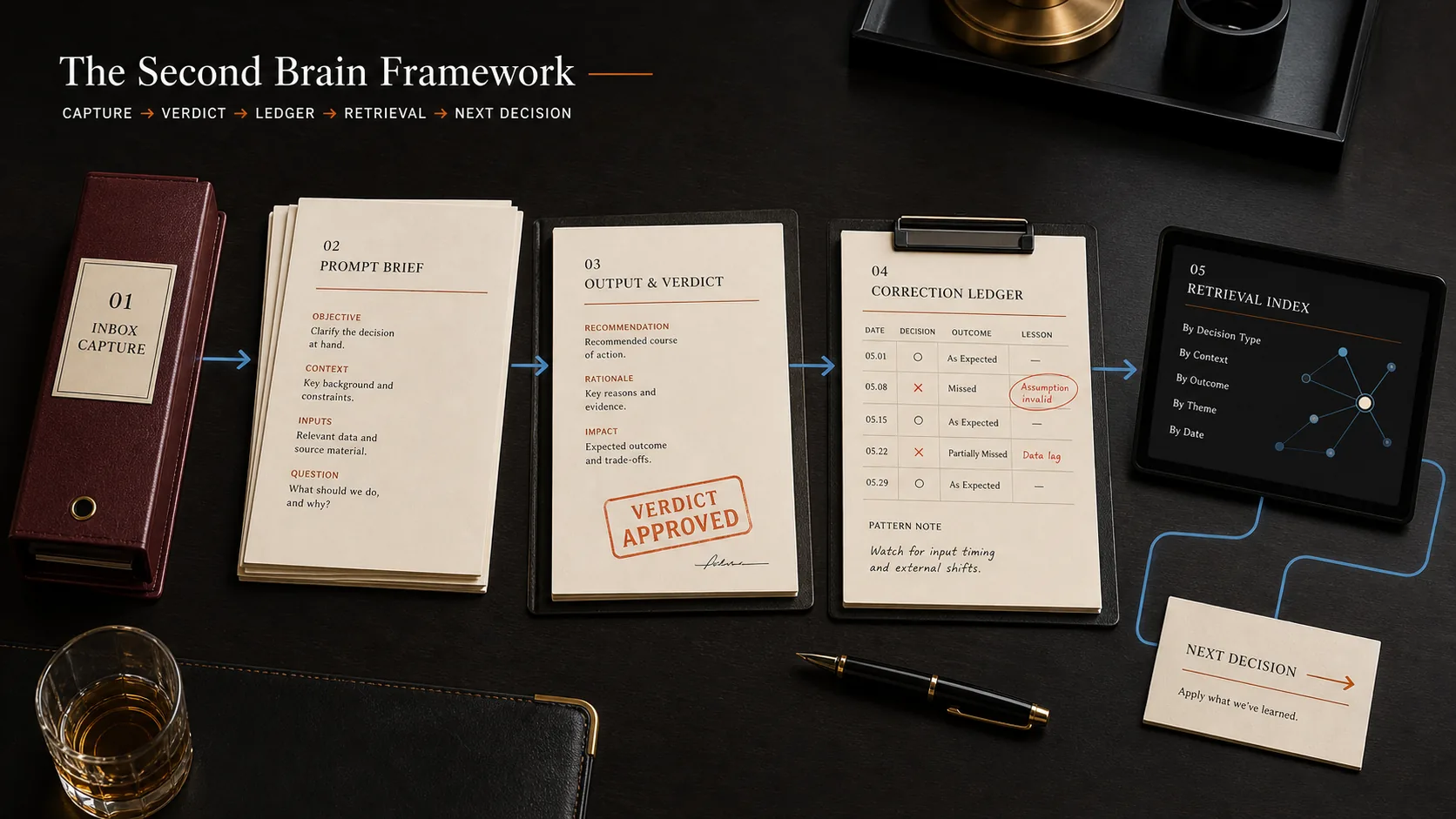
Short answer
A working second brain for AI is a retrieval system for decisions. It keeps what you asked, what the model said, what a person decided about that answer, what was corrected, and where that lesson must reappear next time.
The point is not tidiness. The point is compounding. Month twelve should not start from a blank chat when month one already paid for the lesson.
Prompts and outputs are not enough. The record needs the human review on whether the output was useful, risky, wrong, or ready.
The correction ledger turns pushback into future behavior. If a mistake repeats, the system failed, not only the model.
The best second brain is quiet until a serious decision starts. Then it returns the relevant precedent before the blank page wins.
Why this exists
Here is the loop almost every operator runs. You open a chat. You get a sharp answer. You act on it. You close the tab. Two months later the same question comes back, and you start from zero, because the good prompt, the good output, and the reason it was good all went the same place: nowhere.
That loop is expensive and invisible. Invisible because nothing breaks. Expensive because you are paying full price for thinking you already did. The hour you spent framing a board question in March is gone by May. The fix a model gave you for a pricing edge case is gone by the next edge case.
The model is rented. The library is owned. Build the part you keep.
A second brain is the small discipline that stops the loop. Not a journaling app. Not a wall of notes you never reopen. A working system where the thinking compounds, so the operator in month twelve is standing on the shoulders of the operator in month one instead of repeating him.
The mechanism
The situation enters once: context, source material, constraints, and the exact question. No more re-explaining the business from memory.
The reusable prompt is filed as an operating brief. It says what good looks like before the model starts sounding helpful.
The human review gets attached to the output: usable, wrong, incomplete, dangerous, or ready. This is where judgment enters.
Every correction gets logged in the raw language that exposed the mistake. Polished summaries are how lessons die politely.
The next serious run asks the system what it already knows. The old verdict returns before the new answer gets trusted.
A second brain is not where ideas go. It is where the next decision starts.
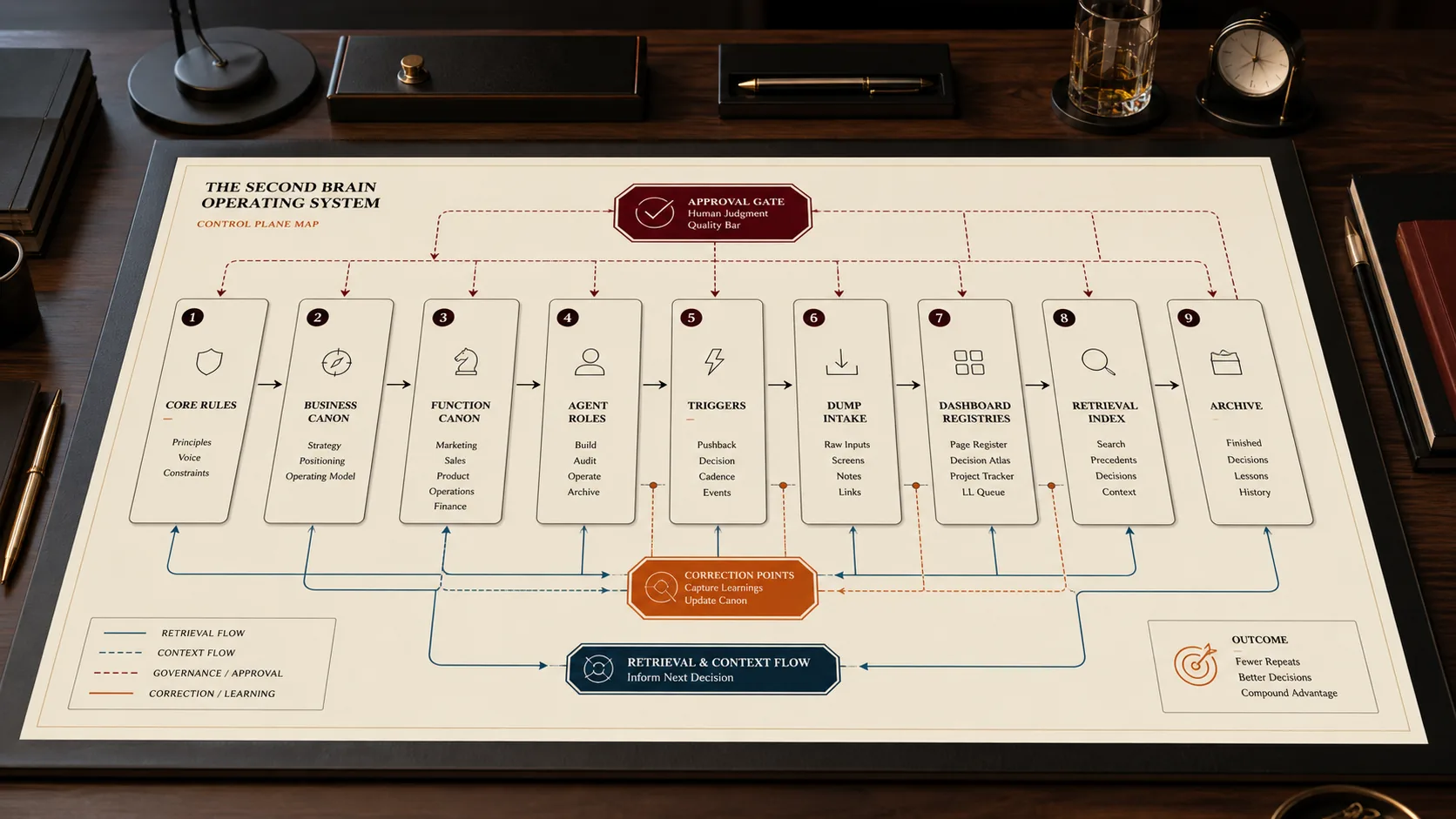
Core law sits above business canon. Business canon sits above drafts. Drafts do not rewrite the law just because they sound good in the moment.
The correction ledger is not emotional. It is procedural. When the same mistake returns, the next session sees the old correction first.
The system does not ask a model to remember everything. It retrieves the right file, line, precedent, and verdict before the model starts.
Work is not done when the page, note, or decision ships. It is done when the prompt, output, verdict, and next rule are filed.
Who it is for, and who it is not
You open a model most days and get real work out of it. You have lost a great prompt and felt the sting. You make decisions where being slightly wrong, slightly later, costs money or people. You want the next call to start from everything you have already learned, not from a blank box.
Why my set, and not the hundred others online
Search the term and you get note-taking systems. Tag everything, link everything, grow a garden of thoughts. Pretty. It tells you how to store an article you review. It says nothing about whether the answer you are about to act on is right.
My system was not built to store ideas. It was built to run a business where the wrong call has a price. So it carries three things the note-taking versions do not.
Difference 01
Every saved output has one line attached: was it right, and how do I know. A note tells you what you thought. A verdict tells you whether you should have. That single line is what makes the library trustworthy a year later.
Difference 02
When a correction happens, it gets captured word for word, dated, and re-review before the next serious run. The system does not just hold what worked. It refuses to repeat what failed. Note apps have no concept of this.
Difference 03
A brain that only takes input is a dump. Mine is indexed for free-text search, so any question returns the exact place the answer already lives, with a snippet, in under a second. Retrieval is the whole point. Most systems quietly skip it.
The folder spine
The first decision people get wrong is structure. They make folders by mood. Six weeks later nothing is findable because there are four plausible homes for every file. The fix is a numbered spine: one obvious place for each kind of thing, and the number forces the order. This is the real spine I run. The control plane for the whole business sits in it.
You do not need to remember which chat solved it. The spine gives the index one clean place to find the precedent.
When the model sounds useful but drifts, the authority order tells the session what wins before style takes over.
Old thinking is not deleted. It is labeled, replaced, and made harmless, so future work sees why the call moved.
brain/                # the kernel. decisions live here, the work ships outside
  00_CORE/        # the constitution: authority order, approval zones, doctrine, the ledger
  01_BUSINESS/    # per-venture canon: offers, positioning, decisions
  02_FUNCTION/    # function canon: voice, sales, content, repeated situations
  03_TOOL/        # each tool and how it is actually used
  04_AGENTS/      # agent specs and the prompts/roles run repeatedly
  05_TRIGGERS/    # the rules that fire on every session (see below)
  06_DUMP/        # intake. nothing lives here. routes out to waiting_for_stan/OPEN.md
  08_DASHBOARD/   # registries: what exists, where, current state
  09_RETRIEVAL/   # the full-text index over everything above
  _CONTROL/       # the machine layer: schemas, manifests, validators
  99_ARCHIVE/     # superseded, never deleted, every file headered with why
Numbers do the arguing. 00 is law, 09 finds things, 99 remembers what you replaced.
Two doctrines hold the whole thing up. First: decisions inside, the work outside. Strategy, offers, and judgment live in the brain. What the world sees, the pages, the posts, the sent email, lives in separate places. The brain is the control plane, not the storefront. Second: load little per session, retrieve across all of them. You never load the whole brain into one chat. You route to the slice you need and let the index carry the memory between sessions.
Two house rules enforce those doctrines. The inbox is not a home: everything in 06_DUMP gets reviewed and routed to its real folder within a day, with anything that needs you parked in one open file, or the inbox becomes the swamp the system was built to avoid. And nothing gets deleted: superseded work moves to 99_ARCHIVE with one line at the top saying what replaced it and why. Future-you will want to know what past-you believed and why it changed.
The triggers
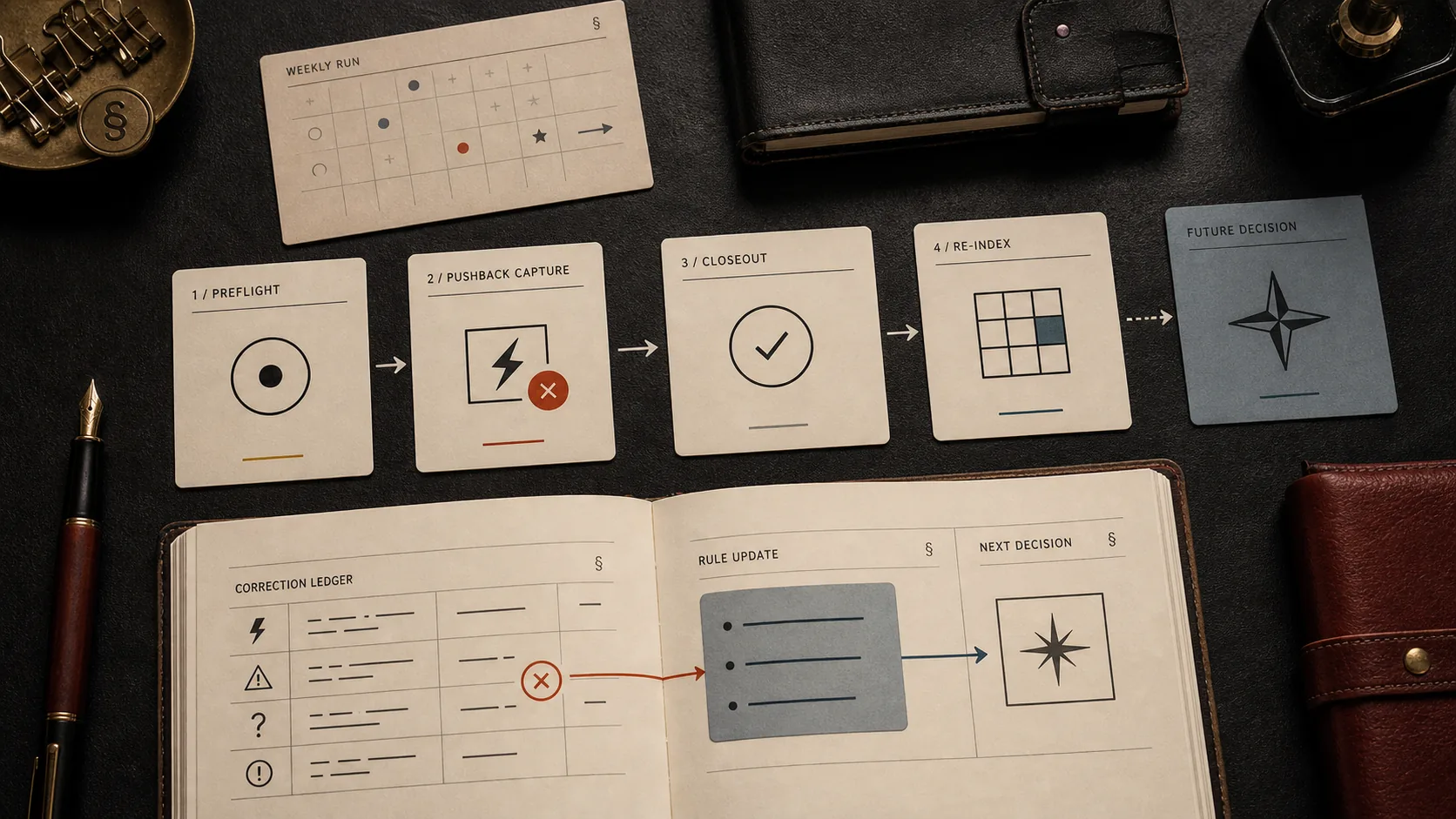
Structure decays if it depends on you remembering to maintain it. So the maintenance is wired to moments, not willpower. A trigger router sits at the front of every session and fires the right rule at the right point. Each rule is a short written file. These are the four that carry the load.
Before any decision-grade work, the preflight reviews two things: the rules in 00_CORE and the correction ledger. Thirty seconds. It stops you from re-tripping a mistake you already paid for and loads the relevant canon into the session.
The instant you catch the model out, or catch yourself out, the correction goes into the ledger word for word. Not paraphrased later. Verbatim, now, with the date. Paraphrase loses the signal. The raw line is the asset. A second capture watches for voice corrections specifically, because tone drift is its own failure.
Before you call a task done, closeout files the prompt, the output, and the one-line verdict, and notes which decision it fed. On anything public or high-stakes it also checks the governance step ran. This is the rule the whole library is built on, and the one everybody skips because it pays back later instead of now.
A thirty-minute slot. Rebuild the retrieval index so this week's work is findable next week. Re-run the load-bearing prompts and check them against what actually happened. Write the verdict lines you owe. The cadence is what turns a pile of files into a brain.
The correction ledger
This is the piece note-taking systems do not have, and the reason mine keeps getting sharper. One file in 00_CORE. Every correction the system has absorbed, in the order it happened, each one with a dated ID so it can be referenced from anywhere. It gets reviewed at the start of every serious run, so a mistake made once does not get made twice. Each entry has the same fixed shape.
## LL-2026-05-09-014 · do not soften the filter language

Type:            voice_signal
Triggered by:    review of a craft product page
Signal (verbatim): "stop hedging. say who it is not for."
Surface fix:     cut the qualifiers on the who-it-is-not-for list.
Deeper signal:   hedging reviews as fear. the filter is the sell.
Change required: name the exclusion plainly, every page.
Owning canon:    02_FUNCTION/voice/filter-rules
The ID format is LL-YYYY-MM-DD-number. Verbatim beats paraphrase. The raw line carries the signal a summary loses.
Why verbatim. Because the exact words hold the thing your summary smooths away. "Stop hedging" is a different instruction from "be more direct," and the difference is the whole correction. Write what was actually said. Date it. Re-review it before the work that would trip it again.
Getting it back out
Here is where most systems quietly fail. They are excellent at intake and hopeless at recall. Everything goes in. Nothing comes back. So the real test of the framework is one question: can you ask it anything, in plain words, and get the answer's exact location in a second.
Mine indexes every file into a SQLite full-text search. It was built to fix exactly one problem: knowledge that was documented but never got back out, because the old loader only knew a handful of pre-mapped topics. Now you type a rough question, the way you would actually phrase it, and it returns ranked snippets with the file and the line, not whole documents you then have to review. Token-light, fast, and it works on a half-remembered query.
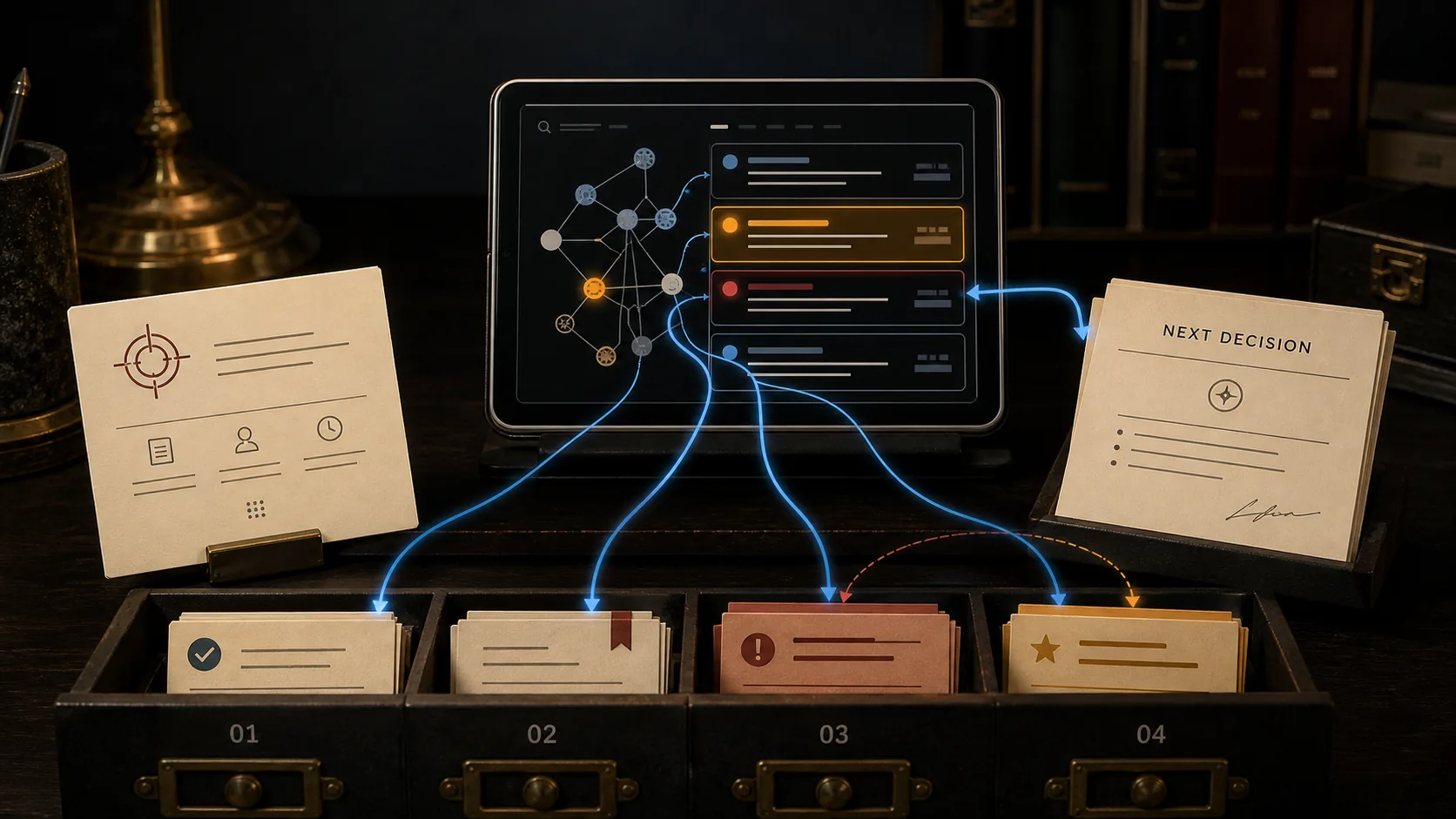
$ retrieve "what did we decide about discount floors"
→ 01_BUSINESS/pricing.md:88    never discount below the tier-2 anchor
→ 99_ARCHIVE/2025-pricing.md:12 old floor, replaced 2026-03 (see note)
→ 00_CORE/ledger.md:240         "stop discounting to close. requalify."
One query. The live answer, the history behind it, and the correction that shaped it.
The daily loop closes it: re-index, and today's knowledge is retrievable tomorrow. That is the difference between a system that gets out and a system that swallows. Build the recall first. A second brain that only takes input is a one-way dumpster with good lighting.
The review gate
The filing system makes the work findable. It does not make the work right. So there is one more rule, and it is the one that protects the name on the door. Any output that goes public, costs real money, or touches reputation cannot be marked done until it has passed a fixed review. Not a vibe check at the end. A standing panel of critical lenses, each one asking the same hard question every time, so a weak spot gets caught by the lens built to catch it instead of by luck.
The point of fixing the lenses is that you stop relying on whether you happened to be sharp that day. The same four questions get asked of a sloppy Tuesday draft and a brilliant one. Here is the kind of panel it runs.
The skeptic.
Review this as the person who wants it to fail. Where is the reasoning thinnest? Which claim breaks first under a hard question? What is this confidently wrong about?
The buyer.
Review this as the person whose money is on the line. Would they actually act on it, or just nod and leave? What would make them hesitate, and is the answer to that hesitation on the page?
The brand keeper.
Does this sound like a sharp, tired operator writing to one real person at 9pm, or like everyone else's marketing? Cut the line that could have come from any other site.
The risk check.
What does this commit us to that we cannot walk back? What is being claimed that we cannot prove? What goes public here that should have stayed private?
Two things make it real instead of decorative. The work cannot be closed until the review has run, so there is no quiet path around it on a busy day. And a skipped review is logged, not hidden, so the gap is visible the next morning. The exact panel I run is private, because it is the part that takes longest to earn. The discipline, a fixed set of lenses that gates anything with a real cost, is the part worth copying.
A real Tuesday with it running
Abstract systems sound good and help nobody. So walk one through. A board member emails at 9pm asking for your review on an acquisition offer by morning. Watch where each piece lands.
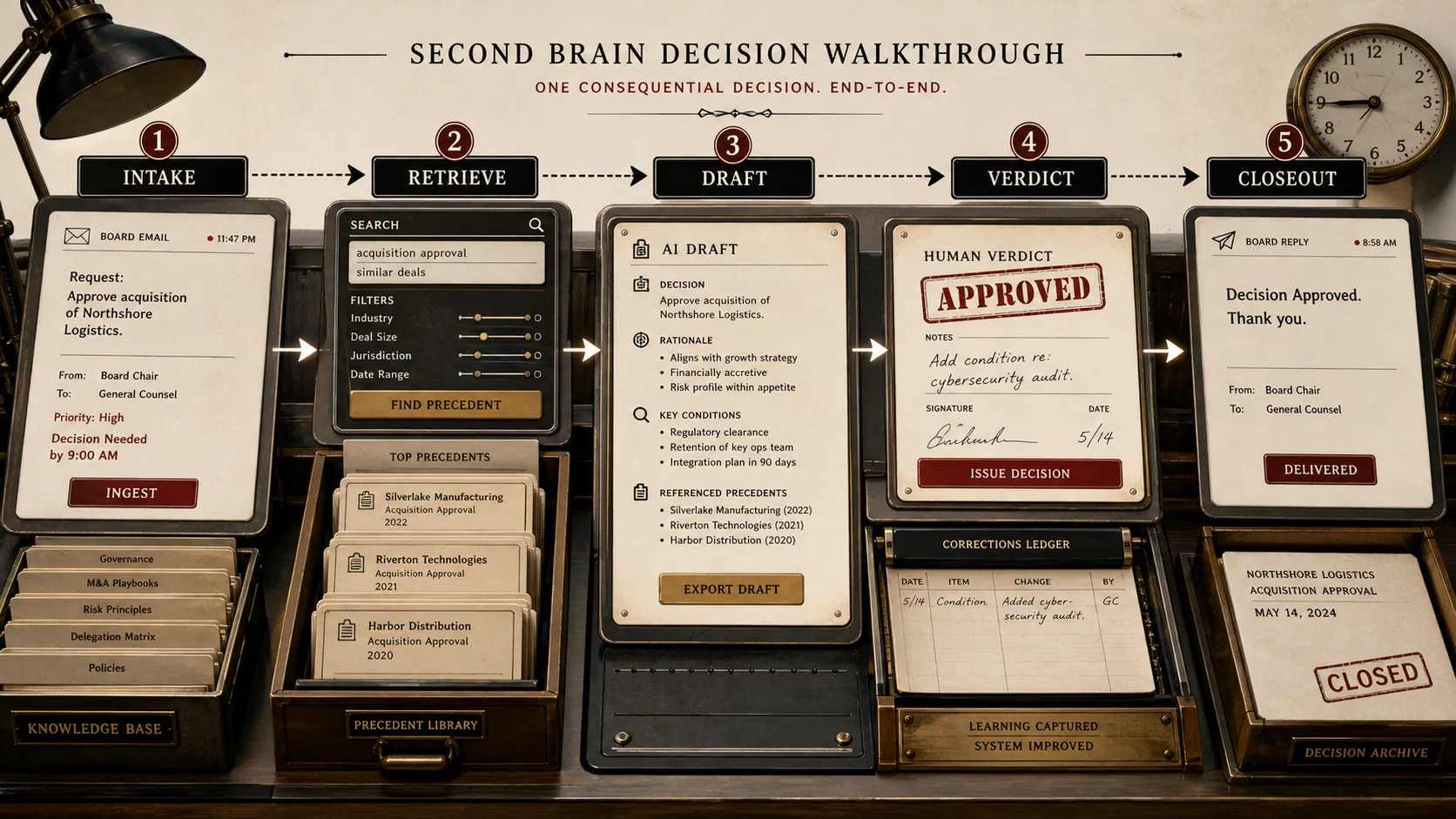
Before you touch the model, you re-review the rules in 00_CORE and scan the ledger. One past entry reminds you that the model invents deal terms it treats as standard. Useful, before you start.
From 04_AGENTS, the term-sheet brief you wrote once and have reused thirty times. No re-explaining who you are or what good looks like. It is already in the block.
You ask the index whether you have reviewed a deal like this before. It returns a note from fourteen months ago, file and line, where a similar board seat quietly took control. You review it in ten seconds. That is the edge the dabbler does not have.
Draft, then the fixed critic prompt, then the reframe. The model flags one clause as routine. The ledger already told you it does that. You cut it and verify against the real document.
Before you reply to the board member, the prompt, the output, and the verdict go into 01_BUSINESS, tied to the decision. Next time a deal like this lands, it is precedent in three seconds instead of a night of re-thinking.
Same task without the system: a blank box at 9pm, a fluent answer you cannot fully trust, no memory of the deal you reviewed last year, and nothing kept for the next one. The framework is the difference between answering the question and compounding the answer.
What it actually buys you
The single biggest return. Every decision you file makes the next similar decision faster and sharper. By the end of a year, your hardest recurring calls are precedent lookups, not blank-page problems. That gap widens every quarter you keep it running.
The verdict line and the ledger mean you remember which kinds of output the model gets confidently wrong. You catch the same trap the second time without thinking about it.
Saved briefs and retrieval kill the hour a week most operators lose retyping context. You load, you ask, you act. The system already knows who you are.
Models change every few months. Your spine, your ledger, and your index do not care which model is best this quarter. You swap the engine and keep the brain.
How to scale it
Stage 01 · week one
Do not build the whole spine on day one. Make a single folder, start filing prompts and verdicts, and open one ledger file. The habit matters more than the architecture. The structure earns its complexity later.
Stage 02 · month one
When one folder gets hard to scan, break it into the numbered layout. Add the search index the week you first fail to find something you know is in there. Pain is the right trigger for each upgrade, not ambition.
Stage 03 · quarter one
Once the spine holds, the four triggers become the operating rhythm: preflight before big calls, capture on every correction, closeout on every ship, re-index every week. Now it runs whether or not you feel like it.
Stage 04 · with a team
The folder structure and briefs become the team's shared standard. The correction ledger stays close to whoever owns the decision, because a verdict without an owner is a rumor. Shared structure, owned judgment.
Interesting facts and operator ideas
Most systems fail because intake feels productive. The real rule is brutal: the inbox is temporary. If it can live there forever, the system is already dead.
The model's answer gets stale. The human verdict keeps aging well because it says what mattered, what failed, and why you trusted or rejected it.
Deleted work erases why you changed your mind. Archive keeps the old belief visible, labeled, and harmless. That is how the system preserves judgment history.
Folders help you file. Search helps you think. If a rough phrase cannot pull the old decision back, the second brain is still mostly theater.
Questions people actually search
A second brain is an external system that captures useful thinking, keeps the verdict on whether it worked, and retrieves it when a future decision needs it. It is not only a notes folder.
A note-taking app stores material. A working second brain stores prompts, outputs, corrections, decisions, and retrieval paths, then brings them back before the same mistake repeats.
Save the brief, the prompt, the source material, the output, the human verdict, the correction, and the decision it affected. The verdict is what makes the record useful later.
Start with one folder and one correction ledger. File the next ten serious AI runs with a one-line verdict. Add the numbered spine and retrieval index only when you feel the pain of not finding things.
Use it now
Use this page to understand the shape, the trigger, and the owner-side decision before you start with the business situation into coaching.
The page gives you the operating structure: a capture layer, a prompt brief, a verdict, a correction ledger, a retrieval index, and a next-decision trigger. Build those parts in the tools you already use.
Use the framework here for the notes system. Use coaching when the difficult part is deciding what the system should hold, retrieve, or change.
What this is not
A good store makes you faster and harder to fool over time. It does not tell you which decision is the real one, or which framing your answer is quietly wrong about. That review belongs to a person with skin in the situation, who has watched a thousand framings drift. The manual names that line, and the coaching is where it gets crossed.
Back to the manual →When the work is live
Stan reviews each request for fit. All corporate work starts with an inquiry and is quoted separately. Stan confirms the people, stakes, scope, and fee in writing before work starts. The page provides the framework; an engagement applies it to the live work.
Start with Business Owner CoachingIf the issue is the business problem, not the notes system, start there. See ways to work
