Glossary

Audit Committee

An audit committee is a board sub-group with delegated oversight of financial reporting, internal controls, the external auditor, and risk.

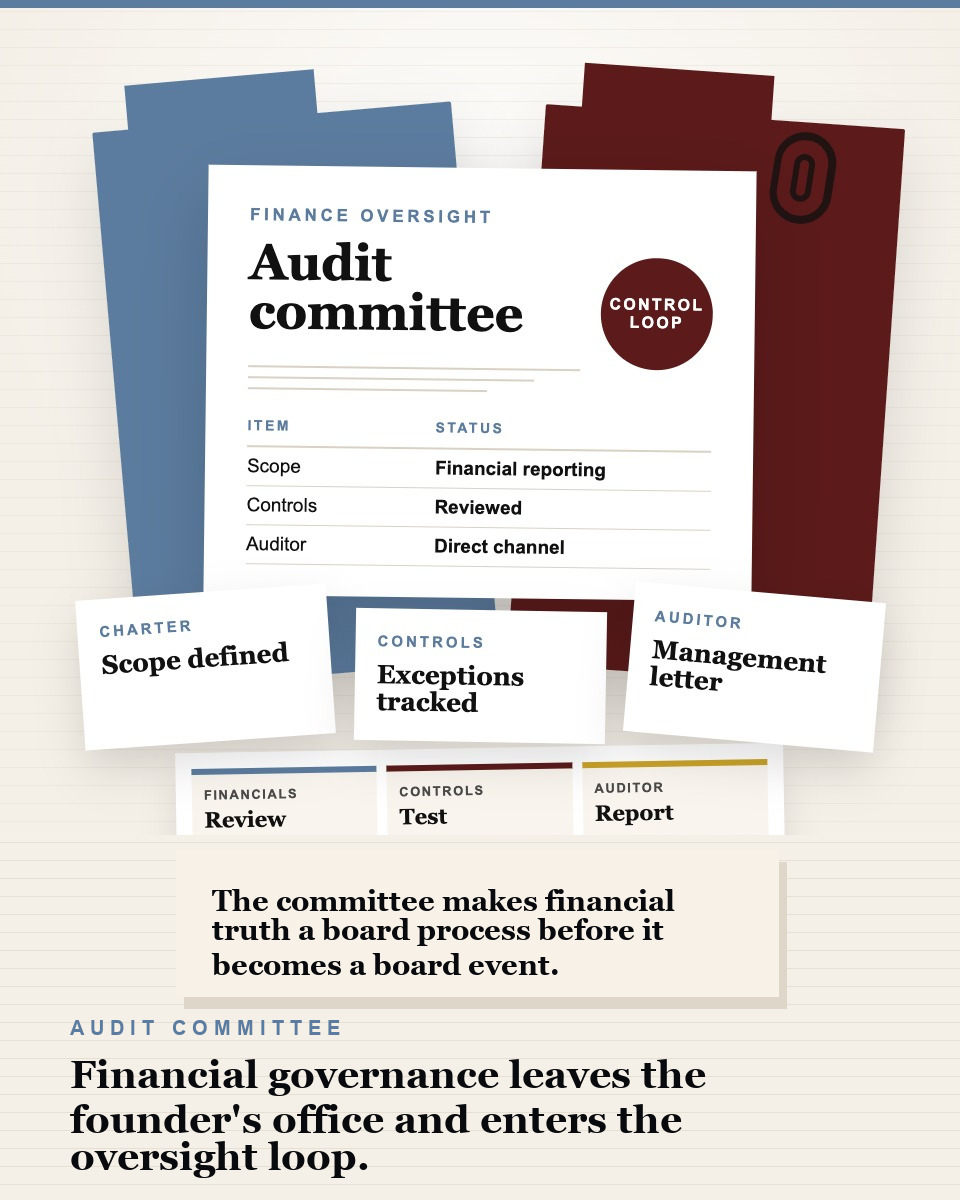
Governance table visual showing an audit committee charter, financial controls checklist, and external auditor management letter.
Reference layer. Mechanisms under pressure.

Plain definition

What it means.

An audit committee is a defined sub-group of the board responsible for oversight of financial reporting, internal controls, external auditor relationships, and risk management. The committee receives the audited financials, the auditor's management letter, and the company's risk and compliance posture before they reach the full board.

Public companies are required to have audit committees with specific independence and financial expertise standards. Private companies are not required to have one. As private companies grow, especially after raising institutional capital, an audit committee is often created to professionalize financial governance and to give investors a defined channel into reporting and controls.

An audit committee is the structural mechanism that pulls financial governance out of the founder's office and into a defined oversight loop.

What goes wrong

The failure pattern this term exists to prevent.

The committee that became a procedural box

The committee meets quarterly. It receives the financials and signs off. It does not ask deeper questions, does not interview the auditor in private, does not push management on internal controls. The structure exists. The function does not. When something is wrong with the numbers, the committee will not be the first to find it.

The auditor relationship that drifted

The audit committee is supposed to manage the relationship with the external auditor. Over time, management drives the auditor relationship and the committee approves what management proposes. The audit firm is selected, the scope is set, and the conclusions are reviewed inside management before the committee sees them. The committee becomes a rubber stamp.

The financial expert who was not

Standard governance requires at least one committee member with deep financial expertise. The seat is filled by a director with title-level financial experience but no operational accounting depth. Routine financials get reviewed. Complex revenue recognition, deferred items, or unusual transactions get nodded through without the second-set-of-eyes review the seat exists to provide.

The committee scope that grew without rules

The committee starts with audit oversight. Then it acquires risk management. Then enterprise risk, then cybersecurity, then compliance. Each addition was reasonable. The cumulative scope exceeds the meeting time, the materials get thinner, and the most consequential items receive the least attention.

Founder questions

The questions people actually ask.

What does an audit committee actually do? An audit committee oversees financial reporting, internal controls, the external auditor relationship, and risk management. It receives the audited financials, the auditor's management letter, and the company's compliance posture before the full board reviews them. It can interview the auditor without management present.
Does a private company need an audit committee? It is not required by law for most private companies. It is often required by the shareholders agreement once institutional investors take a board seat or once the company crosses defined revenue or headcount thresholds. The committee is also commonly created in advance of an IPO or a planned sale.
Who serves on an audit committee? The committee usually includes two to four directors, weighted toward independent directors, and typically requires at least one member with significant financial or accounting expertise. The exact composition is defined by the bylaws, the shareholders agreement, or the listing requirements if the company is preparing for a public market.
How is an audit committee different from the full board? The audit committee has delegated authority over a specific scope, mostly financial reporting and external audit. The full board retains overall authority. The committee surfaces issues, asks questions in depth, and makes recommendations. Decisions of consequence usually return to the full board for vote.

If your audit committee is forming, expanding, or rubber-stamping work the full board should be asking about, that is a different conversation.

Bring the committee charter, the recent audit cycles, and the auditor's most recent management letter.