Glossary

Protective Provisions

Protective provisions are decisions the company cannot make without the consent of a defined investor class, written into the share terms.

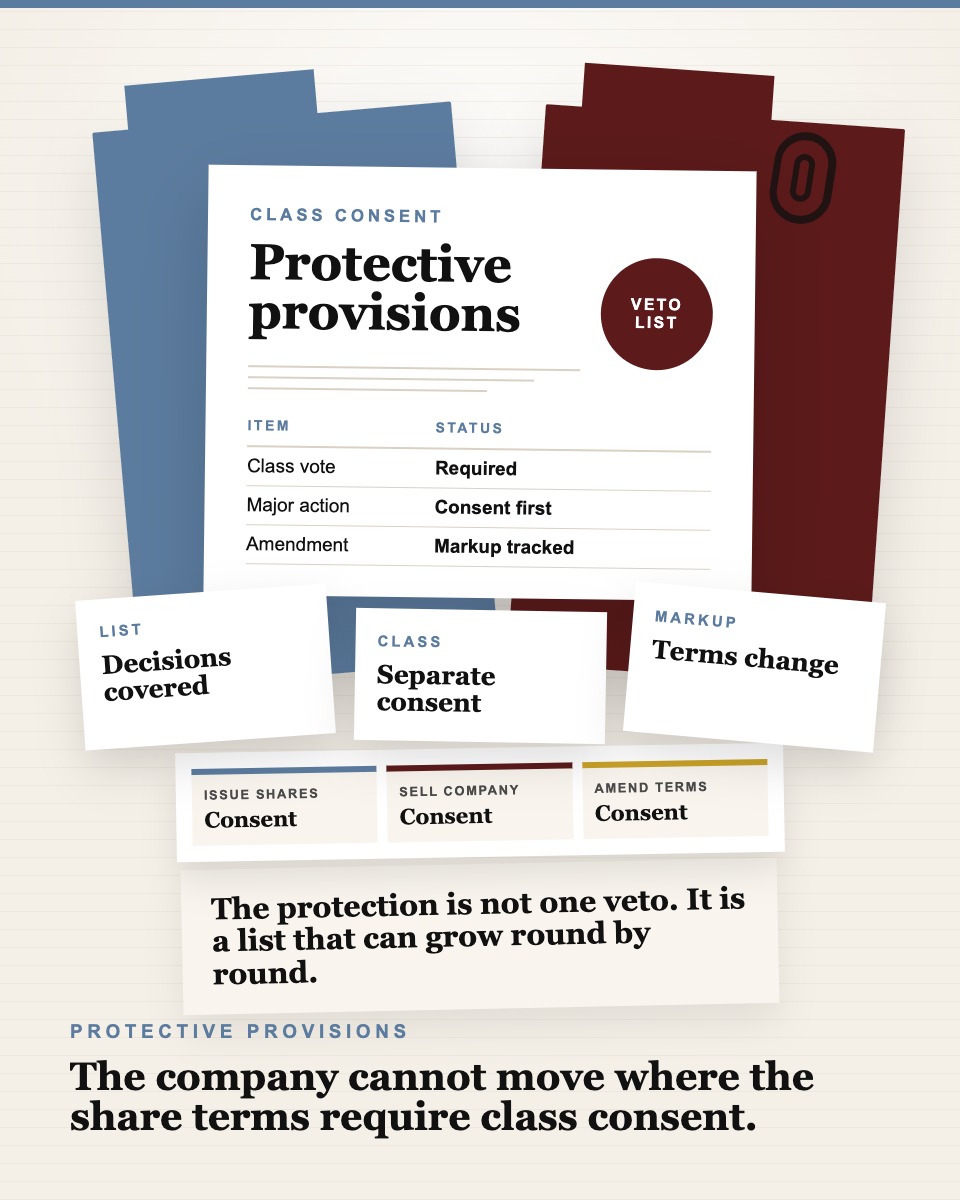
Governance table visual showing a protective provisions list, class consent checklist, and certificate amendment markup.
Reference layer. Mechanisms under pressure.

Plain definition

What it means.

Protective provisions are clauses in the certificate of incorporation or share terms that require the consent of a defined investor class before the company can take specific actions. They function as a class-level veto over decisions that would otherwise be made by the board or by simple shareholder majority.

Common protective provisions include sale of the company, amendments to the certificate that affect the protected class, issuance of senior or pari passu securities, changes to dividend rights, redemption rights, or liquidation preferences, increases in the size of the board, or significant changes to the option pool.

Protective provisions are how preferred investor classes hold structural authority over decisions that would otherwise belong to the company.

What goes wrong

The failure pattern this term exists to prevent.

The list that grew without modeling

Each round adds protective provisions. Series A adds eight items. Series B adds four. Series C adds three. The cumulative list is fifteen items requiring multi-class consent. Most operating decisions still flow through the board. Strategic decisions now require coordination across three preferred classes before they can move.

The clause that triggered on a small transaction

A protective provision against issuing senior securities triggers when the company wants to bring in a new investor at a higher liquidation preference. The deal is small, the new investor is friendly, and the existing class technically has the right to block. The class withholds consent until the new round terms shift in their favor.

The amendment that required the protected class to approve

The company needs to amend the certificate of incorporation. The amendment touches the protected class. The class has consent rights. Approval requires negotiation, which surfaces other unrelated requests. A clean amendment becomes a multi-issue negotiation by the time consent lands.

The dormant clause that woke up at exit

A provision against changes to liquidation preference sat dormant for years. At exit, the buyer wants to restructure the preference stack. The clause activates. The class can hold up the deal until the consent is paid for. Founders learn at the closing table that the provision was the most expensive line in the certificate.

Founder questions

The questions people actually ask.

What are protective provisions in a term sheet? Protective provisions are clauses in the certificate of incorporation or share terms that require the consent of a defined investor class before the company takes specific actions. They include sale of the company, certificate amendments, issuance of senior securities, and changes to liquidation or dividend rights.
Why do investors negotiate protective provisions? Protective provisions give an investor class structural authority over decisions that would otherwise be made by the board or shareholder majority. They protect the class from dilution, value erosion, or structural changes that would alter the economics of their investment without their consent.
How do protective provisions differ from reserved matters? Reserved matters typically operate at the board or general shareholder level, requiring approval from a defined director or shareholder group. Protective provisions operate at the share class level, requiring approval from a specific class. The mechanisms overlap and the terms are sometimes used interchangeably.
Can protective provisions be removed or waived? Yes. Each provision can be waived for a specific event by the consent of the protected class, usually requiring a defined percentage of class consent. Permanent removal usually requires renegotiation of the share terms or a transaction event such as a merger or recapitalization.

If a protective provision is forming or activating around a transaction, that is a different conversation.

Bring the certificate of incorporation, the cap table by class, and the proposed action.