Glossary

Quorum

Quorum is the minimum number of voting members required to be present for a decision to be legally valid.

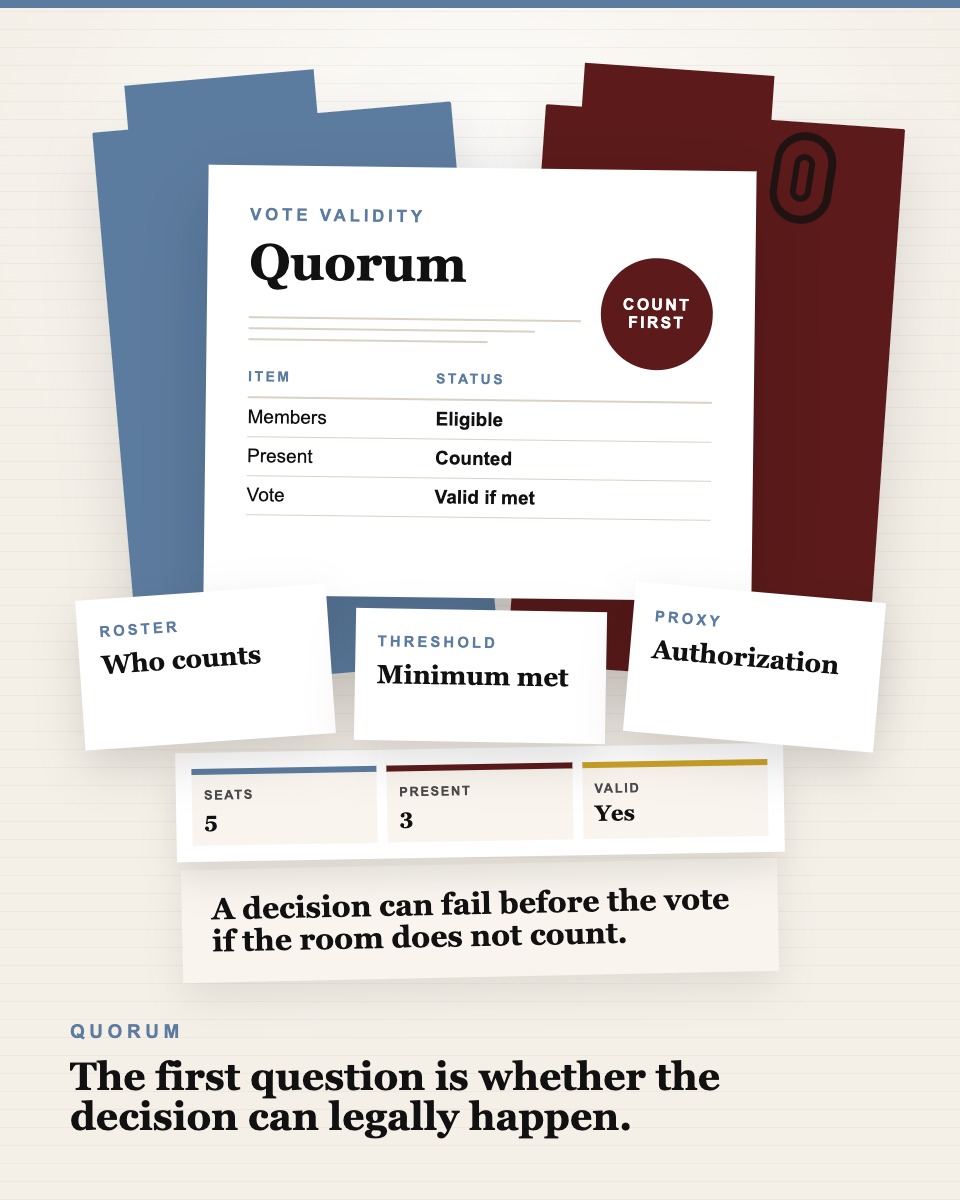
Governance table visual showing a board attendance roster, quorum threshold card, and proxy authorization note.
Reference layer. Mechanisms under pressure.

Plain definition

What it means.

Quorum is the minimum participation threshold required for a board, committee, or shareholder vote to be valid. It is set by the bylaws or governing agreement, and typically expressed as a fraction of total members or shares: a majority of directors, two-thirds of shareholders, or all members of a specific class.

Quorum requirements exist to prevent decisions from being made by an unrepresentative subset. If the threshold is not met, no business can be transacted, no votes can be taken, and no decisions are valid. The threshold is usually higher for fundamental decisions and lower for routine business, depending on the governing documents.

Quorum is the gate. It does not decide the outcome of a vote. It decides whether a vote can happen at all.

What goes wrong

The failure pattern this term exists to prevent.

The director who held the company hostage

The bylaws require quorum of all directors for specific decisions. One director declines to attend. No quorum. No decision. The director's absence becomes their de facto veto, more powerful than any voting position they actually hold.

The standard meeting that hit quorum failure

A board meeting is scheduled. Two directors are traveling. One has a family event. The remaining four directors do not constitute quorum under the bylaws. The meeting cannot transact business. Decisions queued for the meeting slip to the next cycle, and operating items that needed approval get delayed.

The proxy that nobody set up

Proxy voting could have established quorum. The bylaws permit proxies. No one used them because nobody anticipated the absence. The decision is delayed by a meeting cycle, which delays meaningful work by weeks. The mechanism existed. The discipline to use it did not.

The class quorum that nobody read

Some decisions require quorum within a specific share class, not just overall quorum. The vote proceeds with general quorum. The decision is later challenged. The class quorum was not met. The decision is unwound or contested.

Founder questions

The questions people actually ask.

What does quorum require for a board meeting? Quorum requires the minimum number of voting directors defined in the bylaws to be present, in person or by permitted means. Common requirements are a majority of directors, two-thirds of directors, or all directors for specific decisions. The threshold is whatever the bylaws say, not whatever feels reasonable in the moment.
What happens when quorum is not met? Without quorum, no business can be transacted at the meeting. No votes are valid, no resolutions are adopted, and no decisions made at the meeting carry weight. The meeting is typically adjourned to a later date or rescheduled, with the same agenda items pushed to the next valid meeting.
How is quorum different from voting threshold? Quorum is the minimum participation needed for a vote to be valid. Voting threshold is the percentage of those present required to approve the decision. Both must be met. A meeting can have quorum and still fail a supermajority vote, or have a unanimous vote that is invalid because quorum was not met.
Can quorum be established by proxy? Sometimes. Proxy voting and proxy presence depend on what the bylaws or agreement permit. Some agreements count proxies toward quorum, others do not. Some require physical presence for specific categories of decisions. Founders should know what their governing documents permit before assuming a proxy will hold the meeting.

If quorum is being missed regularly or being used as a hold on the company, that is a different conversation.

Bring the bylaws, the meeting cadence, and the recent decisions where quorum failed.