
Plan an expert interview.
Start with the business question you need to answer. Choose someone whose experience is relevant to it, then separate what they observed from what they infer and what still needs checking.
Define what you need to learn
“Is this a good manufacturer?” asks one person to settle too much. A more useful interview question is: what could prevent this production process from meeting our requirement at normal volume?
An interview can help you understand a process, identify failure points and decide what evidence to request. It cannot establish that a particular factory, product or current production run has passed verification.
Write a short brief: the decision, the question the interview can answer, the relevant product or process, and what you already know. Keep the final business decision with its responsible owner.
Match the experience to the question
Check the person's actual work, its timing and its limits. A title alone does not tell you whether someone has seen the process you need to understand.
- Which part of the work did they perform or directly observe?
- When, where and under which conditions?
- What has changed since then?
- Which questions sit outside their experience?
Ask only about information the person is authorized to share. Agree participation, recording and use of notes before the conversation. If a question requires restricted information, change the question or use an authorized source.
A manufacturing interview guide
Illustrative example
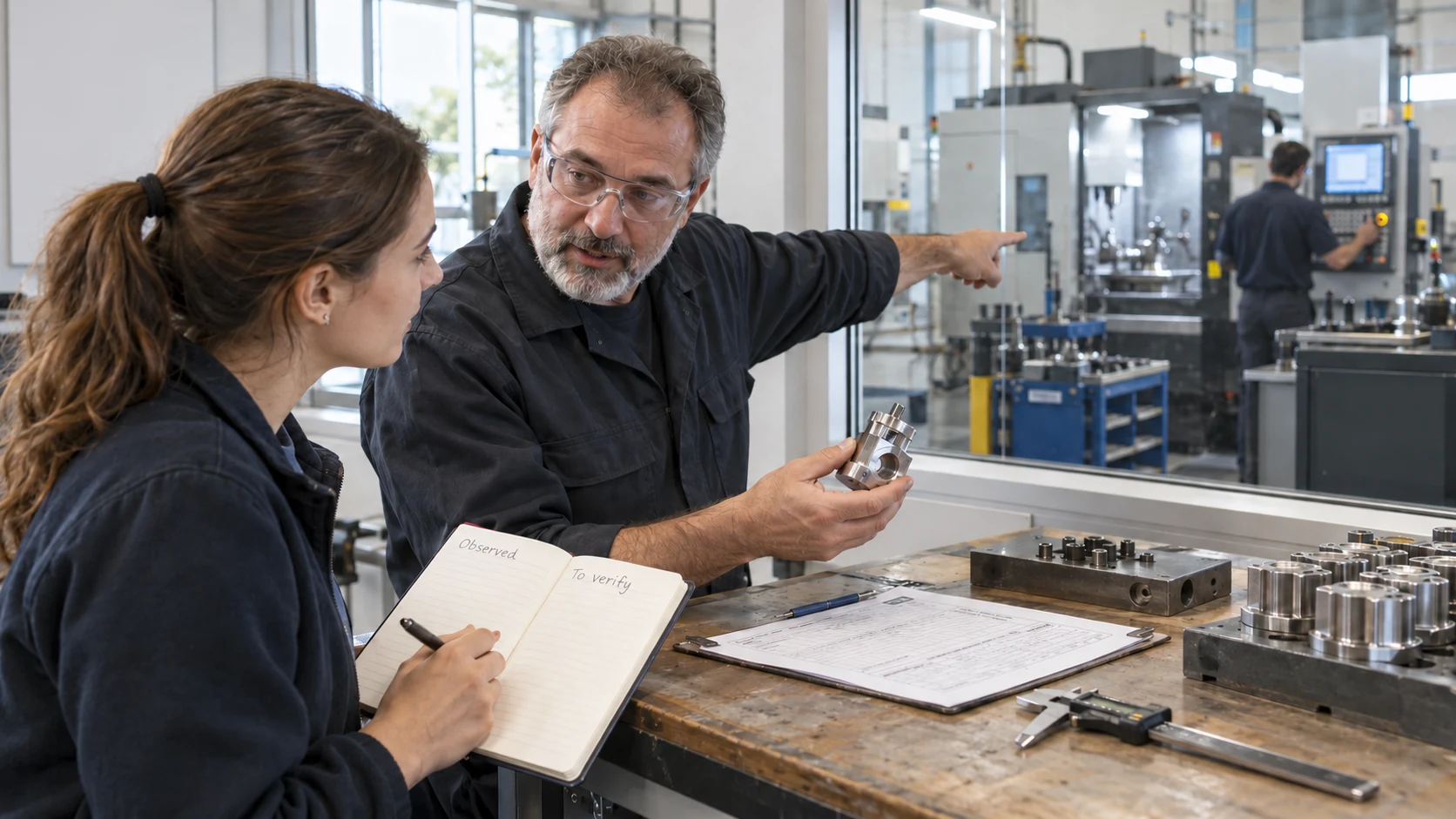
A company is considering moving a machined component to another manufacturer. A sample passed inspection, but the normal production route has not been checked. An experienced production manager can help identify what to investigate.
| Ask | Listen for | Verify separately |
|---|---|---|
| Which steps usually determine consistency for this kind of component? | Specific process experience and the conditions in which it applies. | The actual manufacturer's process route and controls. |
| What can differ between a carefully prepared sample and routine output? | Staffing, equipment, tooling, material, inspection or rework differences. | How the sample was made and what normal production will use. |
| When you saw a similar problem, what happened first? | A concrete observation, date and scope, rather than an industry generalization. | Relevant current records or a production test. |
| Which records would help distinguish those explanations? | Evidence connected to a requirement or suspected failure. | Availability, quality and relevance of those records. |
| What would make your answer different? | Conditions, exceptions and acknowledged limits. | Whether those conditions apply here. |
Use the manufacturer-verification guide for the production work that follows. The interview helps frame that work; it does not replace it.
Keep different kinds of answers separate
These sample answers are fictional:
Observation: “On the line I supervised last year, the sample used different tooling from the normal run.” This is specific experience. It does not prove the proposed supplier has the same issue.
Interpretation: “That could explain why early output looked better.” This is a possible explanation to test.
Unknown: “I have not seen this factory's current setup.” Keep that limit in the notes. Do not turn a confident discussion into a site inspection that never happened.
Record each important answer as claim; basis; context/date; uncertainty; next evidence. Add who owns the next check. Keep the speaker's meaning and any qualifications when you summarize.
Use disagreement to improve the research
One person says the equipment is usually the constraint. Another says operator training matters more. They may have worked with different products, shifts or production volumes.
Ask what each person actually observed and which conditions would change the answer. Then seek evidence about the proposed production route. Counting votes between two different experiences will not settle that question.
The next step might be another interview, a record review or a qualified technical inspection. It may also be to pause because essential evidence is unavailable.
Put the interview into the larger decision
Summarize what you learned, what remains uncertain and the next check that could change the decision. For a supplier choice, continue with testing a second source. For a wider research assignment, define the project before commissioning more calls.
AlphaSights describes matching relevant experience to a particular research need. The sample questions and fictional example above were developed for this guide.
To discuss an interview or research contribution with Stan, see expert interviews and research. Topic fit, evidence access, use and fee are agreed before work starts.