Product · active
An editable spreadsheet to compare candidates, record what you checked and plan the next conversation. Includes an illustrative record and space for your own candidates.
Download roster (XLSX) Read the manual it comes from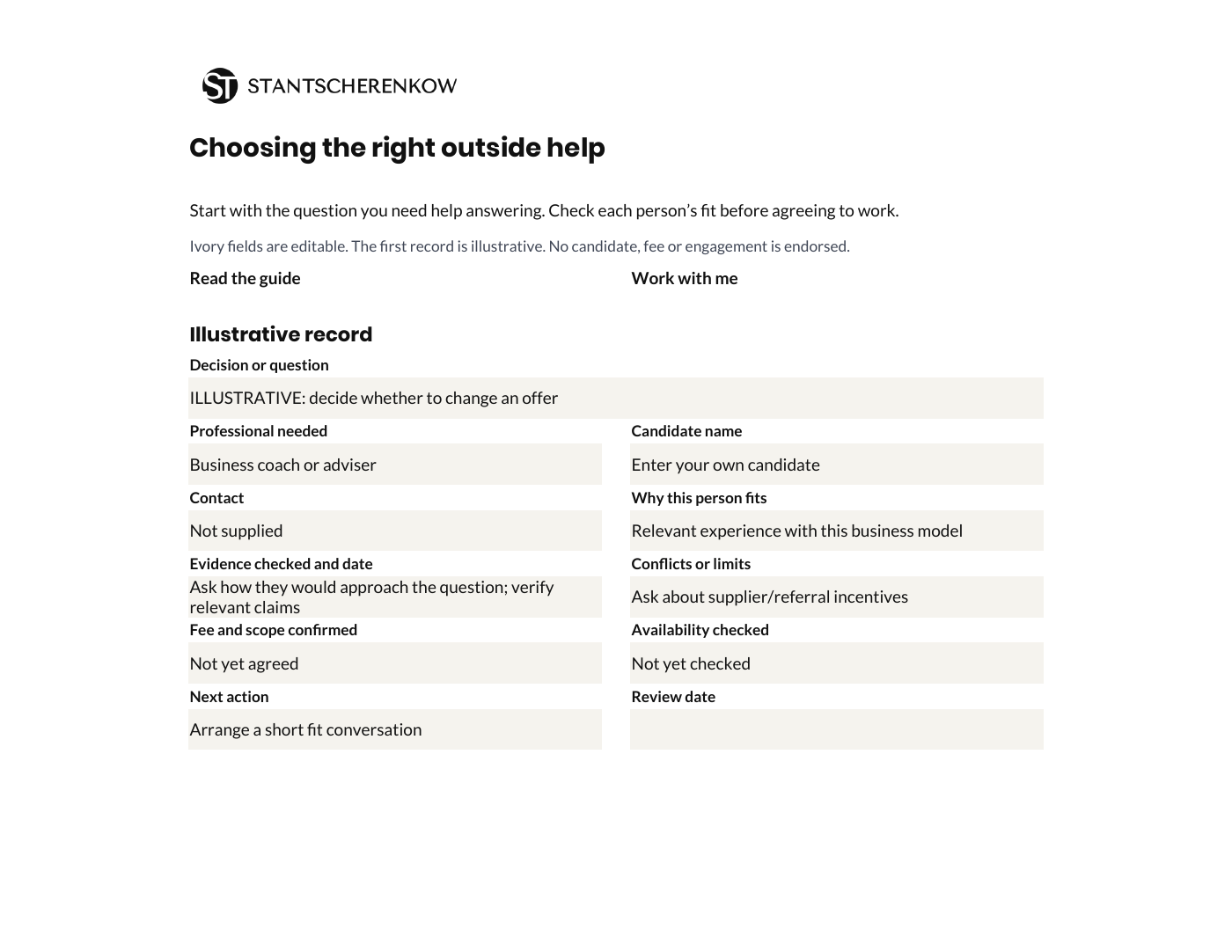
Why you need it
The Coach Roster Starter helps you assemble a small, deliberate bench of coaches and advisors before a decision forces your hand. You decide, while calm, who you would call for which kind of problem, and you do the light groundwork now so the relationship exists before the crisis does.
It is the companion to the escalation flag in the manual. The flag tells you when self-coaching has hit its limit. This makes sure that flag has somewhere to land besides a frantic search.
Here is what happens without it. The notebook flags a call you cannot close alone. You are already stressed and already late. You ask one friend, take one referral, and hire the first person who seems credible and available. You chose under exactly the conditions you would never let yourself choose a hire under. The roster moves that decision to a calm week, when you can actually judge fit.
What you build
01
Map the kinds of decision you actually face: the review on the whole business, the people call, the deal, the personal one. Different problems need different people. The roster starts from your real decision types, not a generic list.
02
A short bench you would actually use beats a long list you scroll past. Two vetted names per kind of call, with how you found them and why you trust them, written down while you have the calm to judge.
03
A short note now, a conversation when convenient, so the relationship exists before the pressure does. The person you have already met gives you a straighter answer than the one meeting your crisis cold.
Who it is for
If you run the decisions alone and you have felt the gap where a bench should be, this is for you. It is most useful right after a decision got heavy and you realized you had no one to take it to.
If you already have three trusted advisors on speed dial and you use them, skip this. Build the roster you do not yet have.
Use the spreadsheet to record the question, candidate, evidence, fee, availability and next step. It includes a clearly marked illustration and space for your own candidates; it contains no recommended or vetted professionals.
Download the plain CSV for importing. The CSV contains one illustrative row and four blank role rows.
First-contact question: “I am deciding [specific question] by [date]. Is this within your work? If so, how would you scope it, what information would you need, and what would the fee and availability be?”
Where it stops
The roster removes the excuse that you had no one to call. It does not make the call for you, and it does not replace the review itself when the decision actually lands. When the flag goes up, the value is in picking up the phone, not in admiring the list. Business owner coaching is one of the seats your roster should have on it.
Back to the manual →Use this with
Weekly proof
Write the recurring decision before deciding what kind of help belongs on the list.
Pattern review
Use the twelve-week pattern to decide which outside call is actually missing.
Manual
Keep the roster tied to the full self-coaching method, not panic.
If the bench is empty and the call is now
Business owner coaching is one seat the roster can include. The session examines the decision, separates noise from evidence, and ends with a clear next move.
Find the next business moveTired of guessing what to fix? Too close to see the pattern? See how business owner coaching works.
Work with Stan
Start with Work with me for monthly 1:1 business work, or request scope when the issue involves board, ownership, partner, leadership, or larger collaboration.
