Product · active
Two pages per week: six questions, an evidence check and one action to review. Print the weeks you need or annotate the PDF.
Download notebook (PDF) Read the manual it comes from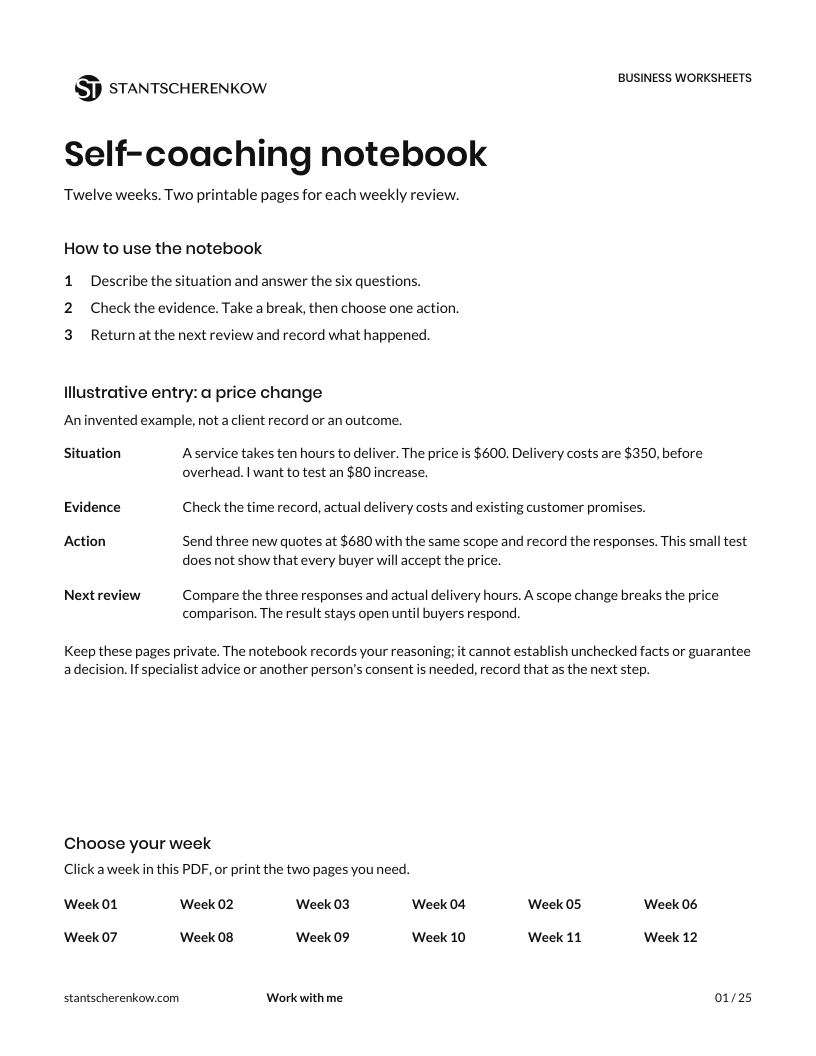
Download the twelve-week notebook (PDF)
Read the six questions. The PDF is printable and can be annotated; it is not an interactive form.
What it actually costs you
The cost is not that you cannot decide. The cost is that you are carrying an open decision everywhere you go, and it taxes every other call you make that week. The pricing conversation you keep not having. The partner issue you keep working around. The number you keep meaning to look at. Each one sits there, half-thought, draining a little off the top of everything else.
A recurring writing session gives you a record to revisit. It may clarify a question, expose missing information or show that you need another perspective.
You do not need a coach to find the answer. You need a structure that makes you stop and look.
The notebook gives you a weekly place to record the facts, examine a choice and return to what happened. Some decisions will need more evidence or help from someone else.
Is this you
You make the calls and carry them alone. A decision has been open too long. You are sharp enough to coach yourself if something forced you to sit down and do it honestly. You want the clarity a coaching session gives you, on your own schedule, without booking one.
Why this, and not a blank journal or another app
You have tried journaling. It turned into a to-do list or a vent, because a blank page asks nothing of you. You tried the apps. They buried the one useful habit under streaks and notifications you swiped away by week two. Neither fixed the actual problem, which is that the hard question is the one you skip when nothing makes you face it.
01
The page has a slot for each. The blank you leave is the question you were dodging, and now it is staring back at you. That one design choice is most of the value, because the dodged question is almost always the one that matters.
02
You answer, you close the book, you walk away, and you re-review in the morning, editing only what you no longer believe. Most bad calls are made in the state you were in when you wrote. The overnight gap is built into the page on purpose.
03
Every week ends with exactly one move. Not a plan, not a list, one move. Insight that does not become a move is just a nicer way of staying stuck, and the page will not let you leave with a feeling instead of an action.
Your week on the page
You do not study a system. You open to this week's spread and follow it. The structure carries you. All you bring is honesty.
this week/
  re-review         # last week's entry and the one move you set
  the situation   # write it in three sentences. no more
  six questions   # one pass, in order, skip nothing
  the hardest one # mark the answer that was hardest to write
  close the book  # cooling-off. do not edit tonight
  morning re-review # cut only what you no longer believe
  one move        # a single move for the week
Twelve weeks to a volume. The method is on the paper, so the only thing you supply is the truth.
Two minutes. You see the move you set and whether you made it. This is where the notebook starts to compound, because last week's honesty sets up this week's.
The cap is the point. Three sentences force you to say what is actually going on instead of narrating around it. If you cannot get it into three, that is your first finding.
The same six every week, in order, no skipping. They are built to surface what you are avoiding, what you actually want, and what you are afraid the answer is. Write fast and ugly. Tidy comes later.
One mark. The hardest answer is worth examining, but discomfort alone does not establish that it is true. Naming it is half the work, and the page makes you do it before you can move on.
No editing tonight. You wrote in a state, and the state is not your judgment. The cooling-off is the cheapest insurance there is against the decision you would regret by Thursday.
Daylight changes what survives. What you cut overnight was heat. What stays is signal. Check the remaining answer against what actually happened.
Just one, written where next week's re-review will find it. That completes the entry. Some decisions will still need more information or another person.
Illustrative scenario, not a client result. A service sells for $600, takes ten hours to deliver and has $350 in direct costs before overhead. The owner is considering a price of $680 for new quotes.
Situation: “Delivery takes longer than I allowed. I have not checked the last five jobs. I want to know whether an $80 increase fits the same scope.”
Evidence: check the time records and direct costs first. Separate new quotes from prices already promised to existing customers.
Next action: issue three comparable new quotes at $680 and record the responses. This tests a price with a small group; it does not prove the whole market will accept it.
Next review: compare responses and delivery hours. If the scope differs, the quotes cannot be treated as a clean price comparison.
What you get out of it
The biggest return is not any one week. It is reviewing four volumes back and seeing the same avoidance show up under three different disguises. The decision you stall on is usually the same kind of decision every time. Seeing a pattern gives you something specific to test; it does not guarantee that the pattern changes.
The cooling-off catches the angry email and the panic decision before they leave your hands. That alone can pay for the habit in one avoided mistake.
The notebook supports reflection between conversations. It does not promise the same outcome as working with another person.
When the same move fails to land three weeks running, the notebook tells you. That is the signal to use outside help and review the facts, attempted moves, and result.
Start small
Week one
Do not worry about consistency yet. Run one full week, including the morning re-review, so you feel the cooling-off do its job. One honest pass is what hooks the habit.
Month one
Same time, same day, alone, on the calendar. The notebook only works if the slot is protected. By week four the re-review shows you whether your moves are landing.
Quarter one
At the end of a volume, see all twelve weeks across and look for the pattern. This is where the notebook stops being a habit and becomes a mirror you cannot argue with.
When it is not enough
If the same move keeps failing, bring the entries to someone qualified to help with that question. A record of what you tried and what happened gives the conversation something specific to examine.
The downloadable notebook provides two pages per week for twelve weeks, plus a worked pricing illustration. Print the pages you need or annotate the PDF in an app. No printed product is being sold here.
Download the twelve-week notebook (PDF)
After a break, check your answers against the evidence. Write one action, who will do it and when you will return to the result. An unanswered question may call for more information rather than an immediate decision.
Where it stops
The notebook is the best tool there is for the decisions you can reason your way through alone. It cannot see the team dynamic you are too close to, the partner motive you keep excusing, or the framing you have been inside too long to question. When the answer needs a person who is not you and has nothing to lose by being honest, that is a review the notebook cannot run. Business owner coaching is where that look happens.
Back to the manual →Use this with
Quarter review
Review twelve weeks across when the same decision shape keeps returning.
Outside bench
Name who you would call before the decision is already too expensive.
Manual
Return to the full weekly method before changing the tool.
If the decision cannot wait for the notebook
Business owner coaching applies the same weekly review to the decision in front of you. The session separates noise from evidence and ends with a clear next move.
Find the next business moveTired of guessing what to fix? Too close to see the pattern? See how business owner coaching works.
Work with Stan
Start with Work with me for monthly 1:1 business work, or request scope when the issue involves board, ownership, partner, leadership, or larger collaboration.
