Glossary

MAC Clause

A material adverse change clause lets the buyer walk away from a signed deal if a defined adverse event affects the company between signing and closing.

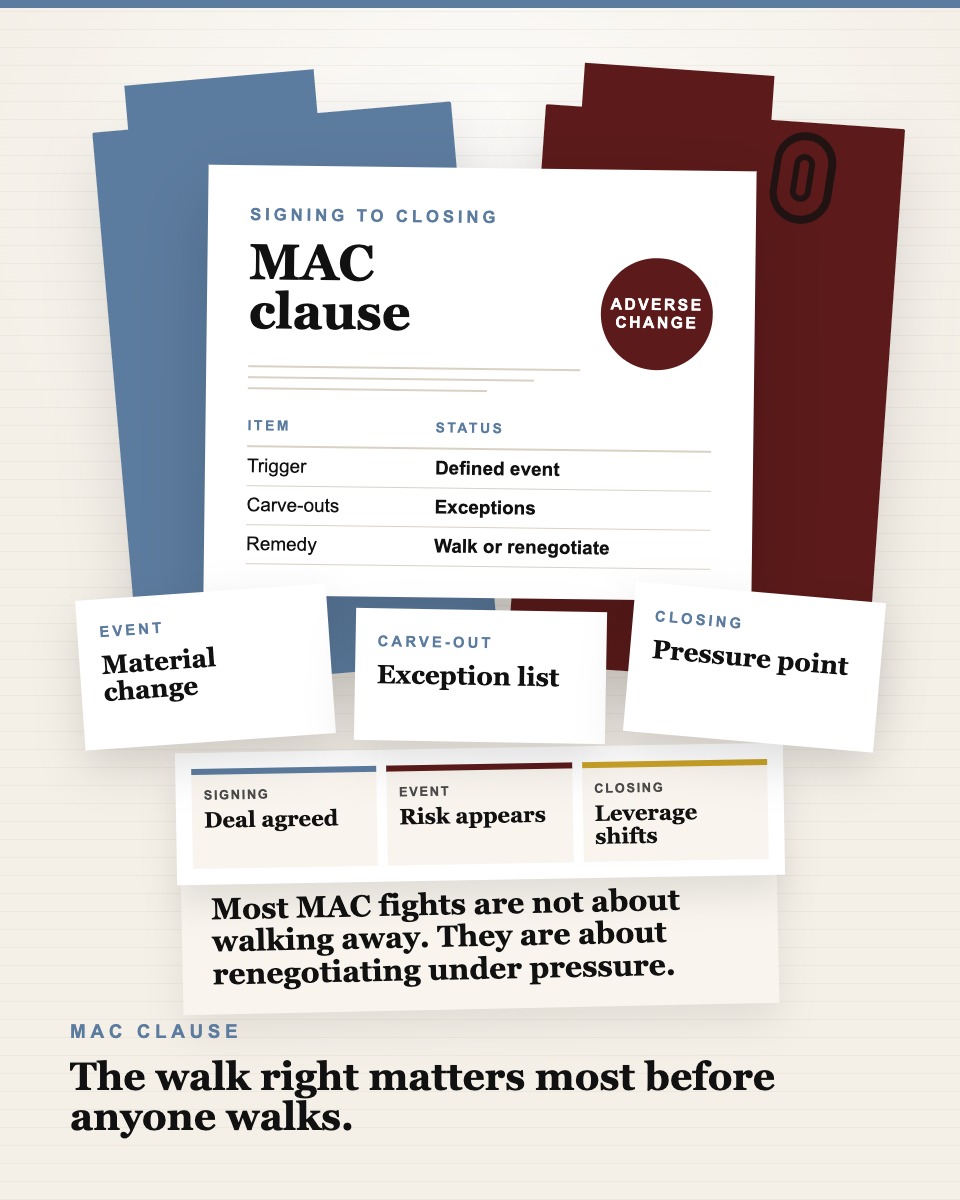
Governance table visual showing a material adverse change clause, signing-to-closing timeline, and carve-out exception list.
Reference layer. Mechanisms under pressure.

Plain definition

What it means.

A material adverse change clause, often abbreviated as MAC or MAE for material adverse effect, is a contractual provision in a definitive purchase agreement. It defines a category of events that, if they occur between signing and closing, allow the buyer to terminate the deal without penalty.

Typical MAC definitions cover material declines in financial performance, regulatory actions, litigation events, loss of major customers, or other defined occurrences. The clause is heavily negotiated and usually includes carve-outs for general economic conditions, industry-wide events, and consequences of the deal itself.

A MAC clause is the buyer's exit ramp between signing and closing. The definition decides whether the ramp is a real exit or only a negotiating point.

What goes wrong

The failure pattern this term exists to prevent.

The walk that became a renegotiation

A MAC event happens. The buyer threatens to walk. The actual purpose is to reopen price. The seller learns that the threat to invoke MAC is more often a pressure event than a termination, and the agreement now becomes a price discussion under stress.

The pandemic that was not a MAC

A truly material event happens, like a pandemic, a market crash, or a regulatory change. The MAC carve-outs exclude general economic conditions. The buyer cannot invoke MAC to walk because the event affects everyone, not just the target. The clause did not do what the buyer assumed.

The MAC that triggered after closing

The agreement defines MAC events that can be claimed pre-closing. After closing, the same event would have to be addressed under the indemnification structure or the reps. The buyer discovers the event after closing and finds the MAC clause no longer applies.

The disclosure that defeated the MAC

The seller disclosed the underlying issue in the disclosure schedule. The MAC clause carves out events that were disclosed. The buyer cannot use the disclosed item to invoke MAC even if the consequence is significantly worse than expected.

Founder questions

The questions people actually ask.

What is a material adverse change clause? A MAC clause is a provision in a purchase agreement that defines events between signing and closing severe enough to allow the buyer to terminate the deal without penalty. Definitions vary by deal but generally cover material declines in financial performance, regulatory action, or major operational disruption.
How specific does a MAC clause have to be? More specific definitions favor the seller because they limit what the buyer can claim. Broader definitions favor the buyer. Most negotiated clauses include both general standards and explicit carve-outs for events the seller does not want included, like general economic or industry-wide changes.
When have MAC clauses actually allowed buyers to walk? Successful MAC walks are rare. Courts generally require the buyer to show a substantial, durable, and company-specific impact rather than a short-term or industry-wide one. Most MAC threats end as renegotiations rather than walks. The exceptions tend to involve clear, severe, and uncovered events.
How are MAC clauses different from termination rights? Termination rights are specific procedural exits defined in the agreement, like failure to obtain regulatory approval by a date. MAC clauses are a general standard. The two often work together: a termination right may require a MAC determination, and MAC events can trigger procedural termination rights elsewhere in the agreement.

If a MAC clause is forming or activating between signing and closing, that is a different conversation.

Bring the draft purchase agreement, the current state of the business, and the carve-outs as proposed.